Kimi K2.6: What Changed in 2026
Kimi K2.6 is Moonshot AI’s open-weights flagship, with agent swarms, INT4 weights, and top-tier coding scores.

Kimi K2.6 is Moonshot AI’s open-weights flagship for long-running coding agents.
Moonshot AI released Kimi K2.6 on April 20, 2026, and the timing matters. In one product cycle, the model moved from a strong open-weights coder to a system that can fan out into 300 sub-agents, coordinate 4,000 steps, and hold its own against closed models that cost far more to run.
| Metric | Kimi K2.5 | Kimi K2.6 |
|---|---|---|
| Release date | November 2025 | April 20, 2026 |
| Active parameters per token | 32B | 32B |
| Agent Swarm limit | 100 sub-agents | 300 sub-agents |
| Coordinated steps | 1,500 | 4,000 |
| SWE-bench Pro | 50.7% | 58.6% |
| Terminal-Bench 2.0 | 50.8% | 66.7% |
| AA Intelligence Index | — | 54 |
What Kimi K2.6 actually is
Get the latest AI news in your inbox
Weekly picks of model releases, tools, and deep dives — no spam, unsubscribe anytime.
No spam. Unsubscribe at any time.
K2.6 is the third model in Moonshot’s K2 line, following K2 in August 2025 and K2.5, also called K2-Thinking, in November 2025. That cadence is fast even by 2026 AI standards, and it shows Moonshot is treating the K2 family as a living product line rather than a one-off release.
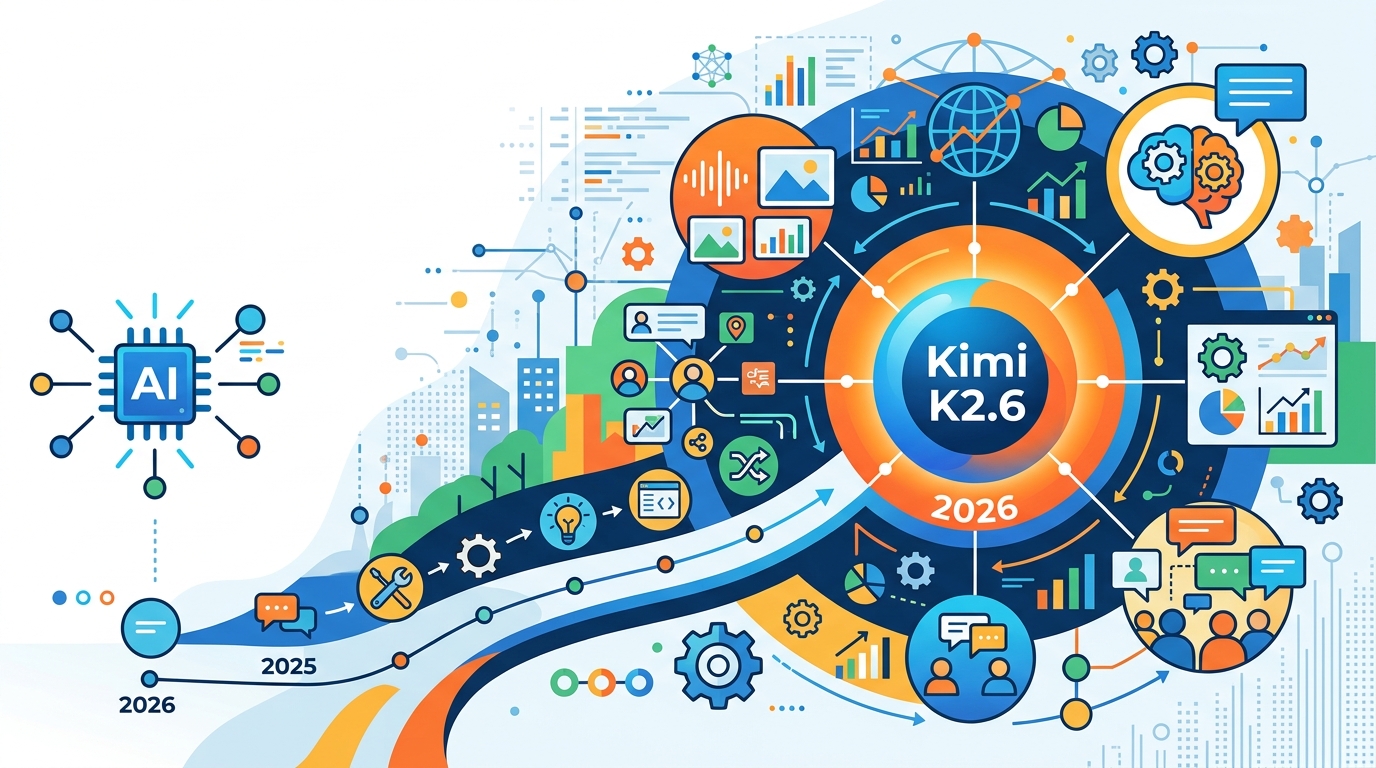
The architecture is a sparse Mixture-of-Experts model with 1 trillion total parameters and 32 billion active parameters per token. It uses Multi-head Latent Attention, 384 routed experts plus one shared expert, 8 experts selected per token, 61 transformer layers, and a 262,144-token context window. The vision stack, MoonViT, now uses 400 million parameters, which helps with screenshots, dense documents, and video input.
Moonshot also ships the weights under a Modified MIT license, which is one reason K2.6 matters to teams that want to deploy locally or fine-tune in-house. The license still has a usage threshold, but for most startups and internal teams it reads much closer to open access than the usual commercial traps attached to large model releases.
- 1T total parameters, 32B active per token
- 262,144-token context window
- MoonViT vision encoder at 400M parameters
- Modified MIT license with a usage threshold
Why the Agent Swarm feature is the real story
Most agent systems in production today still bolt orchestration onto the outside of the model. Frameworks like LangGraph, CrewAI, and AutoGen manage branching, retries, and reconciliation in user space. K2.6 moves that behavior into the model itself.
That is the part worth paying attention to. Moonshot says K2.6 was post-trained to decide when to fan out, how many sub-agents to spawn, what each one should do, and how to combine the results. In practice, that means the model can treat a big coding task like a distributed job instead of a single long chain of thought.
“The key is to use the right tool for the job, and the right tool is often not the biggest or most expensive one.” — Satya Nadella, Microsoft Build 2024
The swarm mode is where K2.6 separates itself from K2.5. The older model capped concurrent sub-agents at 100 and coordinated steps at 1,500. K2.6 raises that ceiling to 300 sub-agents and 4,000 steps, and the model can decide when parallelism is worth the overhead.
That matters for tasks like monorepo debugging, large literature reviews, and multi-repo refactors. It matters less for linear work, where spawning a swarm just adds overhead. The practical rule is simple: if the task can be split into many independent reads or checks, K2.6 benefits; if the task must happen in order, keep it single-threaded.
- BrowseComp rises from 83.2% to 86.3% with swarms enabled
- Moonshot’s reference run shows 4,000+ tool calls over 12 hours
- Sub-agents inherit the parent’s task budget instead of branching forever
- Failed sub-agents return structured errors instead of killing the run
Where K2.6 wins on benchmarks
Benchmarks do not tell the whole story, but they do tell you where the model is strong enough to matter. K2.6 posts 80.2% on SWE-bench Verified, 58.6% on SWE-bench Pro, and 66.7% on Terminal-Bench 2.0. It also reaches 89.6% on LiveCodeBench v6, 96.4% on AIME 2026, and 90.5% on GPQA-Diamond.

Those numbers put K2.6 in a rare spot for an open-weights model. It is not just “good for open source.” It is close enough to the closed frontier that routing decisions now depend on cost, deployment control, and task shape as much as raw quality.
On the broader Artificial Analysis Intelligence Index, K2.6 scores 54, the highest score for any open-weights model in the comparison set. It also reports a 39% hallucination rate on AA-Omniscience, down from 65% in K2.5. That drop matters for agent workflows, where one bad assumption can waste dozens of tool calls.
- SWE-bench Verified: 80.2%
- SWE-bench Pro: 58.6%
- Terminal-Bench 2.0: 66.7%
- LiveCodeBench v6: 89.6%
- AIME 2026: 96.4%
- GPQA-Diamond: 90.5%
How it compares with Claude, GPT, and DeepSeek
The cleanest way to think about K2.6 is by workload, not by leaderboard rank. Against Claude Opus 4.7, K2.6 gives up some coding and science accuracy, but it wins on open weights, agent swarms, multilingual coding, and price. Moonshot’s own positioning says K2.6 runs at roughly one-fifth the per-token cost of Opus 4.7.
Against GPT-5.5, the picture is similar. GPT-5.5 leads on the AAII composite and Terminal-Bench breadth, while K2.6 matches or exceeds it on some coding and web-research tasks. If you need a model that can sit in a terminal for hours and coordinate workers, K2.6 is easier to justify. If you need the broadest generalist, GPT-5.5 still has the edge.
Against DeepSeek, the trade-off shifts again. DeepSeek V4 Pro remains attractive on raw output cost and competitive programming, while K2.6 looks stronger for long-horizon agent work and self-hosted deployments. That makes the 2026 market less about one winner and more about choosing the right model for the job.
- Claude Opus 4.7: 87.6% SWE-bench Verified vs K2.6 at 80.2%
- GPT-5.5: ~82.7% on Terminal-Bench 2.0 vs K2.6 at 66.7%
- K2.6: roughly one-fifth the per-token cost of Opus 4.7
- K2.6: 54 on AAII, highest among open-weights models in the set
What developers should do next
If your team is choosing a model for production coding agents, K2.6 deserves a real trial, not a glance at the benchmark chart. It is especially compelling if you need local deployment, predictable costs, or long autonomous runs that can split into many sub-tasks without human babysitting.
The best test is a real internal workflow: a repo-wide refactor, a documentation sweep, a bug hunt across many files, or a support triage pipeline with tool calls. If the job is parallelizable, K2.6 may save hours. If the job is sequential and narrow, a smaller or more specialized model may be the better default.
The bigger question for 2026 is whether more model vendors copy this pattern. If K2.6 proves that swarm-style orchestration can be trained into the model instead of layered on top, the next wave of coding assistants may look less like chatbots and more like managed worker pools. For now, the practical move is simple: benchmark K2.6 on your own codebase before you decide whether the swarm is useful or just more moving parts.
For related coverage, see our guides to Claude Opus 4.7, GPT-5.5, and DeepSeek V4.
// Related Articles
- [MODEL]
GPT-5.6 turns OpenAI into a model menu
- [MODEL]
Seedream 5.0 Pro Is the Right Choice for Editable AI Images
- [MODEL]
Midjourney v8.2 release is close
- [MODEL]
Rust KRAID enters Mesa for Arm Mali GPUs
- [MODEL]
OpenAI Opens GPT-5.6 and Launches Live Voice AI
- [MODEL]
Mistral is right to push Leanstral into proof engineering