Zero, Everclear, Syndicate Labs Exit as L2s Consolidate
Zero Network, Everclear, and Syndicate Labs are winding down as Ethereum L2 competition shifts from tech to users, liquidity, and revenue.

Zero Network, Everclear, and Syndicate Labs are shutting down as Ethereum L2 competition shifts from tech to users, liquidity, and revenue.
Three Ethereum infrastructure projects announced wind-downs on May 21, 2026, and the timing says a lot about where the market is now. Zerion's Zero Network is ending after about 1.5 years, Everclear is sunsetting its Foundation and Labs, and Syndicate Labs is winding down after five years of building developer infrastructure. None of these teams failed at shipping software. They ran into a harsher test: whether the market would pay enough to keep the lights on.
| Project | Key figures | Status |
|---|---|---|
| Zero Network | ~1.5 years live; ~$1.3M-$1.4M TVS; inbound bridging halted | Winding down, withdrawals open until end of July 2026 |
| Everclear | ~$500M monthly volume at peak; ~$6,891 TVL; $5,539 fees over 30 days | Protocol sunset, UI and chain offline |
| Syndicate Labs | 5 years building; rollup market “fundamentally shifted” | Winding down operations |
What actually happened
Get the latest AI news in your inbox
Weekly picks of model releases, tools, and deep dives — no spam, unsubscribe anytime.
No spam. Unsubscribe at any time.
Zero Network was built as a gasless Ethereum Layer 2 inside the Zerion product stack. Users could send assets, mint NFTs, swap, and bridge without dealing directly with gas fees. That idea made sense when wallet UX was still clunky and every extra click cost users. It made less sense once the broader L2 market matured and attention moved toward networks with deeper liquidity and stronger distribution.

Zerion said it will shift resources back to its API and wallet products instead of maintaining an independent chain. The network has already stopped accepting inbound bridges, and users have until the end of July 2026 to move NFTs, ETH, and tokens out. Assets are reported to remain safe, which matters, because shutdowns in crypto get messy fast when bridges are involved.
Everclear, which used to be called Connext, took a different path to the same ending. The team said the protocol has been sunset, the UI and chain are no longer operational, and remaining TVL has already been withdrawn. The striking part is the gap between activity and economics: Everclear said it once handled $500 million in monthly volume, but that volume did not translate into enough revenue to justify continuing.
Syndicate Labs had a different job entirely. It built on-chain developer infrastructure for five years, then decided the rollup market had shifted too far to keep waiting for a better setup. The message from all three closures is the same: building useful infrastructure is one thing, but sustaining a dedicated network or protocol is another.
The demand problem is bigger than the tech problem
This week’s wind-downs are a reminder that Ethereum scaling is no longer a pure engineering contest. The code can work. The chain can be secure. The bridge can function. None of that guarantees a business model.
Zero Network currently sits around $1.3 million to $1.4 million in total value secured on L2Beat, which places it in Stage 0. That is not a huge number, but it is enough to show why Zerion would rather fold the chain back into its wallet and API products than keep funding a low-demand network.
Everclear’s current numbers tell the same story from the liquidity side. DeFiLlama shows roughly $6,891 in TVL, $5,539 in fees over 30 days, and $0 in fees over 24 hours. Those figures are tiny for a protocol that once moved hundreds of millions of dollars a month. Volume without durable fees is activity, not a stable business.
Syndicate Labs points to the tooling layer. If the market for launching standard EVM rollups cools off, then the need for yet another rollup toolkit shrinks with it. That does not mean there is no demand for infrastructure. It means the market is now picky about which infrastructure gets paid.
“The rollup market has fundamentally shifted,” Syndicate Labs said in its wind-down announcement.
That line is blunt, but it matches the data. Infrastructure teams used to sell a future where every app would want its own chain or its own liquidity layer. Now they have to prove that a chain or a protocol has a real reason to exist beyond technical elegance.
Why liquidity keeps flowing to the same few places
Ethereum L2s are not collapsing. They are consolidating. The market is clustering around a small number of large ecosystems, and that makes life harder for everyone outside the top tier.
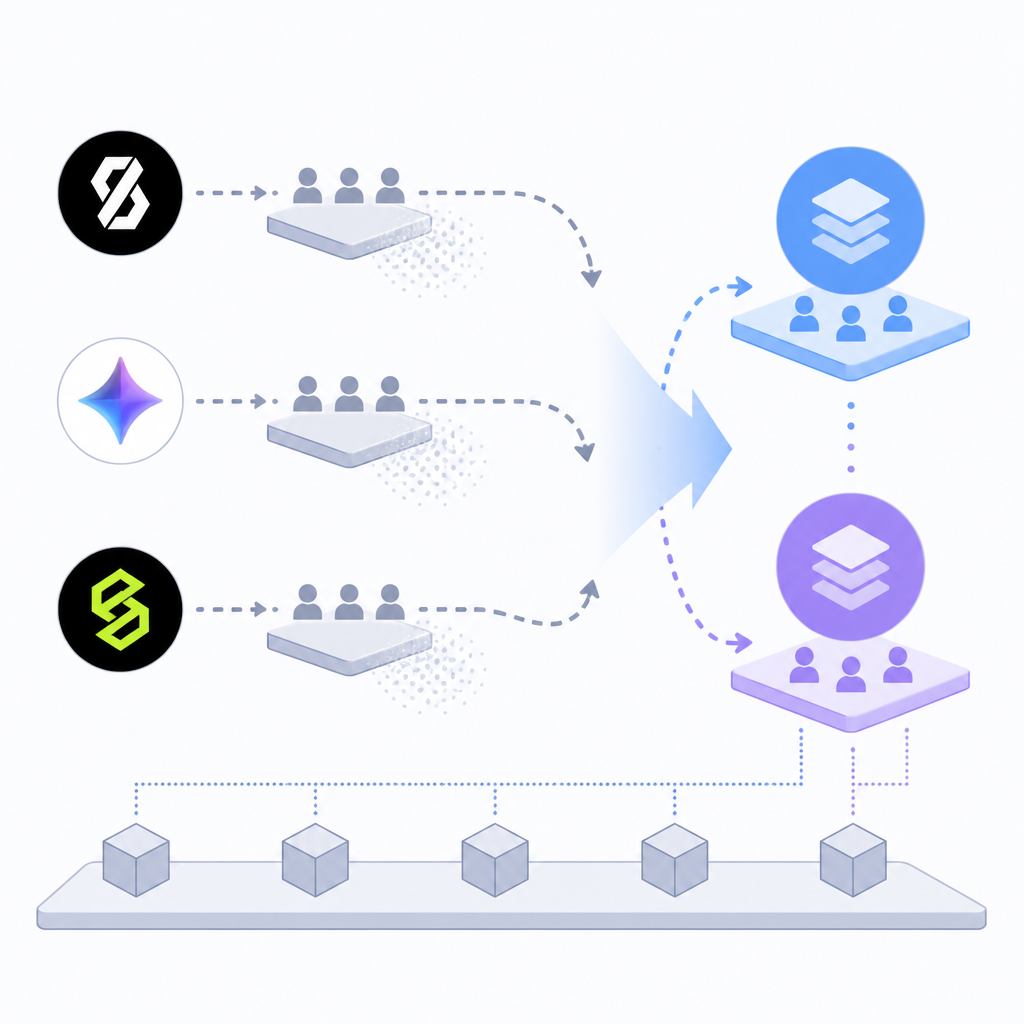
Arbitrum One and Base now account for about two-thirds of the total value secured inside the rollups group, according to L2Beat data cited in the article. That concentration matters because liquidity attracts liquidity. Users go where assets already sit. Developers go where users already are. Wallets and exchanges follow the same gravity.
After Dencun and the improvements in data availability, fees dropped across many L2s. Cheap transactions stopped being a differentiator. The new competition is about distribution, liquidity, app depth, and revenue. Those are harder problems than launching a chain.
- Arbitrum One and Base together hold about two-thirds of rollup TVS.
- Zero Network has about $1.3M-$1.4M in TVS, far below the leaders.
- Everclear’s current TVL is about $6,891, with $5,539 in 30-day fees.
- Syndicate Labs spent 5 years in the market before deciding to wind down.
The economics are brutal but pretty simple. A low-volume chain still needs security, monitoring, support, and ongoing maintenance. A bridge with thin usage still needs liquidity management and risk controls. A tooling company still has to keep shipping docs, audits, upgrades, and support. If the revenue base is too small, the math stops working.
What this says about the next phase of L2s
The next round of L2 competition will favor projects that already have users or a clear path to them. A good launch plan is no longer enough. A clean whitepaper is no longer enough. Even a technically elegant rollup is not enough if nobody has a reason to use it.
That is why the question for new teams is changing. Instead of asking how fast they can launch a chain, investors and builders are asking where the users come from, how liquidity gets seeded, and what the fee model looks like after the incentives fade. If the answer depends on endless subsidies, the project is already in trouble.
For teams building today, the lesson is practical: distribution beats abstraction. If a project cannot point to an exchange, wallet, app, or ecosystem that will bring steady traffic, it will struggle against larger networks like Base, Arbitrum, and Optimism. The market has made its preference clear.
My read is that more small L2s will quietly fold into wallets, SDKs, or app-specific products over the next 12 months. The survivors will be the ones that can answer one question with real numbers: where does the revenue come from once the initial excitement fades?
For builders, that is the question to answer before launching another chain. For users, it is the question to ask before trusting one.
// Related Articles
- [CHAIN]
7 Solana APIs that cut weeks off integration
- [CHAIN]
Solana Unchained token sale nears Phase 1 close at $0.05
- [CHAIN]
June 2026 Web3 Signals Founders Should Use Now
- [CHAIN]
Bitcoin DeFi will grow, but not by copying Ethereum
- [CHAIN]
AI-blockchain projects need real utility, not token theater
- [CHAIN]
DMG’s 50 MW AI LOI is a better use of miners’ power assets