2026 blockchain shifts that will shape business bets
5 blockchain trends for 2026 show where businesses should invest next, from chain abstraction to tokenized assets and enterprise AI.

Five blockchain trends will shape how businesses build, move assets, and automate workflows in 2026.
Business teams tracking 2026 need more than buzzwords. The biggest shift is practical: blockchain is moving from isolated pilots to systems that connect chains, data, assets, and AI across real operations.
| Item | What it changes | Best fit |
|---|---|---|
| Chain abstraction | Hides multi-chain complexity | Apps with users on several networks |
| DePIN | Turns physical infrastructure into tokenized networks | IoT, mobility, energy, compute |
| Modular L1/L2 stacks | Lets teams pick execution, security, and scaling layers | Enterprises building custom chains |
| Enterprise AI + blockchain | Connects automation with audit trails | Workflow-heavy organizations |
| Tokenization | Moves real-world assets onchain | Finance, real estate, funds, treasuries |
1. Chain abstraction becomes the default user layer
Get the latest AI news in your inbox
Weekly picks of model releases, tools, and deep dives — no spam, unsubscribe anytime.
No spam. Unsubscribe at any time.
Chain abstraction is one of the clearest signs that Web3 is maturing. Instead of forcing users to know which chain holds an asset or where a transaction should settle, apps can present one interface while routing activity across networks in the background. That matters for businesses because friction kills adoption faster than fees do.

For product teams, the benefit is simpler onboarding, fewer support tickets, and less wallet confusion. For operations teams, it means one product can reach users on Ethereum, Polygon, Solana, or other networks without rebuilding the front end each time a new chain gains traction.
- Useful when users hold assets on multiple chains
- Reduces the need for manual bridging steps
- Fits consumer apps, wallets, and trading platforms
2. DePIN turns physical infrastructure into software-led networks
DePIN, or decentralized physical infrastructure networks, is moving from niche concept to business category. The idea is simple: instead of a single company owning all the hardware, a network of participants contributes devices, coverage, storage, or compute, and gets rewarded for it.
That model is attractive in sectors where deployment costs are high or geographic reach is hard to scale. It can support sensor networks, distributed connectivity, logistics tracking, and edge compute. Businesses watching DePIN in 2026 should focus less on token talk and more on whether the network can lower capex while expanding coverage.
- Relevant for IoT and smart city systems
- Can support distributed storage and compute
- Works well where local data collection matters
3. Modular blockchain stacks replace one-size-fits-all chains
More teams are choosing modular architectures instead of building on a single monolithic chain. With tools such as zkSync Hyperchains, Cosmos SDK, Polygon zkEVM, Avalanche Subnets, and OP Stack, businesses can choose how much control, throughput, and interoperability they need.
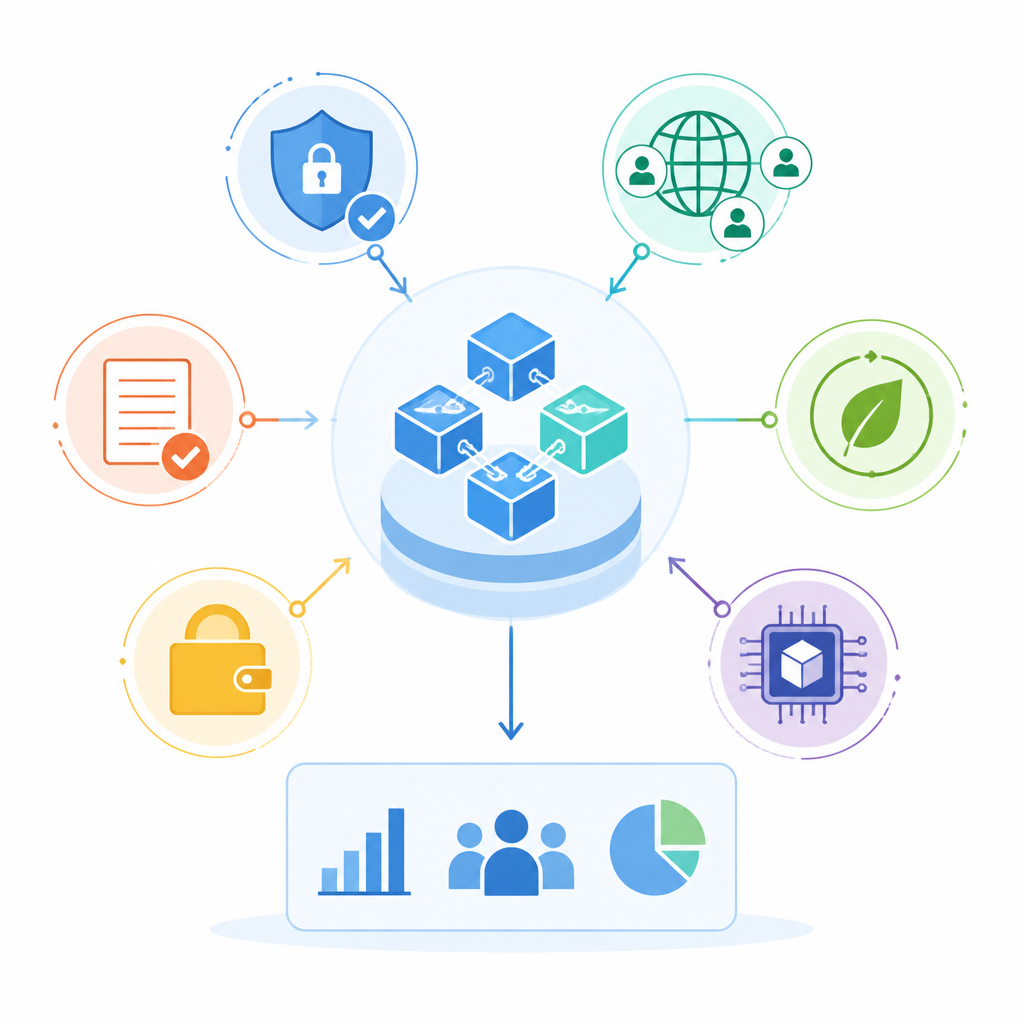
This matters because different products have different constraints. A payments app may prioritize speed and cost. A regulated enterprise system may care more about permissioning and data control. Modular stacks let teams tune the chain to the business instead of forcing the business to fit the chain.
Examples of stack choices:
- zkSync Hyperchains for interoperable rollups
- Cosmos SDK for app-specific chains
- Avalanche Subnets for isolated execution environments
- OP Stack for Ethereum-aligned scaling
- Polkadot Parachains for connected specialized chains
4. Enterprise blockchain shifts from recordkeeping to workflow control
Enterprise blockchain is no longer only about storing records. In 2026, the stronger use case is workflow control across supply chain, finance, healthcare, real estate, education, and logistics. The value comes from shared state, traceability, and rules that execute the same way for every participant.
That makes blockchain useful in places where multiple parties need one version of the truth. A supply chain team can track assets end to end. A finance group can reduce reconciliation work. A healthcare platform can tighten data integrity. The point is not to “put everything onchain,” but to remove the parts of coordination that waste time and create disputes.
- Supply chain visibility and asset traceability
- Finance workflows with better auditability
- Healthcare and education records with stronger integrity
5. Tokenization and enterprise AI move from experiments to production
Tokenization is becoming a practical business tool, not just a crypto theme. Assets such as real estate, funds, treasuries, gold, and carbon credits can be represented onchain to improve transfer speed, ownership clarity, and access. For firms managing illiquid assets, that opens new distribution and settlement models.
At the same time, enterprise AI is being paired with blockchain to keep automation traceable and governed. Tools for workflow automation, intelligent document processing, predictive analytics, and AI governance are increasingly being built with audit trails in mind. That combination is valuable for compliance-heavy teams that want AI output without losing control over data, permissions, or accountability.
- Best for asset managers and fintech teams
- Useful for compliance-heavy document workflows
- Fits organizations that need both automation and auditability
How to decide
If your business struggles with multi-chain complexity, start with chain abstraction. If infrastructure costs or physical coverage are the bottleneck, DePIN deserves a closer look. If you need a chain tailored to your product, modular stacks are the strongest bet. If your pain point is coordination across departments or partners, enterprise blockchain is the better fit.
For finance, real estate, and asset-heavy businesses, tokenization should be near the top of the roadmap. For organizations adopting AI at scale, the smarter move is to pair automation with governance and blockchain-based traceability from the start.
// Related Articles
- [CHAIN]
Shiba Inu slips 6.99% after Shibarium breach
- [CHAIN]
State Street launches a stablecoin reserve fund
- [CHAIN]
Fast Solana Token Development for DeFi, NFTs, and Web3
- [CHAIN]
Solana’s developer slowdown is a healthy reset, not a warning sign
- [CHAIN]
Solana Developer Salary vs Ethereum Developer Salary
- [CHAIN]
Web3 Development Costs in 2026: Real Price Ranges