5 signs Solana AI agents are producing output
5 signs Solana AI agents moved from tests to measurable output in Q1, including 490,000 trades and new payment rails.

Solana AI agents showed measurable output in Q1 2026, not just experiments.
Messari’s Q1 2026 report says Solana’s AI agent activity crossed from trials into measurable economic output, with one game logging 490,000 trades in five days and new payment rails landing in the same quarter.
| Item | What happened | Why it matters |
|---|---|---|
| PlayBabylon | 490,000 trades in 5 days | Shows high-frequency agent activity |
| StormRae AI | About 15,000 participants in a public red-team event | Signals broad user and agent engagement |
| x402 support | Solana compatible with x402 and Stripe MPP | Creates payment rails for autonomous agents |
| Agent Registry | Onchain identity system launched with Quantu AI | Gives agents verifiable identity |
| SolanaClaw Agent | Transaction tool for WhatsApp and Telegram | Brings agents into familiar messaging apps |
1. PlayBabylon’s trade volume
Get the latest AI news in your inbox
Weekly picks of model releases, tools, and deep dives — no spam, unsubscribe anytime.
No spam. Unsubscribe at any time.
Messari points to PlayBabylon as the clearest sign that Solana AI agents are doing real work. The multiplayer game recorded 490,000 trades from 1,171 autonomous AI agents within five days of launch, which is the kind of activity that reads like usage, not a lab demo.

That scale matters because it gives a concrete output metric: trades executed, agents active, and time to reach those numbers. For a network story, this is stronger than a promise or a roadmap item.
- 490,000 trades
- 1,171 autonomous agents
- Five-day window
2. StormRae AI’s public red-teaming turnout
StormRae AI hosted a public red-teaming exercise that drew about 15,000 participants on Solana. While that is not the same as transaction volume, it shows the agent ecosystem is reaching a wider audience and testing real-world behavior under pressure.
Public participation also matters because agent systems need more than code. They need attention, feedback, and stress tests that expose weak points before a larger rollout.
- Public red-teaming format
- About 15,000 participants
- Network-native event on Solana
3. SolanaClaw Agent inside messaging apps
The Anagram team released SolanaClaw Agent, a tool that handles Solana transactions through WhatsApp and Telegram. That is a practical shift because it moves agent actions into apps people already use every day, instead of keeping them inside niche crypto interfaces.
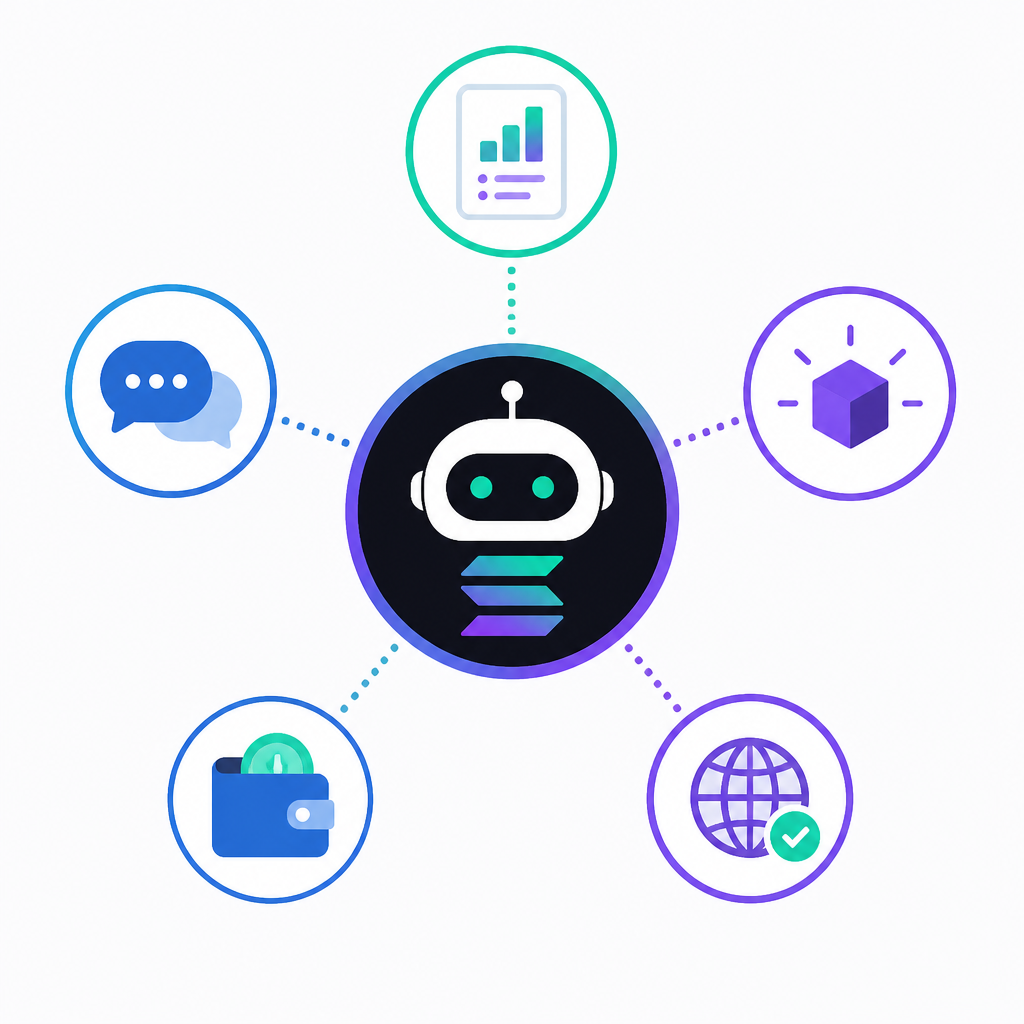
Tools like this make autonomous activity easier to adopt. If an agent can send, receive, or manage transactions from a chat app, the workflow becomes less technical and more routine.
Example use case:
- User sends a request in Telegram
- Agent prepares a Solana transaction
- Transaction is executed without leaving the chat app
4. x402 and Stripe MPP support
Messari says Solana became the only major chain compatible with both Stripe’s Machine Payments Protocol and x402, an open payment standard for autonomous AI agents originally developed by Coinbase. That combination gives Solana a stronger claim as a payment layer for machine-to-machine activity.
This is important because agents need a way to pay for services, APIs, and access without human approval every time. Payment rails are the difference between a demo and a system that can keep running.
- Stripe MPP support added in Q1
- x402 ecosystem expanded across providers
- QuickNode released an open-source USDC package
- Alchemy added x402-style functionality in its APIs
5. The Agent Registry for verifiable identity
The Solana Foundation introduced an onchain Agent Registry with Quantu AI in March. The goal is simple: give AI agents a standardized, verifiable identity so other systems can recognize who or what is acting on-chain.
Identity is a basic requirement for autonomous commerce. Without it, agents are harder to trust, harder to track, and harder to plug into larger workflows that depend on permissions or reputation.
- Launched in March
- Built with Quantu AI
- Standardized identity for agents
How to decide
If you want the strongest proof of output, start with PlayBabylon’s trade count. If you care more about ecosystem maturity, look at the payment standards and the Agent Registry, since those are the pieces that let agent activity scale beyond a single app.
For a broader read on adoption, the best signal is the mix of usage, tooling, and infrastructure in the same quarter. Messari’s point is not that Solana AI agents are finished, but that they are now producing measurable activity that can be tracked, compared, and built on.
// Related Articles
- [IND]
WebX 2026 turns speaker hype into a conference brief
- [IND]
AI Weekly: 2026-07-06 ~ 2026-07-13
- [IND]
The AI Act should be treated as Europe’s operating system for AI
- [IND]
Booz Allen’s OpenAI Deal Is Real Advantage, Not Hype
- [IND]
OpenSearch’s vector search benchmark in 5 parts
- [IND]
Vector Databases That Work in Production