Apple’s Siri bet now includes Google’s Gemini
Apple got access to Google’s Gemini in data centers, then plans to distill smaller models for Siri and on-device AI.
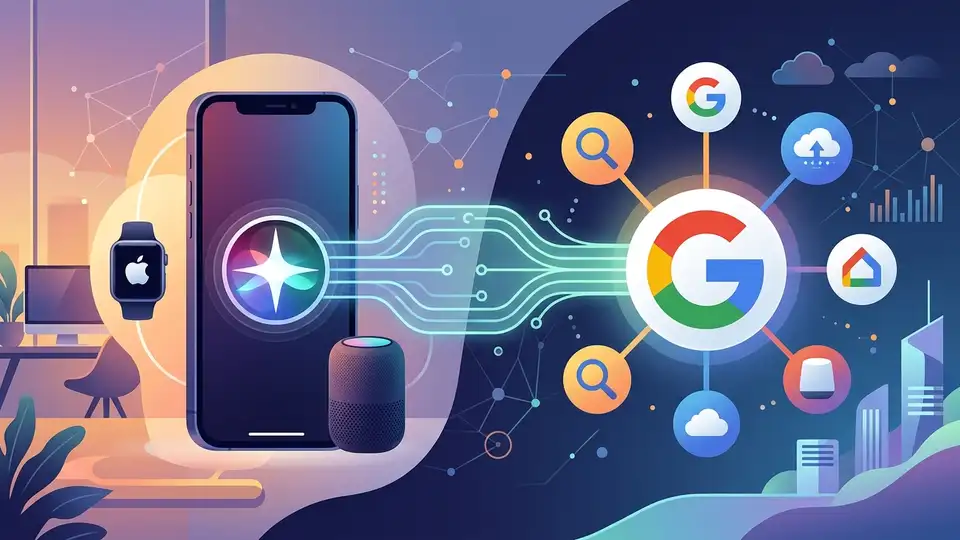
Apple is paying for a very specific kind of access to Google’s AI stack: full use of Gemini in data centers so it can train smaller models for Apple devices. The detail matters because this is not a generic partnership story; it is about distillation, where a larger model teaches a smaller one to do useful work with less compute.
That matters for Apple because its AI strategy has been shaped by two hard constraints at once: privacy expectations and device hardware limits. If Apple can turn Gemini into a teacher model, it gets a shortcut to better on-device behavior without shipping Google’s full model to the iPhone.
What Apple is actually buying
Get the latest AI news in your inbox
Weekly picks of model releases, tools, and deep dives — no spam, unsubscribe anytime.
No spam. Unsubscribe at any time.
According to The Information, Apple and Google have an agreement that gives Apple full access to Gemini in data centers. Apple can then use that access to distill smaller student models tuned for Apple hardware, where memory, battery life, and latency matter far more than raw parameter count.
This is a practical move, not a branding move. A big cloud model can answer broad questions, reason over long contexts, and generate polished text, but phones need something much smaller and cheaper to run. Apple’s goal is to compress useful behavior into models that fit inside its own stack, including the company’s on-device AI features.
The arrangement also says a lot about where Apple thinks its AI strength should live. The company has spent years pushing more work onto the device, from photos to speech to face recognition, and that same instinct is showing up in generative AI. If the model is small enough, Apple can keep more requests local and avoid sending every interaction to a server.
- Apple gets access to Gemini in data centers, not just a thin API wrapper.
- The output is a smaller student model designed for Apple devices.
- Distillation lowers compute needs compared with running a large frontier model.
- On-device execution helps with latency and privacy tradeoffs.
Why distillation matters more than a headline partnership
Model distillation is one of the most useful tricks in modern AI engineering. A large teacher model generates answers, labels, or behavior traces, and a smaller student learns from that output. The student usually loses some breadth, but it can gain speed, lower memory use, and lower operating cost.
That tradeoff is exactly what Apple needs. Siri has long been criticized for lagging behind newer assistants, and Apple cannot solve that problem by simply throwing a giant model at every iPhone. The hardware footprint, thermal limits, and battery cost would be too high for a consumer product that has to run all day.
Apple’s own AI work has already pointed in this direction. The company has been building Apple Machine Learning Research systems that emphasize efficiency, and its public AI push has leaned heavily on smaller, device-friendly models rather than giant always-on cloud systems.
- Large model: better generalization, higher compute cost, slower inference on device.
- Smaller distilled model: narrower capability, faster inference, lower power draw.
- Cloud-only assistant: easier to scale, but more dependent on network quality.
- On-device assistant: more private, but harder to make smart enough without training help.
What this means for Siri and Apple Intelligence
Apple’s Apple Intelligence push has made one thing clear: Apple wants AI features to feel built into the operating system, not bolted on as a chatbot tab. That design choice puts pressure on Siri to become more useful in everyday tasks like drafting, summarizing, finding information, and acting on context across apps.
The Gemini deal gives Apple a way to improve those capabilities without giving up its preference for smaller local models. In practice, this could help Siri better understand prompts, rewrite text more naturally, or route tasks to the right app action with fewer failures. It also gives Apple a training source that already handles a wide range of real-world queries.
The catch is that distillation does not magically create new product quality. If the student model is trained on the wrong tasks, or if Apple trims it too aggressively, the assistant can become faster without becoming genuinely smarter. That is why this agreement feels more like infrastructure than a finished feature.
“There are no shortcuts to building a great product.” — Tim Cook, Apple CEO, from Apple’s Q3 2016 earnings call.
Cook’s line still applies here. Apple can borrow training signals from Google, but the final experience still depends on how well Apple integrates the model into Siri, Shortcuts, Messages, Mail, and the rest of the system.
How Apple compares with other AI players
Apple is taking a different route from companies that ship larger cloud assistants by default. Instead of making the phone a thin client for a giant model, Apple is trying to shrink the model until the device can do more of the work itself. That is a slower path, but it fits Apple’s hardware and software business far better.
Google, meanwhile, is already pushing Gemini across search, Android, and its own cloud products. OpenAI has focused on broad model capability and distribution through ChatGPT and partner integrations. Apple’s move is more selective: it wants a partner model for training, then it wants the user experience to feel like Apple’s own software.
- OpenAI ships large general-purpose models and a consumer chatbot-first experience.
- Google Gemini is already deeply tied to cloud infrastructure and Android-adjacent services.
- Apple Intelligence prioritizes on-device execution and system integration.
- Anthropic has also pushed assistant-style models that run well in partner products and enterprise settings.
The numbers behind the strategy are the real story. A large frontier model can require far more memory and compute than a mobile device can comfortably provide, while a distilled model can fit into a much smaller runtime budget. That difference is what makes it possible to ship AI features to hundreds of millions of iPhones without turning every request into an expensive cloud call.
For Apple, the best-case outcome is straightforward: better Siri behavior, faster responses, and less dependence on sending user data off device. For Google, the payoff is subtler but still important. Gemini becomes part of the training pipeline for one of the world’s biggest consumer platforms, even if the Google brand never appears on the screen.
Apple’s next AI test is practical, not flashy
This deal tells us where Apple is placing its bet: on efficiency, device control, and training-time access to a stronger model rather than a public-facing chatbot war. That makes sense for Apple, but it also raises the bar. If Siri still feels clumsy after this, the problem is not access to a better teacher model; it is execution.
The next thing to watch is whether Apple uses Gemini-derived student models to improve everyday actions, not just demo features. If the company can make Siri faster at text tasks, app control, and context-aware responses in iOS 19-era updates, this partnership will look smart in hindsight. If not, it will read as another sign that Apple is still buying time while it rebuilds its AI stack.
My guess: Apple will use Google’s model help quietly, ship the gains inside system features, and avoid making the partnership part of the marketing pitch. The real question is simpler: can Apple turn a teacher model into Siri behavior people notice in under five seconds?
For more on Apple’s AI rollout, see our coverage of Apple Intelligence’s software-first approach.
// Related Articles
- [MODEL]
GPT-5.6 turns OpenAI into a model menu
- [MODEL]
Seedream 5.0 Pro Is the Right Choice for Editable AI Images
- [MODEL]
Midjourney v8.2 release is close
- [MODEL]
Rust KRAID enters Mesa for Arm Mali GPUs
- [MODEL]
OpenAI Opens GPT-5.6 and Launches Live Voice AI
- [MODEL]
Mistral is right to push Leanstral into proof engineering