OpenAI’s Realtime Audio Models Target Live Voice
OpenAI’s new realtime audio models aim at live translation, transcription, and voice agents for developers and creators.
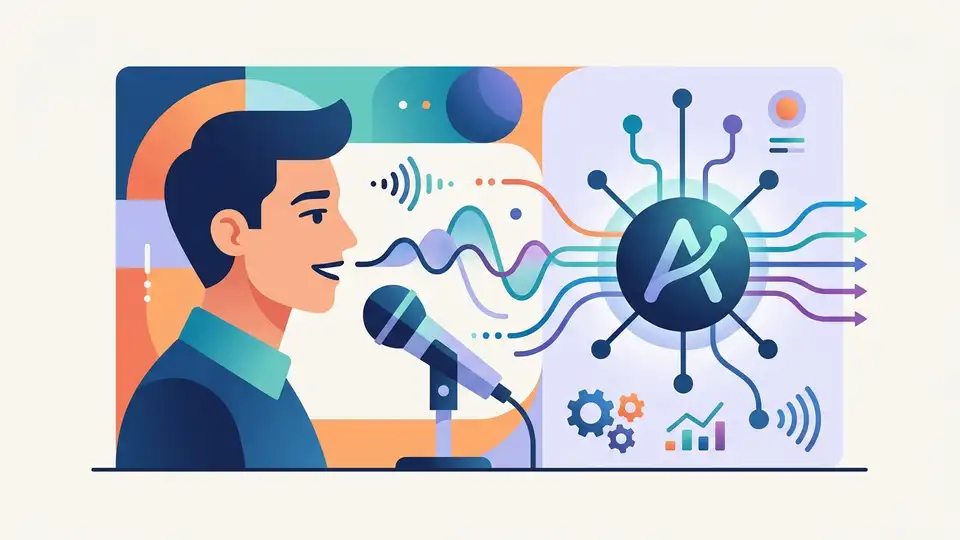
OpenAI released three realtime audio models for live translation, transcription, and voice agents.
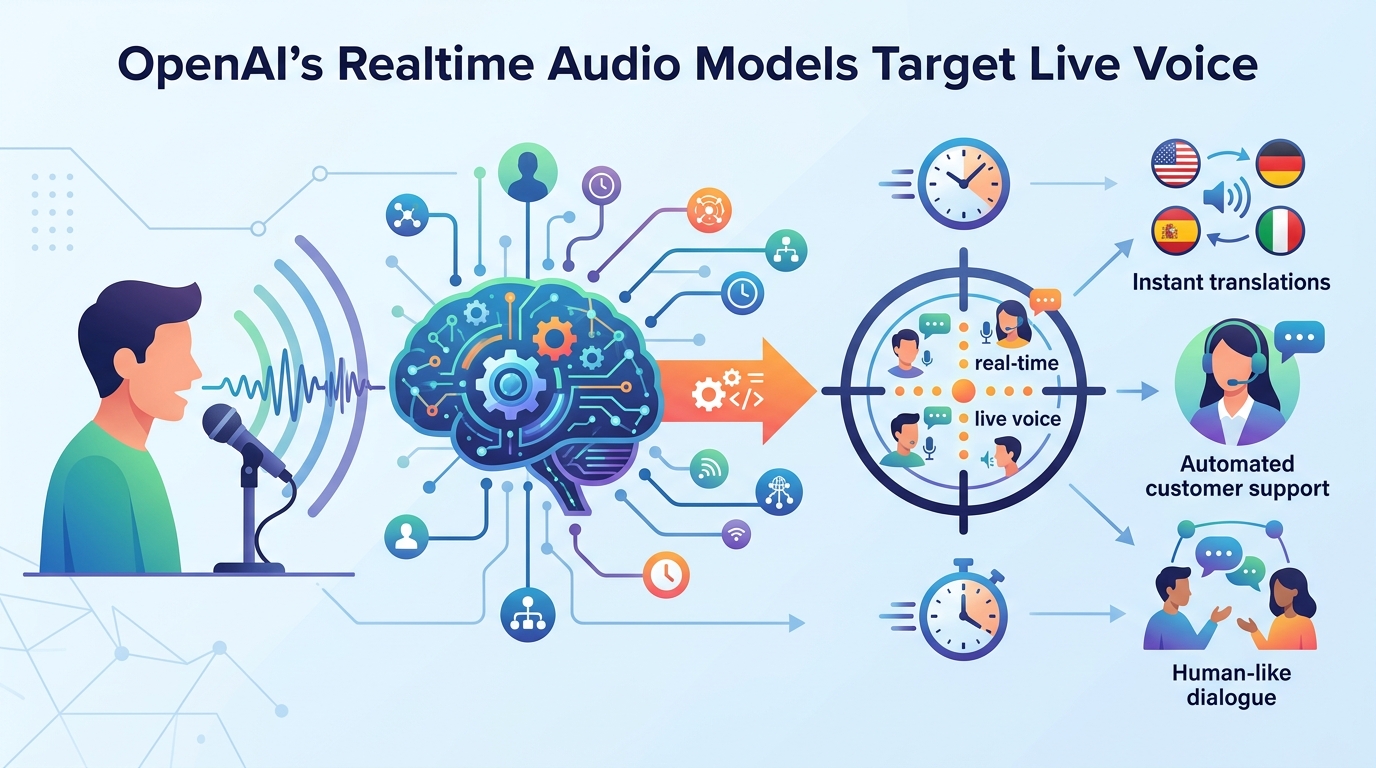
OpenAI has put live audio front and center with three new models aimed at speech-heavy apps: GPT-Realtime-2, GPT-Realtime-Translate, and GPT-Realtime-Whisper. The pitch is simple: lower latency, better live understanding, and fewer awkward pauses when software has to listen and answer at human speed.
That matters because audio is one of the hardest inputs for AI to handle well. Text can wait a second. Live speech cannot. If a model misses a beat during a translation call, a studio session, or a support conversation, the whole interaction feels broken.
| Model | Main job | Notable detail |
|---|---|---|
| GPT-Realtime-2 | Live reasoning and conversation | Built for interactive voice agents |
| GPT-Realtime-Translate | Speech translation | Supports 70+ languages |
| GPT-Realtime-Whisper | Live transcription | Turns speech into text as it happens |
Why live audio is harder than chat
Get the latest AI news in your inbox
Weekly picks of model releases, tools, and deep dives — no spam, unsubscribe anytime.
No spam. Unsubscribe at any time.
Speech systems have to deal with timing, accents, overlapping voices, background noise, and partial sentences. A chatbot can pause and think. A realtime voice model has to decide quickly whether the speaker is done, whether a word was misheard, and whether the response should begin now or wait a fraction longer.
That is why realtime audio has usually felt more fragile than text generation. A clean transcript is useful, but a useful transcript that arrives too late is still a bad product. The same goes for translation. A model can be accurate and still feel clunky if it lags behind the speaker.
OpenAI’s release targets that exact problem. The company is not just trying to make voice AI sound nicer. It is trying to make voice AI usable in live settings where timing matters as much as accuracy.
- Live translation across 70+ languages
- Realtime transcription for meetings, interviews, and sessions
- Interactive voice agents that can reason while speaking
What each model is built to do
GPT-Realtime-2 is the one developers will watch most closely. It is meant for conversational agents that need to respond in the moment, which makes it useful for customer support, assistants, and workflow tools that live inside a microphone instead of a keyboard.
GPT-Realtime-Translate is the most immediately practical for global communication. OpenAI says it handles speech translation in more than 70 languages, which puts it in the territory of live calls, international collaboration, and multilingual creator workflows.
“We are making it possible for developers to build voice experiences that feel natural and responsive.”
OpenAI, announcement on GPT-Realtime
GPT-Realtime-Whisper handles the transcription side. That sounds less flashy than a live agent, but transcription is still the backbone of a lot of audio software. It powers searchable archives, captioning, editing tools, and the first step in many AI workflows.
- GPT-Realtime-2 focuses on response quality during live conversation
- GPT-Realtime-Translate focuses on cross-language speech
- GPT-Realtime-Whisper focuses on speech-to-text speed and accuracy
Why musicians and audio teams should care
The music angle is easy to miss if you only look at the headline. A live transcription model can turn rehearsal notes, jam sessions, and interview recordings into text without waiting for a post-production pass. A translation model can help remote collaborators work across language barriers during writing sessions or label meetings.
There is also a less obvious use case: creative assistance during production. A realtime voice agent can help a producer keep track of session notes, troubleshoot gear, or surface reference ideas while hands stay on instruments and controllers. That kind of workflow matters more in audio than in many other fields because timing is part of the job.
For creators, the value is not abstract. If a tool saves five minutes in a twenty-minute session, that is enough to change how often people use it. If it cuts friction during collaboration, it becomes a habit instead of a demo.
OpenAI’s move also raises the bar for other audio vendors, including AssemblyAI, Deepgram, and Rev AI, which already compete in speech recognition and transcription. The difference now is that realtime interaction is becoming the default expectation, not a premium extra.
What developers will compare next
Developers will test these models against latency, language coverage, and how well they handle messy real-world audio. A polished demo is one thing. A crowded Discord call, a noisy studio, or a guest speaker with a thick accent is another.
The comparison will likely come down to a few measurable questions: how fast does the model respond, how often does it miss context, and how well does it keep working when audio quality drops. Those are the numbers that decide whether a voice model becomes infrastructure or stays a novelty.
- Latency during live speech
- Accuracy under noise and overlap
- Language coverage in real conversations
- Developer integration effort
OpenAI is clearly betting that voice is ready to move from demo territory into everyday software. If these models hold up outside the lab, the next wave of music tools, meeting apps, and multilingual assistants will feel a lot less like bots and a lot more like collaborators.
For teams building with audio, the practical question is simple: do you need a transcript, a translator, or an agent that can think and answer while people are still talking? The answer will decide which of these models matters most.
// Related Articles
- [MODEL]
GPT-5.6 turns OpenAI into a model menu
- [MODEL]
Seedream 5.0 Pro Is the Right Choice for Editable AI Images
- [MODEL]
Midjourney v8.2 release is close
- [MODEL]
Rust KRAID enters Mesa for Arm Mali GPUs
- [MODEL]
OpenAI Opens GPT-5.6 and Launches Live Voice AI
- [MODEL]
Mistral is right to push Leanstral into proof engineering