Apple’s Siri Overhaul Could Arrive in iOS 27
Apple is reportedly rebuilding Siri for iOS 27 with a chat UI, deeper app control, and Gemini-powered AI behind the scenes.

Apple is reportedly preparing a major Siri rewrite for iOS 27, and the numbers behind the plan are hard to ignore: Bloomberg’s Mark Gurman says the company is aiming for a two-step rollout, with an earlier AI upgrade in iOS 26.4 and a fuller Siri overhaul later in 2026. The bigger twist is the reported use of Google Gemini models to help power the new assistant.
If the reports hold up, this is Apple admitting that Siri needs more than a polish. It needs a new brain, a new interface, and a new job inside the operating system.
What Apple is reportedly building
Get the latest AI news in your inbox
Weekly picks of model releases, tools, and deep dives — no spam, unsubscribe anytime.
No spam. Unsubscribe at any time.
The current Siri is good at basic commands, but it has always felt like a command launcher with a voice skin. The reported iOS 27 version is meant to behave more like a conversational AI, with text and voice input, persistent chat history, and tighter control over apps and device settings.

That matters because Apple is not talking about a single feature. It is reportedly building a multi-stage system under an internal effort called Apple Intelligence, with Siri as the front door.
Here is the shape of the change as described in the reports:
- An earlier AI update in iOS 26.4 with web-style answers and better context handling
- A dedicated Siri app with a chat-like layout and saved conversation threads
- Deeper app actions, including multi-step tasks across Mail, Photos, Notes, and Calendar
- Text entry, voice entry, and file attachment support inside the assistant
- More on-device processing for private data, with cloud AI used for heavier requests
The important detail is that Apple wants Siri to stop acting like a one-shot helper. Instead of answering a question and disappearing, it would keep context, remember the thread, and help finish a task later.
That is a much harder product to build. It also fits Apple’s style better than a pure chatbot clone. Apple rarely wins by copying the loudest AI demo. It wins when the feature feels native to the device.
There is also a practical reason for the split rollout. Apple has spent the last year selling Apple Intelligence as a privacy-first AI layer, but Siri has lagged behind the expectations set by ChatGPT, Gemini, and other assistants. A staged launch gives Apple time to fix the plumbing before it promises the full experience.
Why the Gemini deal matters
The most interesting part of this story is not the chat UI. It is the reported partnership with Google. According to Bloomberg’s reporting, Apple plans to use Gemini models inside its own data centers, then distill that knowledge into smaller models that can run on-device or in Apple’s private cloud.
That approach is smart for two reasons. First, it saves Apple from having to build every large model from scratch. Second, it lets Apple keep its privacy story intact while still getting better reasoning and search behavior than its current stack can provide.
“We’re in the early stages of a very exciting field, and we believe we have the best product in the world in our hands.” — Tim Cook, Apple earnings call, August 2017
Cook said that years before the current AI race heated up, but the line still fits Apple’s approach. Apple usually waits, then enters with a product that feels controlled and integrated rather than first and flashy.
The reported Gemini arrangement also says a lot about the economics of AI. Training and running frontier models is expensive, and Apple has the cash to buy time instead of burning years chasing parity. The company ended the March 2026 quarter with more than $160 billion in cash and marketable securities, so a reported $1 billion annual deal is expensive, but not painful.
There is one more reason this deal matters: Apple reportedly considered Anthropic too. That suggests Apple was not looking for a marketing partnership. It was shopping for the best model it could plug into its own product strategy.
How Siri compares with today’s assistants
To understand why this overhaul matters, compare the rumored Siri to what users already get from other assistants. The gap is not just about accuracy. It is about how much work the assistant can complete without forcing the user back into the app.
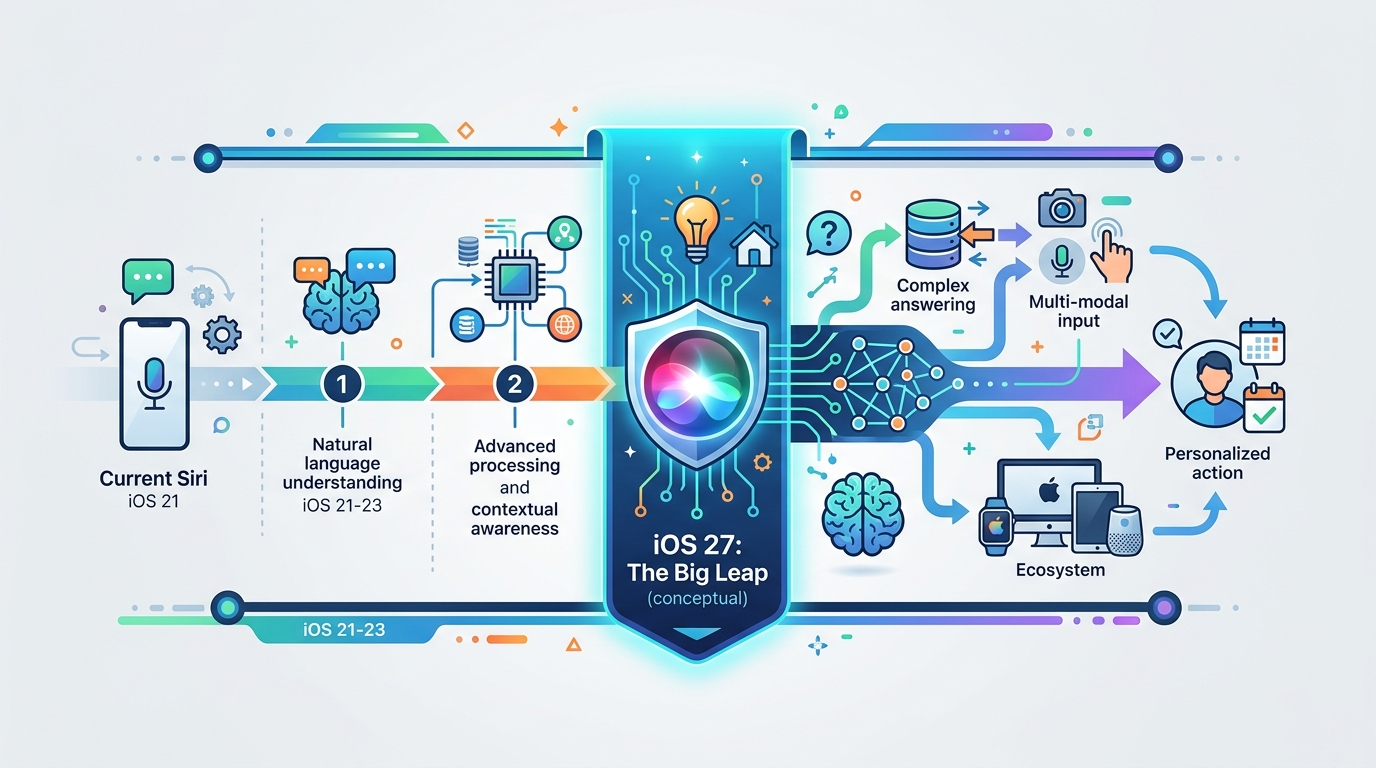
Here is the comparison that jumps out:
- Current Siri: handles short commands, timers, searches, and basic device control
- ChatGPT app: strong conversation, summarization, and content generation, but limited system control on iPhone
- Gemini: strong multimodal reasoning and Google ecosystem integration
- Rumored iOS 27 Siri: combines conversation, app actions, personal context, and system-level control
That last line is the real target. If Apple gets it right, Siri would be less like a voice search box and more like an operating system layer that can act on your behalf.
Apple’s advantage is distribution. Siri ships on hundreds of millions of devices, and that matters more than a flashy benchmark. If the assistant is available everywhere on iPhone, iPad, and Mac, even modest gains in usefulness could reach a huge audience fast.
But the bar is also higher because Apple users are less forgiving when a system feature feels half-finished. A chatbot can afford mistakes. An assistant that edits photos, sends emails, and changes settings cannot.
That is why the reported “Ask Siri” toggle and “Write with Siri” keyboard integration matter. They are not just convenience features. They are the glue that makes AI feel like part of the OS instead of a separate app you remember to open.
What to watch before WWDC
The next few months should tell us whether Apple is shipping a real AI reset or just rebranding Siri with better marketing. If the company previews this at WWDC, the demo will need to answer a few simple questions: Can Siri hold context across multiple steps? Can it act inside apps without breaking? Can it do all that while keeping personal data on-device when possible?
Those are the questions that matter more than any polished keynote line. Apple can afford to be late, but it cannot afford another Siri launch that looks impressive for ten minutes and disappoints for the next year.
If the reports are accurate, iOS 27 will be the first version where Siri feels designed for the AI era rather than patched into it. The bigger test will come after launch, when users try to replace real app work with a spoken request and see whether Siri can actually finish the job.
My bet: Apple will show a cleaner, smarter assistant at WWDC, then spend the rest of 2026 tightening the edge cases before the feature feels dependable enough for everyday use. The real question is simple: when Siri can finally plan, search, write, and act across the device, how many people will still open a separate chatbot at all?
// Related Articles
- [MODEL]
GPT-5.6 turns OpenAI into a model menu
- [MODEL]
Seedream 5.0 Pro Is the Right Choice for Editable AI Images
- [MODEL]
Midjourney v8.2 release is close
- [MODEL]
Rust KRAID enters Mesa for Arm Mali GPUs
- [MODEL]
OpenAI Opens GPT-5.6 and Launches Live Voice AI
- [MODEL]
Mistral is right to push Leanstral into proof engineering