Grok 4.1: xAI’s quieter upgrade that matters
xAI’s Grok 4.1 cuts hallucinations, boosts chat quality, and adds Fast and Thinking modes with 256k context and 2M-token API support.

xAI’s Grok 4.1 arrived on November 19, 2025 with a simple pitch: make the model feel less brittle, less flaky, and more human in conversation. The company says factual hallucinations on information-seeking prompts dropped from 12.09% in Grok 4 Fast to 4.22% in Grok 4.1, a 65% improvement, while the model also climbed to 1586 on Eq Bench and 1483 Elo on the Arena text leaderboard in Thinking mode.
This is not a flashy architecture reveal. It is an incremental release that focuses on better answers, cleaner writing, and fewer embarrassing mistakes. For developers, that matters more than a bigger marketing splash because the model is being pushed into chat, API, and agent workflows where small quality gains show up immediately.
What Grok 4.1 actually changed
Get the latest AI news in your inbox
Weekly picks of model releases, tools, and deep dives — no spam, unsubscribe anytime.
No spam. Unsubscribe at any time.
Grok 4.1 sits inside the xAI family as an upgrade to Grok 4, with the company emphasizing reasoning, multimodal understanding, and lower hallucination rates rather than a new core architecture. It launched with two main flavors: Grok 4.1 Fast for quick responses and tool use, and Grok 4.1 Thinking for deeper reasoning on harder prompts.

The most interesting part is how xAI describes the training process. The model used large-scale reinforcement learning, supervised fine-tuning, human feedback, and verifiable rewards. xAI also says it used frontier agentic reasoning models as reward models, which is a fancy way of saying the system learned from other strong models while being tuned for style, honesty, and usefulness.
That combination seems to have paid off in the areas users notice first. The company reports stronger performance in creative writing, emotional tone, and collaborative dialogue, along with a lower rate of factual drift on information-seeking prompts. If you have ever watched a model confidently invent a citation, you know why that matters.
- Release date: November 19, 2025
- Context length: 256,000 tokens
- Fast variant context: 2 million tokens
- Languages: English, Spanish, Chinese, Japanese, Arabic, Russian
- Availability: grok.com, x.com, Grok iOS and Android apps, API
Why the two-model setup matters
The split between Fast and Thinking is more than a naming trick. Grok 4.1 Fast is built for tool-calling, quick chat, and agent-style workflows where latency matters. Grok 4.1 Thinking uses thinking tokens, which means it spends more time on the answer before speaking.
That tradeoff shows up in the public rankings. xAI says the Thinking model hit #2 on the Arena text leaderboard with a 1483 Elo score, while the non-thinking version landed at #5 with 1465 Elo. In blind pairwise evaluations, the model reportedly beat the prior production model 64.78% of the time. Those are the kinds of numbers that matter when you care about consistency, not just single-shot benchmark wins.
“The best models are not the ones that sound smartest. The best models are the ones that are most useful.” — Sam Altman, OpenAI DevDay 2023 keynote
Altman’s line still lands because it captures the real test for a release like this. If a model is slightly slower but stops hallucinating in the middle of a research task, that is a better deal than a faster model that sounds confident while being wrong.
There is also a practical API angle here. xAI says the Fast variant exposes a unified API structure compatible with OpenAI and Anthropic SDKs, which lowers the friction for teams already shipping LLM features. That kind of compatibility matters more than a glossy demo because it shortens the path from benchmark curiosity to production use.
How it compares with Grok 4 and the newer 4.2 beta
Grok 4.1 is already being treated as a middle chapter in xAI’s release cadence. By February 2026, xAI had announced Grok 4.2 as a public beta, and the company said it performs better than 4.1 on open-ended engineering questions while using a multi-agent system to combine conclusions from specialized agents.
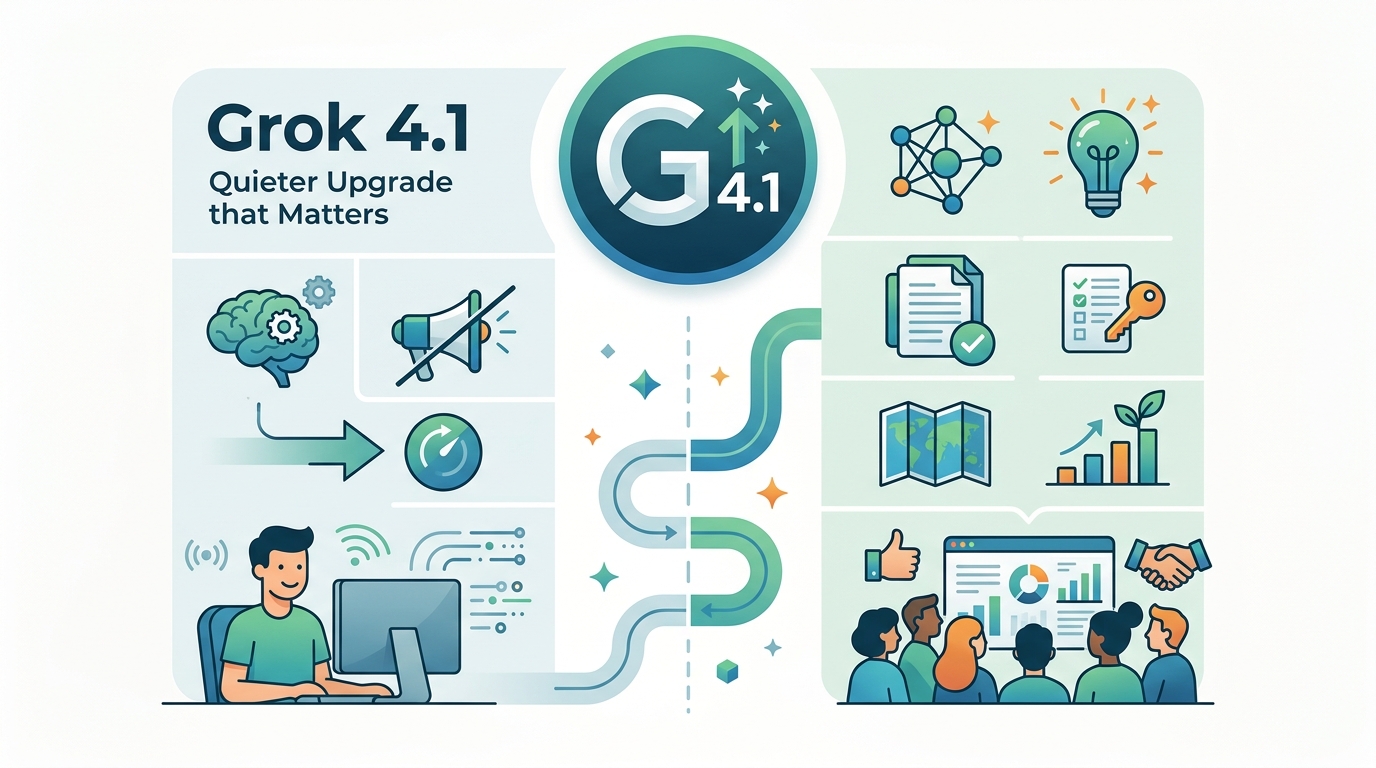
That makes Grok 4.1 feel less like the final destination and more like the version that proved xAI could squeeze a lot more quality out of post-training. The company also says Grok 4.1 reduced hallucinations from 12.09% to 4.22% on internal information-seeking prompts. That is a meaningful drop, especially for users who rely on the model for factual answers rather than casual chat.
- Grok 4 Fast hallucination rate: 12.09%
- Grok 4.1 hallucination rate: 4.22%
- Improvement: 65%
- Blind win rate over previous production model: 64.78%
- Eq Bench score: 1586
There is a second comparison worth making. xAI’s own numbers suggest Grok 4.1 is less about raw capability jumps and more about reliability gains. That is a different kind of progress, and it often matters more in real use. A model that writes cleaner answers, refuses harmful prompts more consistently, and stays on-task in long conversations will earn more trust than one that only tops a benchmark chart.
For developers building agents, that trust translates into fewer manual checks. For writers and analysts, it means less cleanup. For product teams, it means fewer support tickets caused by model nonsense. Those are boring benefits on paper, but they are the ones people keep paying for.
What developers should pay attention to
If you are building against xAI’s API, Grok 4.1 is interesting because it combines long context with distinct operating modes. The 256,000-token window is already large enough for serious document work, while the 2 million-token Fast variant opens the door to heavier agent loops, long codebases, and broad retrieval pipelines.
xAI also says the model was trained with safety filters for biology, chemistry, and cybersecurity. The official model card reports low false negative rates on restricted biology knowledge and chemistry knowledge, which is the sort of detail security-minded teams should care about. Nobody wants an assistant that is helpful right up until it becomes dangerous.
One more practical note: Grok 4.1 is available through grok.com, X, and the Grok mobile apps, with paid tiers like SuperGrok and X Premium+ offering fuller access. That makes adoption easier for casual users, but it also means API buyers need to think about rate limits, model selection, and whether they want Fast or Thinking behavior for each workflow.
For teams comparing it with other model families, the key question is simple: do you need a model that sounds sharper in conversation, or one that can reason more carefully over long tasks? Grok 4.1 gives you both modes, and that is useful if your product has to serve quick chat and deeper analysis from the same backend.
Grok 4.1 is about trust, not spectacle
The cleanest way to read Grok 4.1 is this: xAI spent its effort on making the model less annoying to use. That sounds modest, but it is exactly the kind of improvement that makes a model stick in a workflow.
My guess is that Grok 4.1 will keep finding a home in API and enterprise use even as newer versions take over the consumer UI. If xAI can keep the hallucination rate low while preserving the model’s conversational style, the next question is whether 4.2 and later releases can keep that balance without forcing users to trade speed for reliability. For anyone choosing a model today, the takeaway is simple: test Grok 4.1 on your longest, messiest prompts, because that is where its real value shows up.
// Related Articles
- [MODEL]
GPT-5.6 turns OpenAI into a model menu
- [MODEL]
Seedream 5.0 Pro Is the Right Choice for Editable AI Images
- [MODEL]
Midjourney v8.2 release is close
- [MODEL]
Rust KRAID enters Mesa for Arm Mali GPUs
- [MODEL]
OpenAI Opens GPT-5.6 and Launches Live Voice AI
- [MODEL]
Mistral is right to push Leanstral into proof engineering