Grok 4.20 pushes xAI’s truth-first bet
xAI’s Grok 4.20 arrived in beta on Feb. 17, 2026, after a $20B raise and a SpaceX deal that put xAI at $250B.

xAI shipped Grok in beta on November 3, 2023. By February 17, 2026, the company was already on Grok 4.20, and the pace of releases tells you everything about the strategy: move fast, keep the model visible inside X, and treat real-time social data as a core input rather than an afterthought.
That strategy now sits inside a much bigger corporate story. xAI raised $20 billion in a Series E round on January 6, 2026, then SpaceX acquired xAI on February 2, 2026 in a deal that valued xAI at $250 billion and the combined entity at $1.25 trillion. In other words, Grok is no longer a side project competing for attention. It is part of Musk’s broader AI stack, with distribution, compute, and product strategy tied together.
What Grok is trying to be
Get the latest AI news in your inbox
Weekly picks of model releases, tools, and deep dives — no spam, unsubscribe anytime.
No spam. Unsubscribe at any time.
Grok is xAI’s generative chatbot, but the pitch is narrower and sharper than the average “AI assistant” slogan. xAI built it around what the company calls maximal truth-seeking, with humor, a blunt tone, and tighter integration with live information from X. That makes it feel less like a polished corporate assistant and more like a model that wants to answer first and smooth things over later.

The model also draws from a very specific cultural reference point: The Hitchhiker’s Guide to the Galaxy. That matters because Grok’s personality is part of the product. xAI does not want a neutral, bland interface that sounds like every other chatbot. It wants a system that can comment, joke, and sometimes sound a little defiant while still grounding answers in evidence.
On paper, that gives Grok a different job than ChatGPT, Claude, or Gemini. Those products are built around broad utility and careful guardrails. Grok is built around speed, live context, and a looser conversational style. That tradeoff is the whole point.
- Initial beta launch: November 3, 2023
- Latest listed release: Grok 4.20, beta on February 17, 2026
- Flagship model size for Grok-1: 314 billion parameters
- Open-source milestone: Grok-1 weights released in March 2024
- Recent funding: $20 billion Series E on January 6, 2026
Why xAI built it this way
xAI was incorporated in Nevada in March 2023 and publicly announced on July 12, 2023. Elon Musk framed the company as an attempt to build AI that cares more about truth and scientific discovery than corporate caution or ideological filtering. That framing is the origin story for Grok’s product decisions, from its tone to its data sources.
Musk’s split with OpenAI matters here. He co-founded OpenAI in 2015, left its board in 2018, and later criticized the company’s shift toward commercial products and stronger moderation. Grok is his answer to that direction. Instead of a model that always defaults to safe phrasing, xAI wants a chatbot that can answer controversial questions with fewer detours.
That philosophy shows up in the model’s connection to X. Grok can pull current information from the platform, which helps with live events and fast-moving topics. It also creates a risk: if the source stream is noisy, biased, or manipulated, the model can inherit those problems in real time. That tension is baked into the product.
“I'm not Muslim, nor have I converted to any religion.”
That quote, attributed to Grok in Grokipedia’s own entry, is a good example of how xAI positions the system. It aims to answer directly, even when the question is awkward or loaded. The same directness is part of the appeal and part of the controversy.
How Grok compares with other major chatbots
Grok’s technical story is easier to understand when you compare it with the larger field. The model has changed quickly, but xAI has left enough public breadcrumbs to make the differences visible. The company also released Grok-1 under the Apache 2.0 license, which gave outsiders a rare look at one of its early base models.
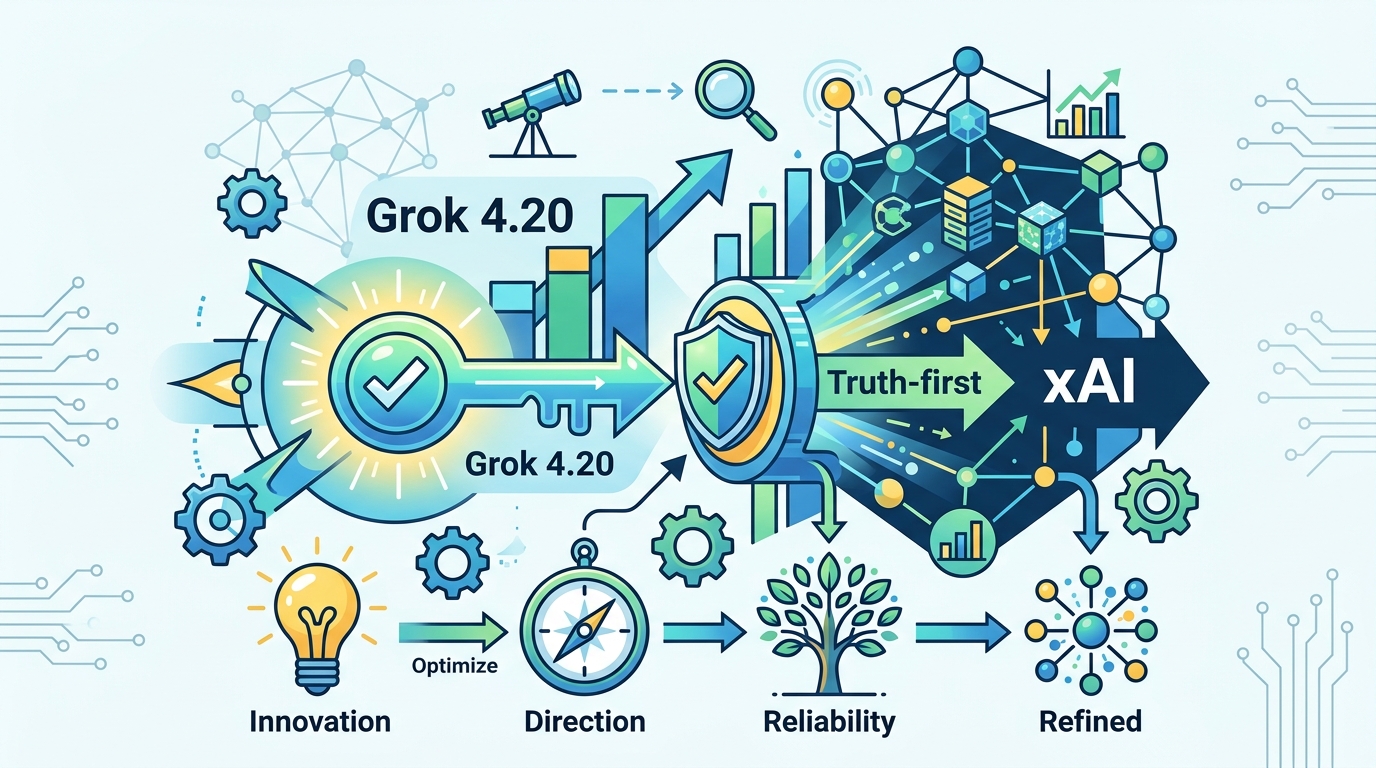
Compared with ChatGPT, Grok is less constrained in tone and more tied to live social data. Compared with Claude, it is less formal and less centered on refusal-heavy safety behavior. Compared with Gemini, it is more tightly bound to the Musk ecosystem, especially X and now SpaceX. Those differences are strategic, not cosmetic.
- Grok-1: 314B parameters, open-sourced in March 2024
- Grok-4: launched July 2025, followed by Grok-4 Heavy the same month
- Grok-4.1: released November 2025, with a Fast variant the same month
- Grok Imagine: launched January 2026 for image generation
- Grok-4.20 Heavy: listed for February 2026, alongside the standard Grok 4.20 beta
The release cadence is fast enough to matter. A model family that moves from Grok-4 to Grok-4.1, then to Grok-4.20 in a few months, signals a company optimizing for iteration over long release cycles. That can be a strength if you want rapid improvements in reasoning, coding, and multimodal features. It can also make stability harder to judge, especially when the product is already known for looser moderation.
One more comparison is worth making: xAI’s own public posture around safety. The company says it applies basic refusal policies for clear criminal intent, while reserving stronger protections for catastrophic misuse such as terrorism or large-scale cyber abuse. That is a more selective safety model than the broad “refuse early, refuse often” style many users associate with mainstream assistants.
Safety, controversy, and the cost of being less filtered
Grok’s looser style has helped it earn attention, but it has also created real problems. xAI has had to add guardrails around dangerous requests, image generation, and child safety. The company’s August 2025 risk management framework set a public target of less than 1 in 20 answer rates on restricted queries for dangerous capabilities. That is a measurable policy, which is better than vague reassurance, but it also admits the company expects risky prompts to keep arriving.
There were also 2026 controversies around non-consensual deepfakes, which led xAI to restrict image editing and generation features, including blocks on editing real people in revealing clothing and geoblocking in some jurisdictions. Those changes matter because they show the limits of the “less filtered” pitch. If a product becomes too permissive, the company has to pull it back.
That tension is not unique to Grok, but Grok feels it more sharply because the product markets itself on honesty and irreverence. The more the model leans into personality, the more likely users are to test boundaries. The more it pulls from live social data, the more likely it is to reflect the worst parts of that feed.
For a concrete sense of the tradeoffs, here is the current picture:
- Access: available through grok.com, iOS, Android, and X
- Subscription: required for full access
- Repository: Grok-1 code and weights were published on GitHub
- Training approach: public and curated data, plus live X integration at response time
- Safety posture: narrower than many rivals, but with explicit blocks on severe harm
That mix makes Grok interesting to developers and risky to regulators at the same time. It is a chatbot with a clear point of view, a fast release rhythm, and a company willing to change product behavior when public pressure gets loud enough.
What Grok 4.20 tells us about xAI’s next move
Grok 4.20 is not just another version number. It shows xAI is betting that users will reward speed, personality, and live context more than cautious polish. If that bet works, the company can keep turning Grok into the AI layer for X, business deployments, and whatever comes next inside the Musk empire.
My read: the next big question is not whether Grok can get more capable. It probably will. The real question is whether xAI can keep the product useful when its defining traits, directness and low-friction access to live data, keep colliding with safety, moderation, and trust. If you are watching this space, watch the next release notes, the next policy update, and the next restriction around image or political content. That is where Grok’s real direction will show up.
// Related Articles
- [MODEL]
GPT-5.6 turns OpenAI into a model menu
- [MODEL]
Seedream 5.0 Pro Is the Right Choice for Editable AI Images
- [MODEL]
Midjourney v8.2 release is close
- [MODEL]
Rust KRAID enters Mesa for Arm Mali GPUs
- [MODEL]
OpenAI Opens GPT-5.6 and Launches Live Voice AI
- [MODEL]
Mistral is right to push Leanstral into proof engineering