Jensen Huang Joins Trump on China Trip
Trump invited Nvidia CEO Jensen Huang onto Air Force One before a Beijing summit, putting chips and China policy in the same frame.
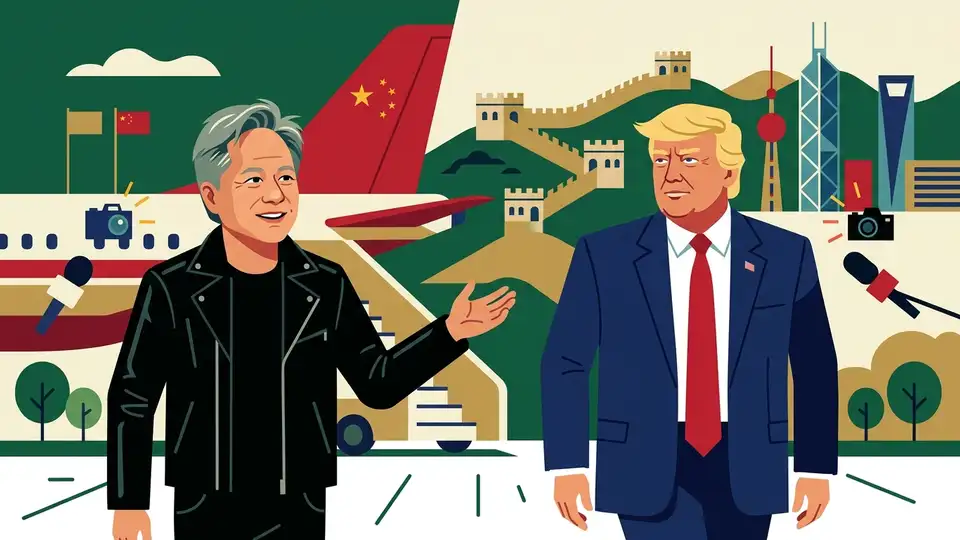
Trump invited Nvidia CEO Jensen Huang onto Air Force One before a Beijing summit.
President Donald Trump brought Nvidia chief executive Jensen Huang onto Air Force One late Tuesday as he headed to Beijing for a summit with China’s leader. The move put the world’s most valuable chip company directly into the middle of a high-stakes diplomatic trip.
This was a short piece of news, but the signal matters. Nvidia sits at the center of the AI chip market, and any U.S.-China meeting that touches technology policy can affect export rules, supply chains, and the companies building AI systems around those chips.
| Fact | Detail |
|---|---|
| Company | Nvidia |
| CEO | Jensen Huang |
| Trip | Trump’s flight to Beijing |
| Meeting | Summit with China’s leader |
Why this invitation matters
Get the latest AI news in your inbox
Weekly picks of model releases, tools, and deep dives — no spam, unsubscribe anytime.
No spam. Unsubscribe at any time.
When a chip executive gets added to a presidential trip at the last minute, it usually means the administration wants direct input from the industry most exposed to policy risk. Nvidia has spent years trying to balance fast-growing demand in China with tighter U.S. controls on advanced semiconductors.
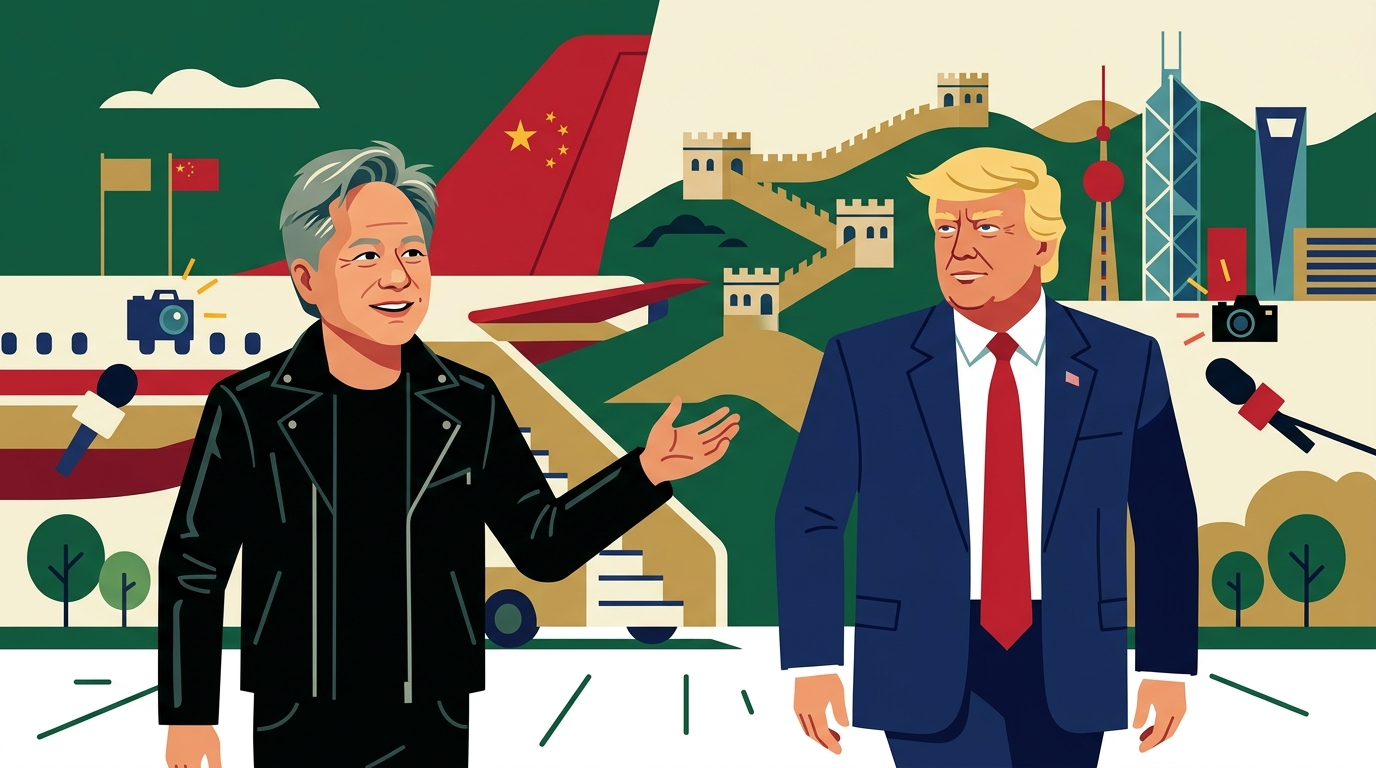
That tension is easy to miss if you only look at the headline. Huang is not a ceremonial passenger here. He is the leader of a company whose products power much of the current AI boom, from training large models to running inference in data centers.
- Nvidia is the dominant name in AI accelerators.
- U.S. export controls have already changed what Nvidia can sell into China.
- China remains too large a market for chipmakers to ignore.
- Trump’s trip suggests tech policy may sit close to the center of the talks.
What Nvidia has at stake
Nvidia’s business depends on selling high-end GPUs, networking gear, and software to cloud providers, startups, and enterprises. China has been one of the most important demand centers for advanced chips, even as Washington has tightened the rules around what can be exported.
That puts Huang in a delicate spot. He needs to protect access to one of the world’s biggest markets while keeping Nvidia aligned with U.S. policy. For a company that also publishes investor updates and product news on its own site, the message to customers is usually simple: keep building. The policy environment is anything but simple.
“We are at the beginning of the next era of computing.” — Jensen Huang, Nvidia GTC keynote, 2024
That quote has become one of Huang’s most repeated lines because it captures Nvidia’s pitch: AI infrastructure is the new core computing platform, and chips are the bottleneck. If policy narrows access to those chips in China, it changes who gets to build at full speed and who has to work around constraints.
How this compares with past tech-policy moments
Presidential trips have long included business leaders, but chip executives now carry more political weight than they did a decade ago. In earlier trade fights, the focus often fell on tariffs, assembly plants, or consumer electronics. Today the fight is about compute, model training, and who controls the hardware behind AI.
That shift is why Huang’s presence is more than a photo-op. It ties together geopolitics, semiconductor policy, and the economics of AI infrastructure in one scene.
- Nvidia data center products are built for large-scale AI workloads.
- The White House controls the policy side of export restrictions.
- U.S. Bureau of Industry and Security enforces many chip export rules.
- The New York Times reported the invitation and the Beijing trip.
What to watch next
The key question is whether this trip leads to any sign of easing, tightening, or simply clarifying the rules around advanced chips. Even a small policy shift can move billions of dollars in sales and reshape how AI companies plan their hardware purchases.
For developers and founders, the practical takeaway is straightforward: AI progress is still tied to chip access, and chip access is still tied to politics. If you build on top of Nvidia hardware, the next round of U.S.-China talks may matter more than the next product launch.
Watch for any statement on export controls, licensing, or China-specific chip restrictions after the summit. If those topics come up, Huang’s ride on Air Force One may look less like a surprise and more like a preview of how AI infrastructure policy gets made now.
// Related Articles
- [IND]
WebX 2026 turns speaker hype into a conference brief
- [IND]
AI Weekly: 2026-07-06 ~ 2026-07-13
- [IND]
The AI Act should be treated as Europe’s operating system for AI
- [IND]
Booz Allen’s OpenAI Deal Is Real Advantage, Not Hype
- [IND]
OpenSearch’s vector search benchmark in 5 parts
- [IND]
Vector Databases That Work in Production