Microsoft launches three in-house AI models
Microsoft AI released text, voice, and image models, with MAI-Transcribe-1 claiming 2.5x faster transcription than Azure Fast.

Microsoft just added three more chips to the AI poker table. On April 2, 2026, Microsoft said its AI lab is shipping in-house models for text, voice, and images, with pricing that undercuts some of the biggest names in the market.
The headline numbers are hard to ignore: MAI-Transcribe-1 handles speech in 25 languages and is 2.5 times faster than Microsoft’s Azure Fast offering, while MAI-Voice-1 can generate 60 seconds of audio in one second. Microsoft also priced MAI-Transcribe-1 at $0.36 per hour, which tells you exactly where it wants to compete.
Microsoft is building its own model stack
Get the latest AI news in your inbox
Weekly picks of model releases, tools, and deep dives — no spam, unsubscribe anytime.
No spam. Unsubscribe at any time.
The release comes from Microsoft AI, the company’s research and product group led by Mustafa Suleyman. The three models are called MAI-Transcribe-1, MAI-Voice-1, and MAI-Image-2. Microsoft is putting them into Microsoft Foundry and MAI Playground, which gives developers a place to test them before wiring them into products.

This matters because Microsoft has spent the last few years being both a partner and a competitor in AI. It backs OpenAI heavily, but it also wants its own models in the stack when the economics make sense. That dual strategy is now visible in public product releases, not just in boardroom language.
- MAI-Transcribe-1 supports 25 languages
- Microsoft says it is 2.5x faster than Azure Fast
- MAI-Voice-1 generates 60 seconds of audio in 1 second
- MAI-Transcribe-1 starts at $0.36 per hour
- MAI-Voice-1 starts at $22 per 1 million characters
- MAI-Image-2 starts at $5 per 1 million text-input tokens and $33 per 1 million image-output tokens
The pricing tells a useful story. Microsoft is not trying to win every benchmark with a single giant model. It is trying to make specific workloads cheaper and easier to ship, which is often what enterprise buyers actually care about.
Mustafa Suleyman is pushing “Humanist AI”
The models were built by Microsoft’s MAI Superintelligence team, a group formed in November 2025 and led by Mustafa Suleyman. In a blog post, Suleyman said Microsoft is building “Humanist AI,” with humans at the center and practical communication as the target.
“At Microsoft AI, we’re building Humanist AI. We have a distinct view when creating our AI models — putting humans at the center, optimizing for how people actually communicate, training for practical use.”
That line sounds polished, but it also signals a product strategy. Microsoft wants these models to feel less like research demos and more like tools that fit into everyday work, support, and media workflows. The company also said more models are coming soon to Foundry and Microsoft products.
Suleyman has been careful to say that Microsoft’s OpenAI relationship is still intact. In a recent interview with VentureBeat, he reaffirmed the partnership, and The Verge reported that a renegotiated deal gave Microsoft more room to pursue its own superintelligence research.
The numbers show where Microsoft wants an edge
Microsoft is not entering a blank market. It is entering a market where Google, OpenAI, and several startup labs already fight over price, latency, and developer loyalty. So the comparison that matters is not abstract intelligence; it is cost per task and speed per dollar.
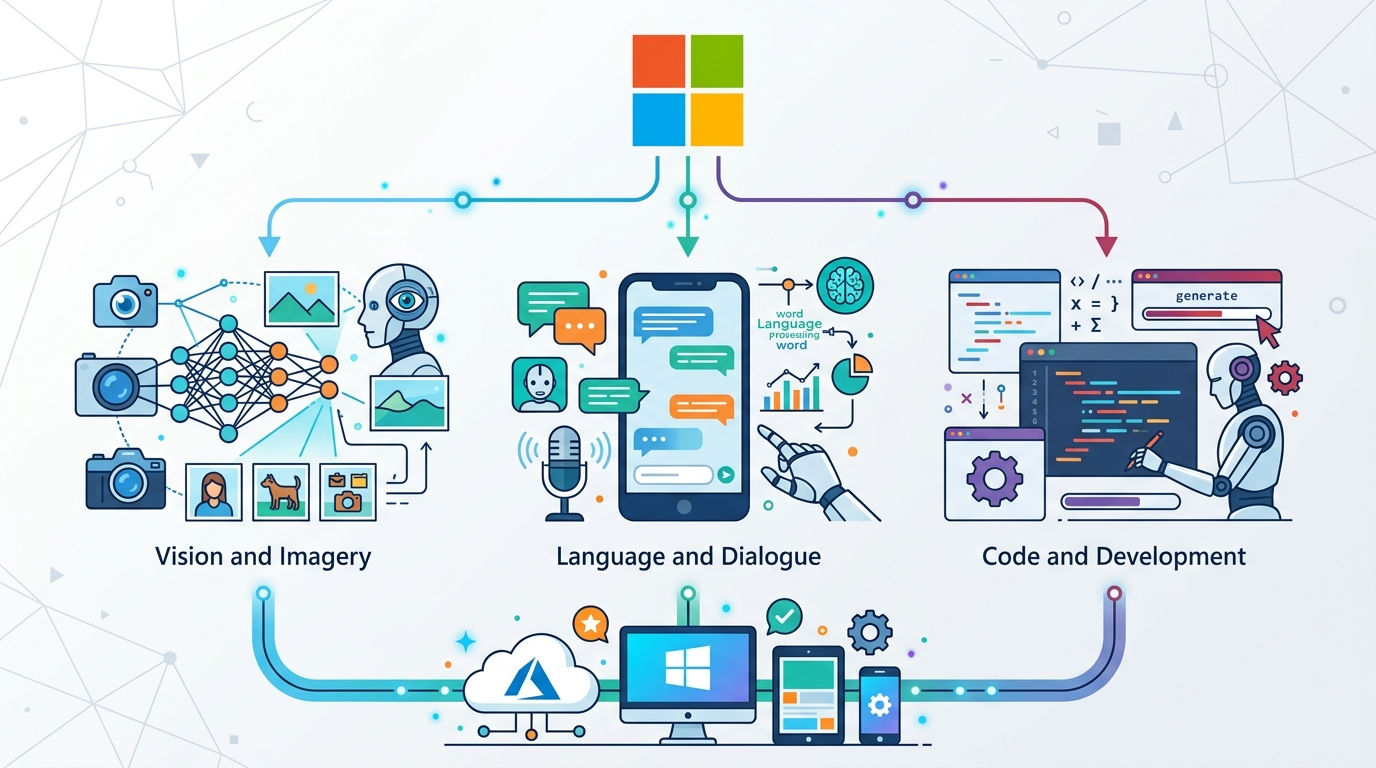
Here is the practical comparison from Microsoft’s own release:
- MAI-Transcribe-1: $0.36 per hour, 25 languages, 2.5x faster than Azure Fast
- MAI-Voice-1: $22 per 1 million characters, 60 seconds of audio in 1 second
- MAI-Image-2: $5 per 1 million text-input tokens, $33 per 1 million image-output tokens
Those numbers suggest Microsoft is aiming at real workloads like call-center transcription, voice generation for assistants, and media creation for apps. If a team can shave inference costs while keeping quality acceptable, that is far more persuasive than a flashy demo.
There is also a platform angle here. By putting the models in Foundry, Microsoft gives enterprises a path from test to deployment without rebuilding their entire AI pipeline. That is a familiar Microsoft move: make the default path the easiest one to buy, test, and ship.
What this means for developers and buyers
For developers, the release gives another set of APIs to evaluate, especially if they already live inside Azure. For buyers, it creates a new negotiation point. If Microsoft can offer lower-cost text, voice, or image generation inside the same cloud account, procurement teams get more room to push vendors against each other.
It also changes how Microsoft talks about its own AI future. The company is no longer just packaging other models into its products. It is now trying to own more of the model layer itself, while still keeping OpenAI close enough to matter. That is a very Microsoft way to play the market: partner when it helps, build when it pays.
If you want a broader view of where this kind of strategy leads, see our related coverage of AI model pricing in enterprise cloud and Microsoft Foundry for developers.
The real question now is whether these models become the default choice for production workloads or stay as cheaper options for narrow tasks. My bet: transcription and voice will get adopted first, because the economics are already visible, and because enterprise teams love a model that makes a spreadsheet look better.
Microsoft has spent billions on OpenAI, but this launch shows it wants a second path that it controls more directly. If MAI models keep getting cheaper and faster, the next fight will not be about who has the largest demo. It will be about which vendor can make AI feel boring in the best possible way: predictable, affordable, and easy to deploy.
// Related Articles
- [MODEL]
GPT-5.6 turns OpenAI into a model menu
- [MODEL]
Seedream 5.0 Pro Is the Right Choice for Editable AI Images
- [MODEL]
Midjourney v8.2 release is close
- [MODEL]
Rust KRAID enters Mesa for Arm Mali GPUs
- [MODEL]
OpenAI Opens GPT-5.6 and Launches Live Voice AI
- [MODEL]
Mistral is right to push Leanstral into proof engineering