MiMo V2 Pro vs Omni vs Flash in 2026
MiMo V2 Flash leads open-source coding benchmarks, Pro adds 1M context, and Omni handles images, audio, and video for agents.
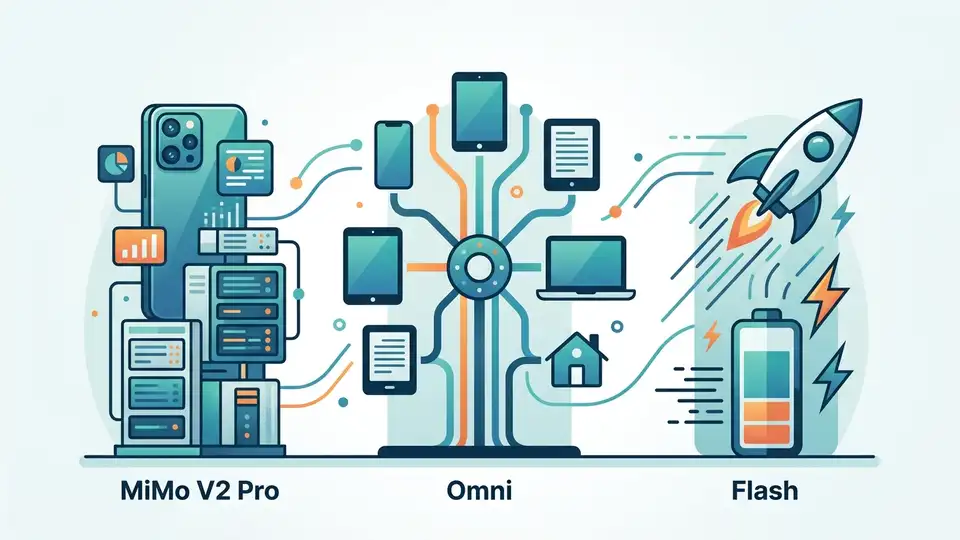
MiMo’s 2026 lineup is unusual for one simple reason: it splits into three models with very different jobs. MiMo V2 Flash launched on December 16, 2025, while Xiaomi unveiled MiMo V2 Pro and MiMo V2 Omni on March 18, 2026. If you are choosing one model for a product, the real question is not which one is strongest on paper, but which one fits your workload without wasting money or context.
That matters because the three models are built for different tradeoffs. Flash is the open-source efficiency pick, Pro is the long-context reasoning model, and Omni is the multimodal agent model that can process text, images, video, and audio in one system. In practice, that means one model can be the right answer for coding copilots, another for deep workflow automation, and another for interfaces that need to see and hear the world.
What Xiaomi actually changed with MiMo V2
Get the latest AI news in your inbox
Weekly picks of model releases, tools, and deep dives — no spam, unsubscribe anytime.
No spam. Unsubscribe at any time.
Xiaomi did what many model vendors still avoid: it separated one family into specialized products instead of forcing a single general model to do everything. That makes the MiMo V2 lineup easier to reason about if you build software, because each model has a clearer economic and technical role.
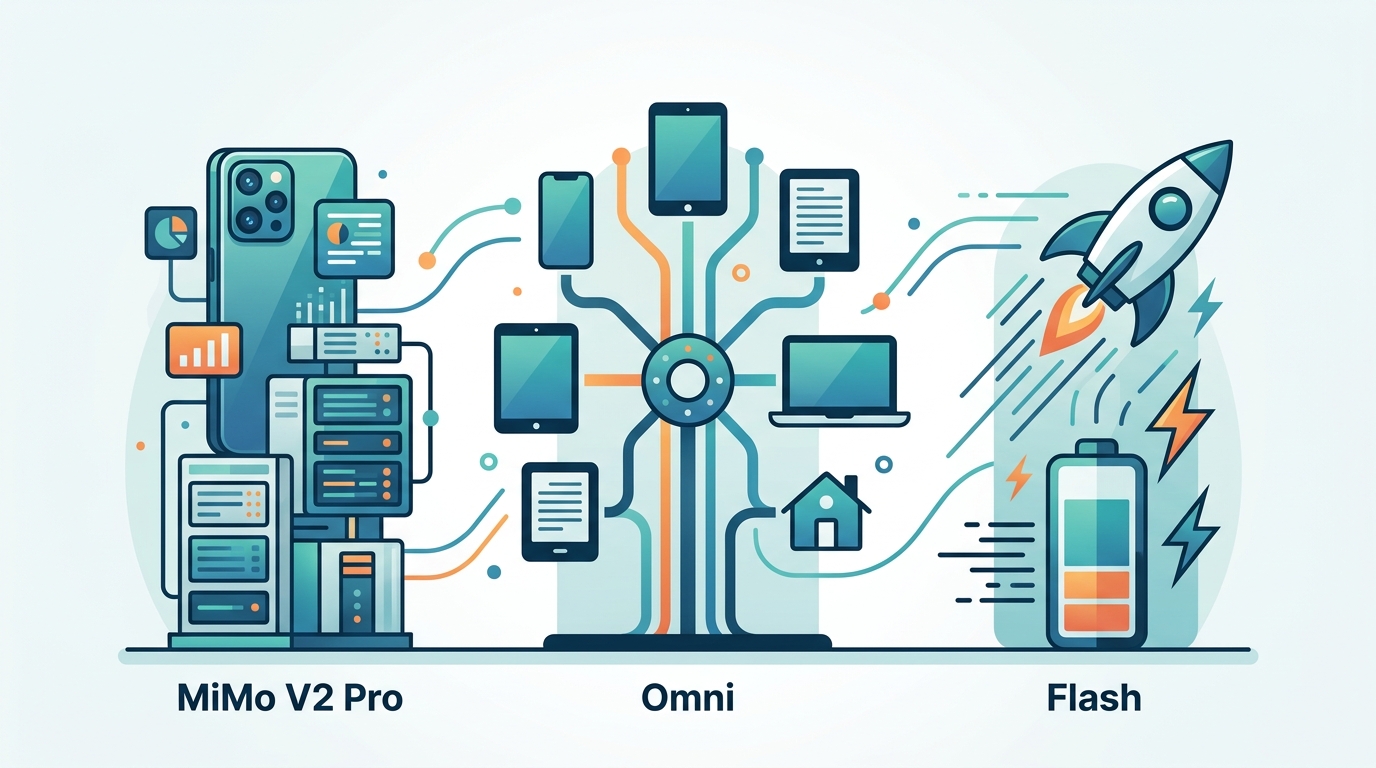
The architecture behind the family is Mixture-of-Experts, or MoE. In simple terms, the model may have a very large total parameter count, but only a smaller subset is active for each token. That helps Xiaomi push capacity up without making every request pay the full compute bill.
MiMo V2 also leans hard into tool use and agent workflows. That is a practical signal, not marketing fluff. The company is clearly aiming at applications where the model reads a prompt, calls tools, checks state, and keeps going instead of producing a single answer and stopping.
- Flash: 309B total parameters, 15B active, 256K context, open-source
- Pro: about 1T total parameters, 42B active, 1M context, API-only
- Omni: multimodal model with text, image, video, and audio support
- Flash pricing: about $0.09 input and $0.29 output per 1M tokens
- Pro pricing: tiered at $1/$3 up to 256K, then $2/$6 above that
- Omni pricing: about $0.40 input and $2 output per 1M tokens
Flash is the value pick, and the benchmarks back that up
If your work is mostly text, code, or agent loops, MiMo V2 Flash is the most interesting model in the trio. Xiaomi positions it as a fast, affordable MoE model for reasoning and coding, and the benchmark numbers explain why developers keep circling back to it.
The headline stat is SWE-bench Verified. Flash scores 73.4% there, which puts it at the top of open-source models in the article’s comparison. It also scores 71.7% on SWE-bench Multilingual, which is useful if your codebase or agent tasks are not all in English. On AIME 2025, Flash reaches 94.1%, showing that small active parameter counts do not automatically mean weak reasoning.
The cost story is even louder than the benchmark story. The source article says Flash costs about 3.5% as much as Claude Sonnet 4.5, and the listed API price is roughly $0.09 input and $0.29 output per 1M tokens. That is the kind of pricing that makes batch jobs, internal tools, and high-volume copilots much easier to justify.
“The fastest way to kill a good idea is to make it too expensive to test.” — Sam Altman, OpenAI DevDay 2023
That quote fits Flash well. If you want to try a coding agent, run a support automation pilot, or compare prompt strategies across thousands of requests, Flash gives you room to experiment without blowing up the bill. It is also the only model in the family that is openly available on Hugging Face, which matters if you care about inspection, local testing, or self-hosting options.
Pro is the model for long jobs and messy tool chains
MiMo V2 Pro is the one you pick when the task is less about speed and more about staying accurate across a long chain of steps. Xiaomi says it has more than 1 trillion total parameters, 42 billion active parameters, and a 1 million token context window. That context number is the real story here, because it changes what the model can keep in working memory.

For developers, that means Pro can hold a large codebase, a pile of documents, and a long tool history in a single session much better than a 256K model can. The article also notes improved tool-call stability and accuracy, which is the sort of detail that matters when a model is expected to operate inside production workflows instead of a demo script.
On the numbers, Pro is the strongest of the three on general reasoning and agentic control. The comparison puts its Artificial Analysis Intelligence Index at 49, versus about 39 to 41 for Flash. It also posts a ClawEval score around 61.5, while Flash lands in the 48.1 to 62.1 range depending on the variant and task setup.
- Pro context: 1M tokens, which is ideal for large codebases and long task histories
- Pro SWE-bench Verified: 78.0%, ahead of Flash’s 73.4%
- Pro ClawEval: about 61.5 to 81.0 depending on the benchmark slice
- Pro hallucination rate: about 30%, lower than Flash’s roughly 48%
- Pro price: about $1/$3 up to 256K, then $2/$6 above that
- Pro is API-only, so it fits product teams rather than open model tinkerers
If you are building a coding assistant for enterprise teams, a long-running browser agent, or a multi-step workflow system that cannot afford frequent resets, Pro is probably the safest choice in the family. It costs more than Flash, but the article makes a strong case that it can reduce retries, tool failures, and manual cleanup.
Omni is the one to watch for multimodal products
MiMo V2 Omni is Xiaomi’s answer to multimodal agents. It takes text, images, video, and audio, then pushes them through a shared model stack so the system can reason across formats instead of treating each one as a separate add-on.
That design matters if your product touches screenshots, dashboards, camera input, voice notes, browser state, or video clips. The article says Omni handles continuous audio longer than 10 hours and performs strongly on browser and mobile workflows. It also claims competitive results against models like Gemini 3 Pro and Claude Opus 4.6 on selected audio and image tasks.
Omni’s pricing is also easier to stomach than many frontier multimodal APIs. The article lists about $0.40 input and $2 output per 1M tokens, which is far below what many teams associate with premium multimodal use. If your app needs perception plus action, that pricing can change the build-versus-buy calculation.
- Omni is the only model in the family built for text, image, video, and audio together
- Omni is priced at about $0.40 input and $2 output per 1M tokens
- Omni is tuned for UI grounding and structured tool calling
- Omni performs well on audio tasks, including long-form audio beyond 10 hours
- Omni is the best fit for browser agents, mobile agents, and visual assistants
Here is the cleanest way to think about it: if Flash is a high-throughput worker and Pro is a long-memory analyst, Omni is the model that can actually see what the user sees. That difference matters a lot more than raw benchmark bragging rights once you start shipping products.
So which MiMo model should you pick in 2026?
Pick Flash if your workload is text-heavy, cost-sensitive, and high-volume. It is the best fit for coding copilots, batch agents, internal automation, and experiments where open weights matter.
Pick Pro if you need long-horizon reasoning, a 1M-token context window, and stronger tool stability. This is the model for serious agent systems that have to keep state over long sessions and produce fewer bad steps.
Pick Omni if your product needs vision, audio, video, and text in one loop. That is the model for assistants that inspect screens, understand media, and act on what they perceive.
If you want a blunt recommendation, start with Flash unless you know you need multimodal input or ultra-long context. Then move to Pro when the workflow gets messy, and move to Omni when the product needs to see and hear. For teams using CometAPI, the practical next step is a side-by-side eval on your own prompts, because the cheapest model is only the best model when it finishes the job correctly.
My prediction: in 2026, teams will stop asking which model is “best” and start asking which one is cheapest for a specific task class. MiMo’s split lineup is built for that exact question, and the answer will usually be Flash for scale, Pro for depth, or Omni for perception. The smartest move now is to benchmark all three on your own data before you lock in a production stack.
// Related Articles
- [MODEL]
GPT-5.6 turns OpenAI into a model menu
- [MODEL]
Seedream 5.0 Pro Is the Right Choice for Editable AI Images
- [MODEL]
Midjourney v8.2 release is close
- [MODEL]
Rust KRAID enters Mesa for Arm Mali GPUs
- [MODEL]
OpenAI Opens GPT-5.6 and Launches Live Voice AI
- [MODEL]
Mistral is right to push Leanstral into proof engineering