Open Source LLMs in 2026: Who Leads?
Qwen 3.5, GLM-5, DeepSeek R1, and Llama 4 now push open models into serious production territory, with licensing still deciding deployments.

In March 2026, ComputingForGeeks compiled a comparison that says a lot about where open large language models are headed: Qwen 3.5 ships with a 256K context window, DeepSeek R1 hits 97.3% on MATH-500, and GLM-5 posts 77.8% on SWE-bench Verified. That last number matters because it is the strongest coding benchmark result in the table.
The headline is simple: open-weight models are no longer just cheaper alternatives for hobby projects. They now compete on reasoning, coding, context length, and deployment control, while license terms decide who can actually ship them in production.
The 2026 open model race is crowded
Get the latest AI news in your inbox
Weekly picks of model releases, tools, and deep dives — no spam, unsubscribe anytime.
No spam. Unsubscribe at any time.
The table pulls together the major families that matter right now: Qwen 3 and 3.5, GLM-5, DeepSeek V3.2 and R1, Llama 4, Gemma 3, Mistral Large 3, Phi-4, Command A, Falcon 3, DBRX, and Grok-1. That is already a lot of surface area, and the differences are not cosmetic.

Alibaba’s Qwen line is the most flexible on paper. The flagship Qwen 3.5 397B-A17B uses only 17B active parameters per token, which is a big deal if you care about inference cost. DeepSeek R1 takes a different route, using a 671B MoE design with 37B active parameters and a strong reasoning focus. Meta’s Llama 4 pushes context length hard, with Scout at 10M tokens and Maverick at 1M tokens.
The practical takeaway is that model choice now depends on what you are building, not just on who tops a leaderboard. A coding assistant, a research tool, and a long-context document system will not value the same tradeoffs.
- Qwen 3.5: 256K context, text + image, Apache 2.0
- GLM-5: 205K context, text + image, MIT
- DeepSeek V3.2: 128K context, MIT
- Llama 4 Maverick: 1M context, Llama 4 Community license
- Mistral Small 4: 256K context, Apache 2.0
Benchmarks tell a clearer story than marketing
Benchmarks still do the heavy lifting here. The table uses MMLU, MMLU-Pro, GPQA Diamond, AIME ’24, MATH-500, and SWE-bench Verified, which gives a decent spread across general knowledge, harder reasoning, math, and coding.
Two numbers jump out immediately. Qwen 3 235B leads on GPQA Diamond at 77.2% and AIME ’24 at 85.7%, which makes it the strongest open-weight model for reasoning and math in this set. DeepSeek R1 dominates MATH-500 at 97.3%, which is near-perfect for that benchmark. Then GLM-5 lands at 77.8% on SWE-bench Verified, the best coding score listed.
“We are seeing open models catch up fast in both quality and efficiency.” — Satya Nadella, Microsoft Build 2024 keynote
That quote aged well. It fits this table because the gap is no longer about whether open models can perform; it is about which model performs best for a specific job and under what license.
One more detail matters: Llama 4 Maverick posts the highest raw MMLU score in the table at 85.5%, but MMLU alone does not capture deep reasoning or coding skill. If you only chase one benchmark, you will probably pick the wrong model.
- Qwen 3 235B: 83.6% MMLU-Pro, 77.2% GPQA Diamond, 85.7% AIME ’24
- DeepSeek R1: 84.0% MMLU-Pro, 71.5% GPQA Diamond, 97.3% MATH-500
- GLM-5: 77.8% SWE-bench Verified
- Llama 4 Maverick: 85.5% MMLU
- Gemma 3 27B: 78.6% MMLU, 50.0% MATH-500
Licenses decide what you can ship
This is where the article gets practical. The best model on paper may be the wrong model for a startup, a regulated enterprise, or a product that expects to scale past a few hundred million users.
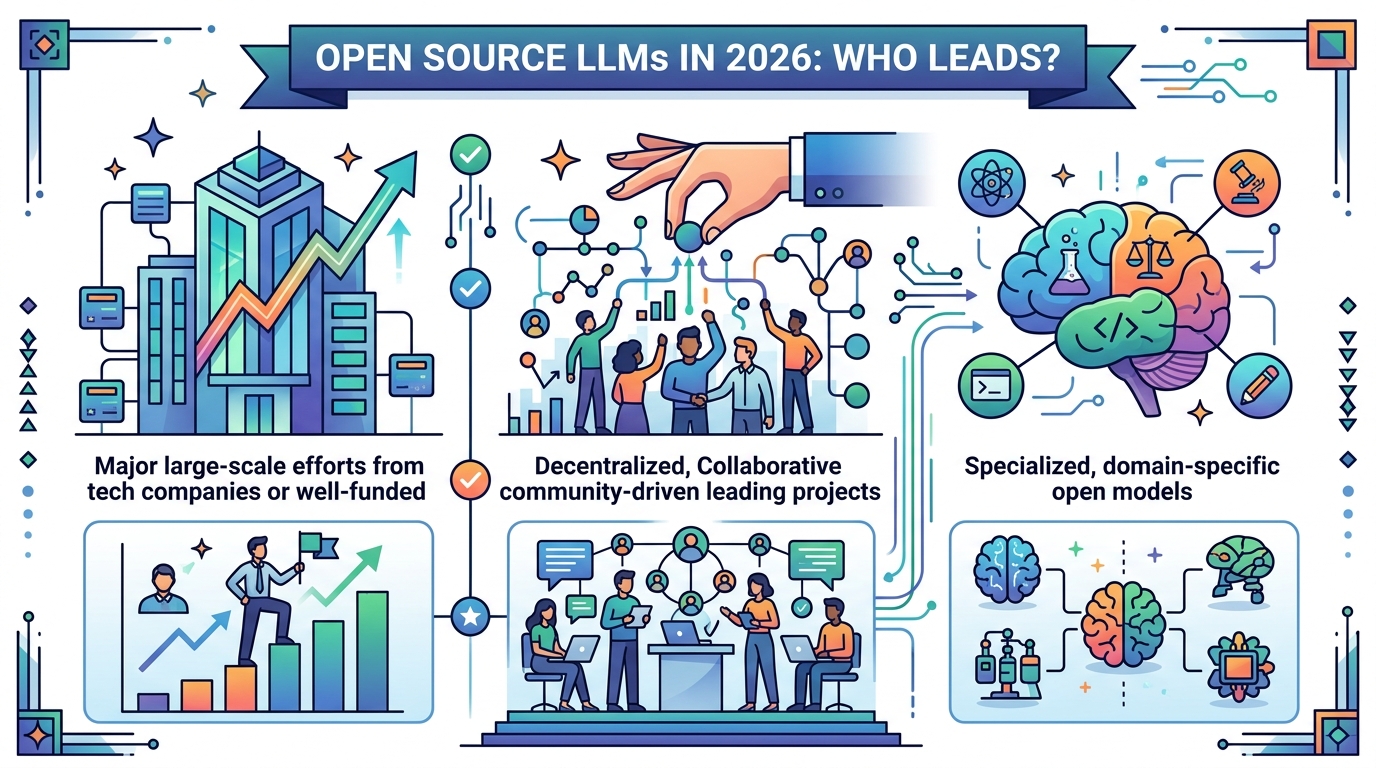
Qwen, DeepSeek, GLM-5, and Mistral now give developers some of the cleanest paths to commercial use. Apache 2.0 and MIT are the licenses most teams want to see when they plan to fine-tune, self-host, and sell a product without extra legal drama.
The picture changes with Meta’s Llama family and Google’s Gemma. Llama 4 and Llama 3.3 are free under a 700M monthly active users threshold, but large deployments need to pay attention to Meta’s terms. Gemma permits commercial use after accepting Google’s terms. Cohere’s Command models are non-commercial under CC-BY-NC. TII’s Falcon 3 adds a revenue-based royalty clause above $1M.
That means the “best” model is often the one your legal team can sign off on quickly.
- Apache 2.0: Qwen 3/3.5, Mistral Large 3, Mistral Small 4, Mixtral 8x7B, Grok-1
- MIT: DeepSeek V3/R1/V3.2, Phi-4 variants, GLM-5
- Llama 4 Community: free under 700M MAU, then Meta terms apply
- CC-BY-NC: Command R+ and Command A, no commercial deployment without separate terms
- Databricks Open Model: DBRX cannot be used to train other LLMs
Self-hosting changes the ranking in real life
Benchmarks are one thing. Running the model on your own machine is another. The article’s Ollama tests used Ubuntu 24.04 LTS, 4 vCPUs, 16 GB RAM, and CPU-only inference, which is a pretty honest baseline for people who want local deployment without a GPU farm.
The results are revealing. Ollama ran Gemma 3 4B using just 4.2 GB of RAM, making it the most memory-friendly option in the test. Llama 3.2 3B was the fastest at 88 seconds, but it used 11.4 GB of RAM. DeepSeek R1 8B and Qwen 3 8B both took 433 seconds because reasoning-heavy models generate more intermediate tokens before answering.
That CPU test is a reminder that “small” does not always mean “fast,” and “smart” often costs time. For local use, memory footprint and response latency matter as much as benchmark scores.
- Gemma 3 4B: 4.2 GB RAM, 94s response time
- Llama 3.2 3B: 11.4 GB RAM, 88s response time
- Phi-4 Mini 3.8B: 8.9 GB RAM, 97s response time
- Mistral 7B: 7.4 GB RAM, 125s response time
- Qwen 3 8B and DeepSeek R1 8B: 433s each on CPU
What I would pick today
If I were shipping a product this quarter, I would start with Qwen 3.5 for general-purpose work, DeepSeek R1 for reasoning-heavy tasks, and GLM-5 for coding workloads where SWE-bench matters more than brand familiarity. That is the short version.
The longer version is that open model selection in 2026 is less about “which model is best” and more about “which model fits the job, the hardware, and the license.” Teams with strict compliance needs will keep preferring Apache 2.0 or MIT. Teams that need long context will keep watching Llama 4, Qwen 3.5, and Mistral Large 3. Teams that care about coding should look hard at GLM-5 and then verify it on their own repos.
The next question is not whether open models can compete with closed ones. It is whether your stack is ready to swap models quickly when a better one appears next month. If your answer is no, that is the real bottleneck.
For a practical next step, compare these models against your own prompts, your own latency targets, and your own license constraints before you commit. That will tell you more than any leaderboard ever will.
// Related Articles
- [MODEL]
GPT-5.6 turns OpenAI into a model menu
- [MODEL]
Seedream 5.0 Pro Is the Right Choice for Editable AI Images
- [MODEL]
Midjourney v8.2 release is close
- [MODEL]
Rust KRAID enters Mesa for Arm Mali GPUs
- [MODEL]
OpenAI Opens GPT-5.6 and Launches Live Voice AI
- [MODEL]
Mistral is right to push Leanstral into proof engineering