OpenAI shuts down Sora video app and API
OpenAI is ending Sora’s app and API after recent updates, leaving video creators with an abrupt cutoff and no clear explanation.
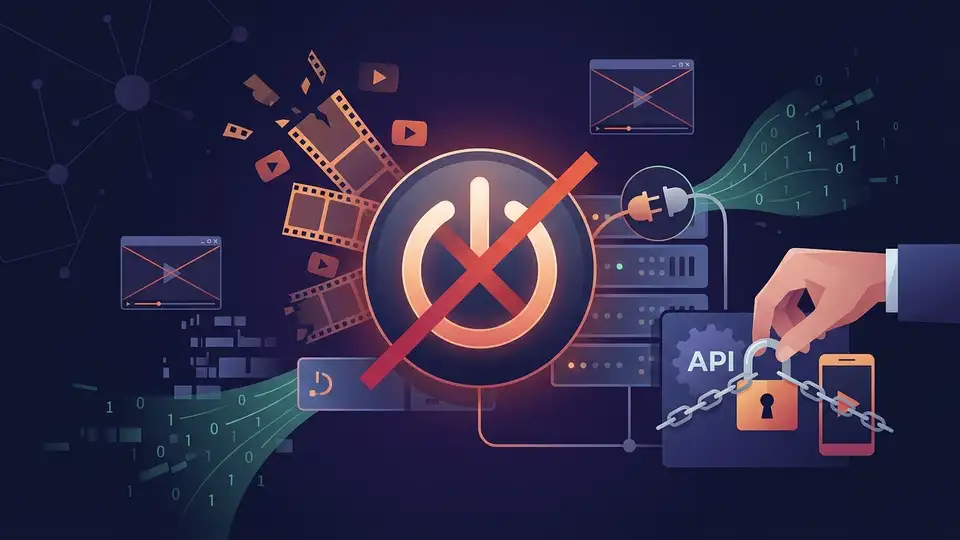
OpenAI has shut down Sora, its AI video generation app and API, after what looked like an active rollout week. The timing is what makes this weird: the product was still getting updates earlier this week, then the shutdown notice landed with no clear public explanation.
For developers and creators, this is more than a product note. It is a reminder that even high-profile AI tools can disappear fast, especially when the company behind them decides the product, policy, or infrastructure story is not ready for public use.
What OpenAI actually shut down
Get the latest AI news in your inbox
Weekly picks of model releases, tools, and deep dives — no spam, unsubscribe anytime.
No spam. Unsubscribe at any time.
According to the report from VentureBeat, OpenAI is ending both the consumer-facing Sora app and the API access tied to it. That means the shutdown hits two different groups at once: people experimenting with video generation in the app, and developers who were building workflows around the API.
The lack of detail matters here. OpenAI did not pair the shutdown with a public technical postmortem, a policy update, or a product roadmap explaining what comes next. That leaves users guessing whether this is a temporary pause, a restructuring, or a full retreat from the current Sora setup.
- Sora was still receiving updates earlier in the same week, which makes the shutdown feel abrupt.
- Both the app and the API are affected, so this is not a partial feature cut.
- OpenAI has not publicly explained the reason in the material reported so far.
That combination is unusual for a company of OpenAI’s size. Big AI products often get sunsetted quietly in enterprise settings, but consumer-facing tools tied to a brand-new model family usually get at least a short transition period. Here, users seem to have gotten speed without much warning.
Why the timing matters for AI video
AI video is one of the hardest product categories in generative AI. Models can produce impressive clips, but they also bring expensive compute costs, moderation problems, and a lot of uncertainty around rights, consent, and misuse. A video tool that looks polished in demos can become difficult to run at scale once real users start pushing it in every direction.
That makes Sora’s shutdown more than a single-product story. It hints at the gap between a model demo and a dependable product. Text models can tolerate a lot of rough edges. Video tools usually cannot, because the output is heavier, slower, and more likely to trigger policy questions.
OpenAI has been under pressure to make its products feel dependable to both developers and enterprise customers. Pulling the plug on Sora, even temporarily, suggests the company may have decided that the current version created more operational or policy risk than value.
- Video generation requires far more compute than text generation, which raises operating cost quickly.
- Moderation is harder because every frame can contain a policy issue.
- Creators expect consistency, and video workflows break fast when availability changes.
What this says about OpenAI’s product strategy
OpenAI has a habit of moving quickly, then tightening up later. That works when the company is shipping a research preview or a limited beta. It gets trickier when people start depending on the tool for client work, production pipelines, or app development.
The Sora shutdown also lands in the middle of a broader industry debate about how much access companies should give to powerful generative tools before they are stable. OpenAI has already shown with ChatGPT that it can turn a research product into a mass-market service. Sora may have hit the point where the company decided the current version was not ready for that same treatment.
“With great power comes great responsibility.” — Stan Lee, through Uncle Ben in Spider-Man
That quote gets repeated so often it can sound like a cliché, but it fits this moment. The more capable the model, the more pressure there is to control misuse, manage cost, and avoid shipping something that looks ready before the company can support it properly.
OpenAI has also been building a broader platform around model access, including developer tooling and multimodal products. If Sora was creating friction inside that stack, shutting it down may have been an internal cleanup move rather than a public failure. The problem is that users rarely experience it that way.
How this compares with other AI product rollbacks
OpenAI is not the only company to pull back a product after a visible launch. Google, Meta, and smaller startups have all adjusted access when costs, policy, or product quality became harder to manage than expected. The difference here is scale and visibility.
Sora was one of the most talked-about AI video efforts in the market, so any shutdown gets attention fast. The numbers behind these products also make the tradeoffs obvious. A text response might cost pennies or less to generate at scale, while video generation can consume far more GPU time per request, especially when users want longer clips, higher resolution, or repeated retries.
- Text models can answer in seconds with relatively small compute load.
- Video models often need much larger inference budgets per output.
- Moderation and abuse review are harder because the content is visual, temporal, and more varied.
- Developer trust drops quickly when an API disappears without a transition plan.
That last point may matter most for the people building on top of Sora. If a model API can vanish with little warning, teams will think harder before wiring it into customer-facing products. They may wait for stronger service commitments, clearer pricing, and better disclosure around access limits.
What developers should watch next
The real question is whether Sora returns in a different form or whether OpenAI is reworking the product behind the scenes. If it comes back, expect a narrower launch, tighter access rules, and a clearer explanation of who can use it and why. If it does not, this shutdown may become a cautionary example for AI teams shipping ambitious multimodal products too quickly.
For developers, the takeaway is simple: treat AI model access like a dependency with a failure plan. If your workflow depends on a hosted model, assume pricing can change, endpoints can disappear, and product direction can shift without much notice. That is especially true in video, where the technical and policy burdens are heavier than in chat or image generation.
My bet is that OpenAI will not leave the Sora story hanging forever. Either the product comes back in a narrower, more controlled release, or the company folds its video work into a different interface and stops treating this version as a standalone app. If you are building around AI video today, the smart move is to keep a backup provider ready instead of betting everything on one API.
For more coverage of AI product shifts, see our related report on OpenAI’s platform changes and our analysis of AI video tools in creator workflows.
// Related Articles
- [MODEL]
GPT-5.6 turns OpenAI into a model menu
- [MODEL]
Seedream 5.0 Pro Is the Right Choice for Editable AI Images
- [MODEL]
Midjourney v8.2 release is close
- [MODEL]
Rust KRAID enters Mesa for Arm Mali GPUs
- [MODEL]
OpenAI Opens GPT-5.6 and Launches Live Voice AI
- [MODEL]
Mistral is right to push Leanstral into proof engineering