Tokenized RWAs Hit $33.78B as Treasuries Lead
Tokenized real-world assets reached $33.78 billion, led by U.S. Treasuries and cash products that are pulling finance onto blockchains.
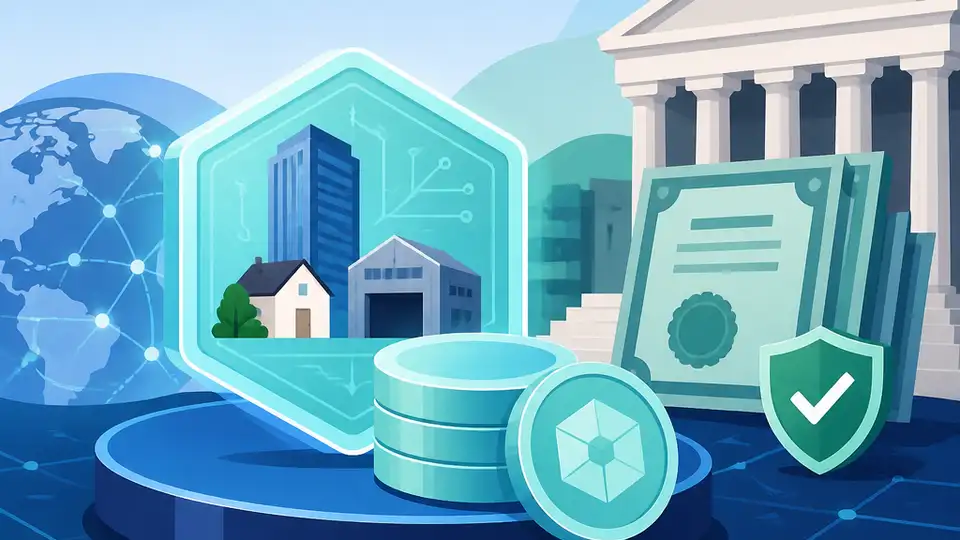
Tokenized real-world assets reached $33.78 billion, led by U.S. Treasuries and cash products.
Tokenized real-world assets have crossed a big psychological line: the market is now about $33.78 billion, up from under $1 billion just 18 months ago. That kind of jump does not happen because of hype alone; it happens when institutions find a product that is easier to hold, move, and settle than the old version.
The story here is straightforward. Ondo Finance, Franklin Templeton, MakerDAO, and Maple Finance are pushing tokenized funds, credit, and cash-like products into a market that used to feel experimental. The result is a cleaner bridge between traditional assets and blockchain rails.
| Metric | Figure | Why it matters |
|---|---|---|
| Tokenized RWA market size | $33.78 billion | Shows the category has moved beyond pilot scale |
| Starting point | Under $1 billion | Highlights the speed of growth over roughly 18 months |
| On-chain perpetual futures volume in Q1 2024 | Over $500 billion | Signals deep trading demand in crypto markets |
| Global fixed-income market | Over $100 trillion | Shows how small tokenized RWAs still are relative to traditional finance |
Why Treasuries are driving the market
Get the latest AI news in your inbox
Weekly picks of model releases, tools, and deep dives — no spam, unsubscribe anytime.
No spam. Unsubscribe at any time.
The biggest reason tokenized RWAs are growing so fast is boring in the best way possible: U.S. Treasuries and cash equivalents. Investors want yield without taking on wild price swings, and tokenized government debt gives them a way to hold that exposure on-chain.

That matters because the old process is slow. Brokerage accounts, custodians, settlement delays, and banking hours all add friction. Tokenized bonds can settle faster, trade around the clock, and cut out layers that usually make simple fixed-income products feel cumbersome.
This is also why the category is drawing attention outside crypto-native circles. When the product is a Treasury bill or a money market-like instrument, the pitch is easier to understand than a speculative token with no cash flow.
- Faster settlement than many traditional fund workflows
- Lower transaction overhead in some market structures
- 24/7 availability instead of market-hour restrictions
- Direct blockchain transferability for some products
Institutions are testing the rails
Big finance is not waiting on the sidelines. BlackRock has already moved into tokenized products, while JPMorgan Onyx has spent years experimenting with blockchain settlement and asset tokenization. That matters because institutional adoption usually changes a market faster than retail enthusiasm does.
BlackRock managing tokenization experiments sends a different message than a small crypto startup doing the same thing. It says the infrastructure is mature enough to be worth serious operational attention, even if the economics are still being tested.
“Tokenization is the next generation for markets,” Larry Fink said in his annual letter to investors.
That quote from Larry Fink is important because it comes from the CEO of the world’s largest asset manager, not a crypto promoter. When a firm that size talks about tokenization in public, compliance teams, product teams, and trading desks all start paying attention.
There is also a practical reason institutions care. Tokenized assets can simplify transfer, improve transparency, and reduce the number of intermediaries involved in a trade. None of that removes risk, but it does make the operating model easier to modernize.
How tokenized RWAs compare with the old system
The comparison with traditional finance is where the scale of the opportunity becomes obvious. Global fixed-income markets are worth more than $100 trillion, while tokenized RWAs are still at $33.78 billion. The gap is enormous, which is why even a small share of that market would matter.

On the trading side, on-chain perpetual futures posted more than $500 billion in Q1 2024 volume. That number does not prove RWAs will explode, but it does show that blockchain-based markets can support serious activity and real liquidity.
Here is the basic comparison that investors should keep in mind:
- Traditional fixed income: huge scale, slower workflows, more intermediaries
- Tokenized RWAs: smaller today, faster settlement, simpler transfer mechanics
- On-chain perpetuals: proof that crypto markets can handle large trading volumes
- Institutional pilots: evidence that tokenization is moving into real product design
The catch is that tokenization does not magically remove the hard parts of finance. Smart contract bugs, oracle issues, custody questions, and jurisdiction-specific securities rules still matter. A token is only as useful as the legal claim and operational plumbing behind it.
What this means for investors and builders
For retail investors, tokenized RWAs are interesting because they may open access to products that were previously awkward or unavailable on-chain. For builders, the challenge is harder: they need to combine compliance, liquidity, and user experience in a way that does not feel like a compromise.
The market is also getting more crowded. Traditional firms want a piece of the flow, while crypto-native protocols are trying to prove they can handle real assets, not just synthetic trading products. That competition will likely reward teams that can offer strong compliance, deep liquidity, and clear legal structures.
Injective is one example of a blockchain project positioning itself around financial applications and tokenized assets. It is trying to build infrastructure for markets rather than for general-purpose consumer apps, which is where a lot of the current momentum sits.
The next number to watch is not just market cap. It is the share of institutional volume, because that will tell us whether tokenized RWAs are becoming a real distribution channel for finance or staying a niche product for crypto-curious investors.
If tokenized Treasuries keep growing at this pace, the real question is how quickly compliance-heavy products like private credit and fund shares follow. That is the point where tokenization stops being a side story and starts changing how capital markets are packaged and sold.
// Related Articles
- [CHAIN]
x402 and agent wallets are moving crypto agents on-chain
- [CHAIN]
7 Solana APIs that cut weeks off integration
- [CHAIN]
Solana Unchained token sale nears Phase 1 close at $0.05
- [CHAIN]
June 2026 Web3 Signals Founders Should Use Now
- [CHAIN]
Bitcoin DeFi will grow, but not by copying Ethereum
- [CHAIN]
AI-blockchain projects need real utility, not token theater