Why Claude’s release timeline proves Anthropic is winning the platfor…
Anthropic’s Claude timeline shows a platform strategy built on capability, not just model launches.

Anthropic’s Claude timeline shows a platform strategy built on capability, not just model launches.
Anthropic’s Claude release history is not a random sequence of model drops; it is a deliberate platform strategy that has turned capability upgrades, distribution, and developer trust into the real product.
First argument: Claude’s timeline shows relentless capability compounding, not cosmetic iteration
Get the latest AI news in your inbox
Weekly picks of model releases, tools, and deep dives — no spam, unsubscribe anytime.
No spam. Unsubscribe at any time.
The strongest fact in the timeline is how quickly Anthropic moved from a 9K context model to 100K tokens in May 2023, then to 200K with Claude 2.1, and later to a 1-million-token beta window in the 4.x line. That is not the pace of a team polishing a chatbot. It is the pace of a company treating context length, reasoning, and tool access as core infrastructure.

That same pattern appears in the feature stack. Vision arrived across all tiers with Claude 3. Tool use moved from beta to general availability. Computer Use showed up as a public beta in late 2024. Then extended thinking, memory, context compaction, and the effort parameter arrived as explicit controls developers can use to tune cost against capability. Each release adds a new control surface, which is exactly what a platform company does when it wants developers to build around it.
Second argument: Anthropic won by making Claude available where developers already work
Distribution matters as much as raw model quality, and Anthropic understood that early. Claude 2 reached Amazon Bedrock in preview in August 2023, Bedrock went GA with Claude as a launch model in September 2023, and Anthropic later expanded availability across the Anthropic API, Bedrock, Google Cloud Vertex AI, and Microsoft Foundry. That is a serious multi-cloud footprint, not a single-vendor walled garden.
The release timeline also shows that Anthropic did not wait for a perfect flagship before broadening access. Claude 3.5 Sonnet, Claude 4, Claude 4.1, Claude 4.5, and Claude 4.6 all landed with clear platform placement, while Claude Code moved from research preview to general availability. The result is obvious: developers can adopt Claude where procurement, security, and cloud commitments already exist. That is how a model family becomes a default choice in enterprise workflows.
The counter-argument
The best objection is that the timeline looks like feature churn. Minor revisions pile up fast, naming gets dense, and the family tree becomes hard to explain. A buyer does not want to memorize Claude 3.5 Sonnet new, Claude 3.7 Sonnet, Claude Sonnet 4, Sonnet 4.5, and Sonnet 4.6 just to know which model to call. In that reading, Anthropic is creating confusion, not clarity.
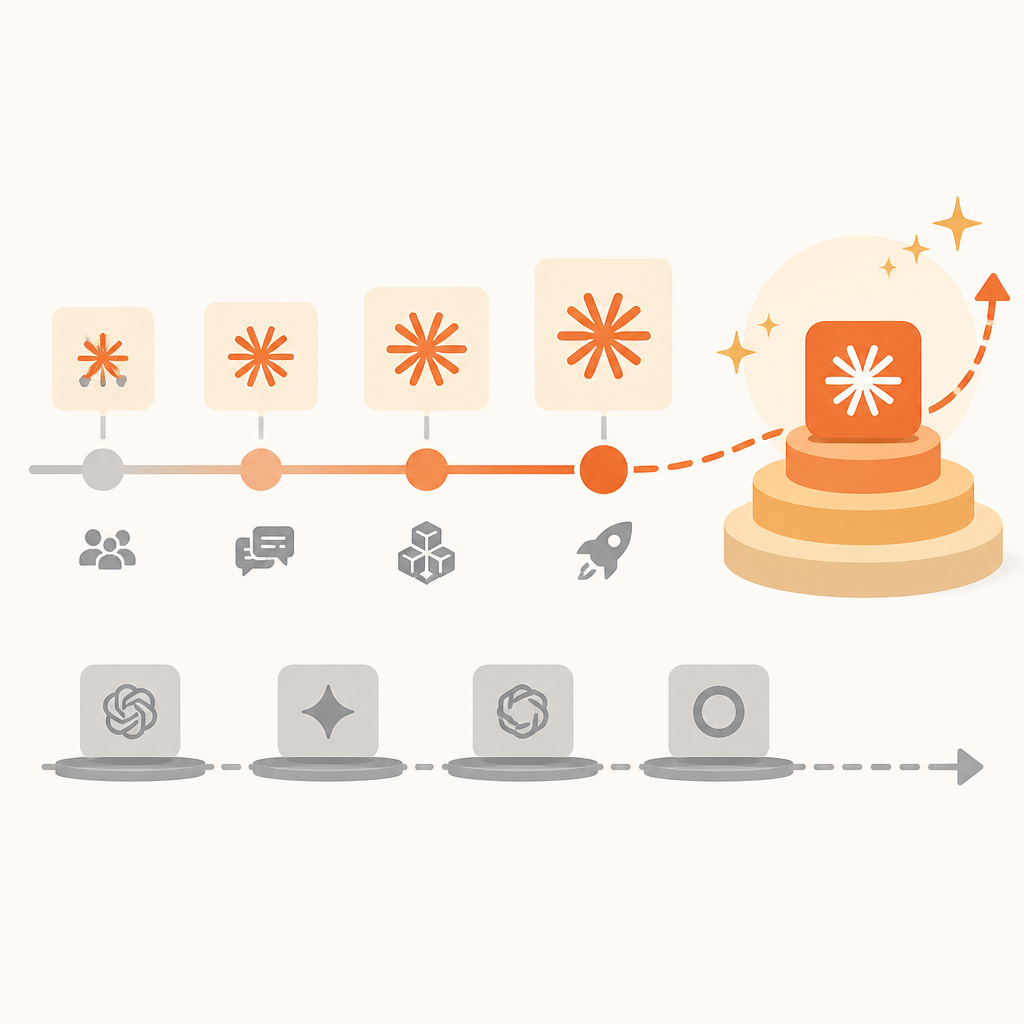
There is truth in that criticism. The naming is messy, and the release cadence is fast enough to punish teams that do not track deprecations closely. But the objection fails on substance because the product is not the name; the product is the operational advantage. When Sonnet 4.6 beats Opus 4.5 in early-access preference tests, and when Opus 4.5 adds effort control, memory, and compaction, the release train is proving that the family can absorb new capability without forcing a platform reset. The complexity is real, but it is the cost of a model line that keeps moving up the stack.
What to do with this
If you are an engineer, stop choosing Claude models by headline number alone and build a policy around task class, context size, latency, and tool needs. If you are a PM or founder, treat Anthropic’s release cadence as a signal that the winning layer is not “best chat model” but “best controllable runtime for agents and enterprise workflows.” Design for model swaps, track deprecations, and use the tiered family the way Anthropic intends: Haiku for speed, Sonnet for balance, Opus for the hardest jobs.
// Related Articles
- [MODEL]
Bree Hall Returns to Fever on Final Roster Spot
- [MODEL]
SiFive launches third-gen P550 and P570 cores
- [MODEL]
SOLAI starts selling Solode Neo for local AI agents
- [MODEL]
Why MiniMax M2.7’s Self-Evolution Claim Matters More Than Its Benchma…
- [MODEL]
MiniMax M2 opens up cheap agentic coding
- [MODEL]
Copilot Studio shifts to GPT-4.1 by default