BTC Ecosystem, AntPool, Bitmain Announce 2026 Push
BTC Ecosystem says it will work with AntPool and Bitmain on Bitcoin infrastructure, with a focus on efficiency, cooling, and Layer 2 support.

BTC Ecosystem says it will work with AntPool and Bitmain on Bitcoin infrastructure, with a focus on efficiency, cooling, and Layer 2 support.
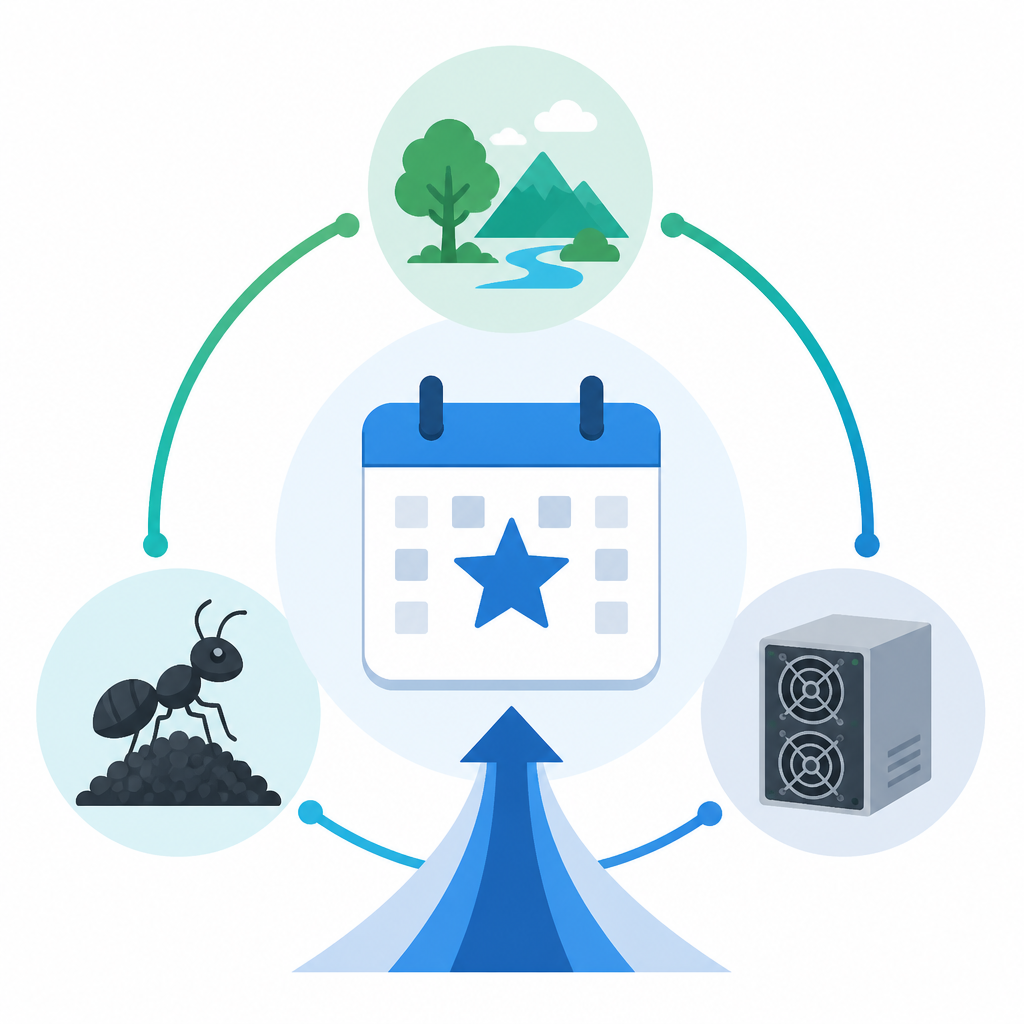
BTC Ecosystem announced a new initiative on May 22, 2026, tying together BTC Ecosystem, AntPool, and Bitmain. The pitch is simple: make Bitcoin infrastructure more efficient, more adaptable, and more useful for workloads beyond basic mining.
The release leans hard on hardware economics. It points to Bitmain’s Antminer S21 Pro line with an energy efficiency figure below 15 J/TH, says liquid cooling could improve heat dissipation by nearly 40%, and suggests future devices may include modules for Bitcoin Layer 2 zero-knowledge proof work.
| Metric | Claim in the release | Why it matters |
|---|---|---|
| Announcement date | May 22, 2026 | Sets the timing for the partnership push |
| Hardware efficiency | Less than 15 J/TH | Lower power per hash usually means better operating economics |
| Cooling gain | Nearly 40% | Suggests better thermal management for dense deployments |
| BTC Ecosystem launch | October 2022 | Shows the platform is still relatively young |
What this initiative is really about
Get the latest AI news in your inbox
Weekly picks of model releases, tools, and deep dives — no spam, unsubscribe anytime.
No spam. Unsubscribe at any time.
The announcement reads like a mix of infrastructure update and investor pitch. BTC Ecosystem says it wants to build around renewable-powered operations across Texas, Canada, and Australia, while the Bitmain and AntPool connection gives the plan hardware credibility and mining-adjacent distribution.

That combination matters because Bitcoin infrastructure is no longer judged only by hash rate. Operators now talk about power prices, cooling costs, uptime, firmware stability, and whether the same machines can do more than one job over their lifetime.
In plain English, the partnership is trying to turn mining gear into a broader compute platform. That is a big claim, and it will live or die on execution.
- Texas brings grid capacity and continuous power access.
- Canada adds hydroelectric energy for lower-carbon operations.
- Australia contributes solar and wind integration for longer-term expansion.
- Bitmain brings the hardware stack and a known mining brand.
- AntPool brings mining pool reach and operational experience.
The hardware claims deserve a closer look
The release spends a lot of time on efficiency because that is where the money is. A miner that runs below 15 J/TH can, in theory, produce more output per watt than older machines, and that matters when electricity is the biggest line item on the balance sheet.
Liquid cooling is the other headline. The company says standardized liquid-cooled cabinets could improve heat dissipation by nearly 40%. That is not a small tweak; it changes how densely equipment can be packed and how long chips can stay within safe operating temperatures.
“The core technology of this collaboration lies in the deep customization and optimization of Bitmain's most advanced hardware performance and ecosystem protocols.”
That quote comes from the press release itself, and it gives away the strategy. This is less about a single mining farm and more about building a hardware-plus-software stack around Bitcoin infrastructure.
There is also a more ambitious claim buried in the announcement: future Antminer devices may include a dedicated module for Bitcoin Layer 2 zero-knowledge proof computation. If that happens, mining hardware could start looking more like specialized infrastructure for adjacent blockchain services.
- Less than 15 J/TH is the efficiency target the release highlights.
- Nearly 40% better heat dissipation is the cooling claim.
- Layer 2 ZK support would widen the use case beyond block validation.
- Firmware upgrades are described as more stable after protocol adaptation.
Why investors are paying attention
The press release makes a clear bet on how capital markets will value Bitcoin infrastructure in 2026. It argues that holding Bitcoin is one thing, while owning the systems that support Bitcoin may expose investors to a wider set of revenue streams.
That idea is already visible in public markets. Companies like MARA Holdings and Riot Platforms have spent years proving that mining firms are judged on more than coin production. Power contracts, fleet efficiency, and expansion strategy now matter almost as much as bitcoin price.
BTC Ecosystem is trying to push that logic one step further. If its infrastructure can support mining, validation, and adjacent compute tasks, then the company can argue for a valuation model that looks closer to a platform business than a pure-play miner.
That is an attractive story, but it comes with a hard question: can a Bitcoin infrastructure operator really diversify usage without losing the simplicity that makes mining economics work?
The decentralization question is still open
Any time a press release talks about deep coordination among major industry players, decentralization comes up fast. Bitcoin’s culture is built around distributed control, yet the economics of mining keep pulling the industry toward scale, specialization, and tighter supply chains.
BTC Ecosystem says more transparent operational protocols could help address those concerns. That is the right language, but transparency is easier to promise than to measure. Investors and the Bitcoin community will want to know who controls the hardware, where the power comes from, and how much of the stack is actually open to outside scrutiny.
That tension is what makes this announcement interesting. It is a sign that Bitcoin infrastructure is maturing, but it also shows how quickly the sector can drift toward centralization when efficiency becomes the main goal.
If BTC Ecosystem, AntPool, and Bitmain can prove that higher efficiency, better cooling, and broader compute support can coexist with operational transparency, this initiative could become a template for the next wave of mining infrastructure. If they cannot, it will read like another ambitious pitch that ran into the physics and politics of Bitcoin at scale.
// Related Articles
- [CHAIN]
MetaMask’s AI Agent Wallet Adds New ETH Demand
- [CHAIN]
MetaMask turns agent wallets into guarded automation
- [CHAIN]
Crypto agents should not get wallet access without hard containment
- [CHAIN]
x402 and agent wallets are moving crypto agents on-chain
- [CHAIN]
7 Solana APIs that cut weeks off integration
- [CHAIN]
Solana Unchained token sale nears Phase 1 close at $0.05