AI-skilled grads get hired first at Nvidia
I break down Jensen Huang’s hiring rule and turn it into a copy-ready AI skill checklist for new grads.

I break down Jensen Huang’s hiring rule into a copy-ready AI skill checklist for new grads.
I've been watching the hiring advice for new grads get more and more mushy lately. Everyone says, “learn AI,” but half the time that means nothing. I’ve seen candidates list ChatGPT on a resume like it’s a personality trait, then freeze the second I ask them to use AI to debug a workflow, compare options, or write a decent spec. That’s the part that’s been off. Not the hype. The gap between “I’ve tried AI” and “I can actually work with AI.”
Then I hit Jensen Huang’s take in India Today’s write-up of his Lex Fridman Podcast appearance, and, honestly, it was annoyingly clear. He’s not saying every grad needs to be an ML researcher. He’s saying if two people are otherwise similar, he’d hire the one who can use AI well. That’s a much sharper standard, and it’s one I think a lot of teams are already applying without saying it out loud.
He’s not hiring for “knows AI,” he’s hiring for “can work with AI”
Get the latest AI news in your inbox
Weekly picks of model releases, tools, and deep dives — no spam, unsubscribe anytime.
No spam. Unsubscribe at any time.
“If we were to hire a new college graduate today, and I have a choice between two, one that has no clue what AI is and one that is expert in using AI, I would hire the one who’s expert in using AI.”
What this actually means is that AI fluency has moved from bonus skill to tie-breaker. Huang isn’t talking about a certification badge. He’s talking about whether a graduate can use AI to think faster, draft better, explore alternatives, and avoid getting stuck on first-pass answers.
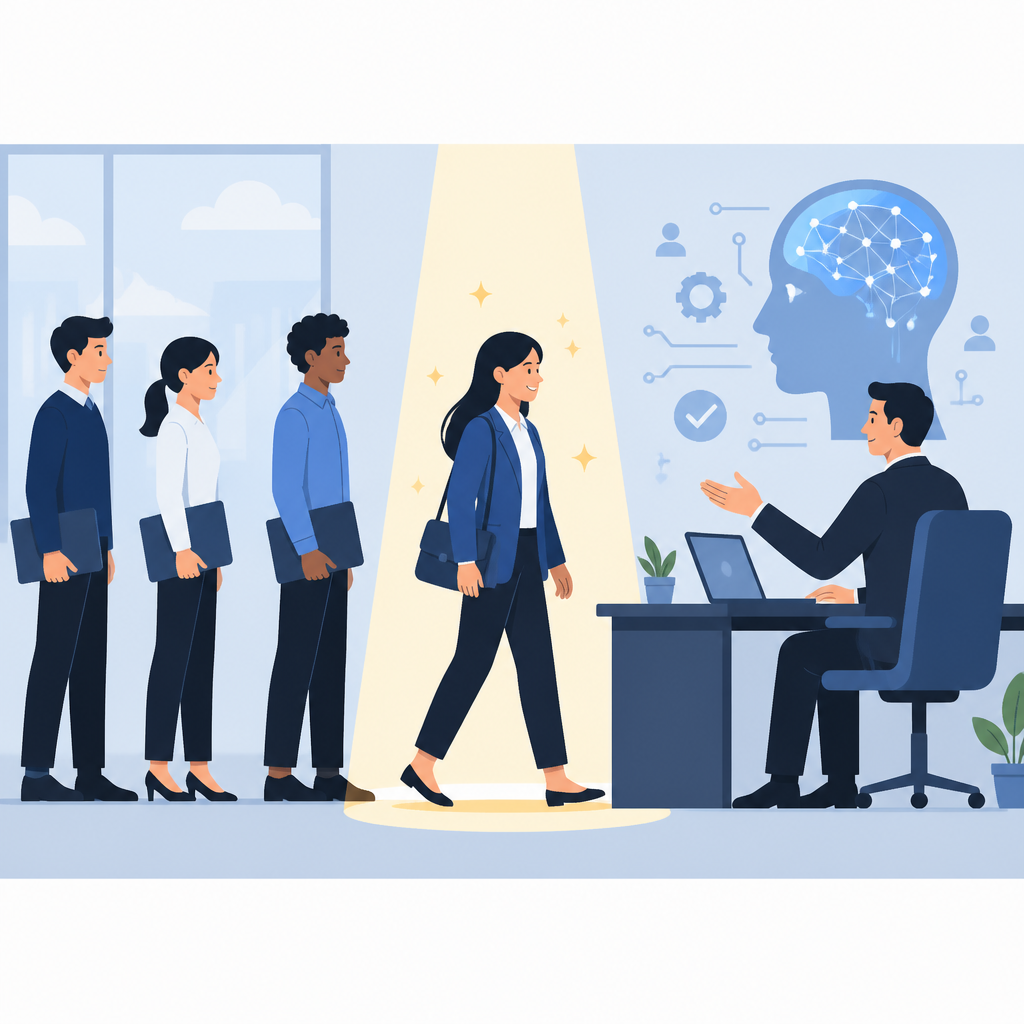
I’ve interviewed enough people to know the difference. One person says, “I used ChatGPT for homework.” Another says, “I used it to generate three approaches, then I pressure-tested the outputs, found the bad assumption, and rewrote the prompt.” Those are not the same person. The second one is already working like a junior operator, not a passive consumer.
India Today’s article frames Huang’s point around hiring graduates, but the bigger implication is broader: if AI is part of the job, then your ability to direct it matters more than your ability to admire it.
How to apply it: if you’re a student or junior developer, stop treating AI as a search box. Use it as a collaborator that can brainstorm, critique, summarize, draft, and reformat. Then show evidence. Put the prompt, the revision, and the result in your portfolio.
AI literacy is becoming the new spreadsheet literacy
Huang’s comparison to earlier workplace tools is the cleanest part of the whole argument. He’s basically saying AI is heading toward the same status computers and spreadsheets got: not “specialized software,” just normal office competence.
That sounds obvious until you remember how long it took organizations to actually get there. Plenty of people could open Excel. Far fewer could use formulas, pivot tables, or basic modeling without turning the file into a crime scene. AI is on the same path. A lot of people will be able to open the tool. Much fewer will be able to use it well enough to create real value.
I ran into this when teams started asking for “AI-assisted” workflows and then handed the work to people who only knew how to ask generic questions. The output was bland, inconsistent, and usually too confident. The issue wasn’t the model. It was the operator.
Huang’s point is not that AI magically makes everyone smarter. It’s that people who learn to direct it will have a wider surface area for useful work. That matters in coding, but it also matters in marketing, operations, finance, support, and sales. If your job includes writing, summarizing, planning, or decision support, AI can already help. If you don’t know how to use it, you’re voluntarily slower than your peers.
- Use AI to draft first versions, not final versions.
- Ask it to compare options and explain tradeoffs.
- Make it show its assumptions, then verify them yourself.
How to apply it: build one repeatable AI workflow for your actual work. Not a toy demo. Something like “turn meeting notes into action items,” “turn bug reports into reproduction steps,” or “turn a rough outline into a client-ready brief.”
He’s arguing that AI changes tasks, not the existence of jobs
One part of Huang’s answer that matters more than the headline is his pushback on the usual doom story. He says people confuse the purpose of a job with the tasks inside it. That’s a smart distinction, and it’s the one most hand-wringing misses.

Take radiology. The article says people once predicted AI would wipe out radiologists because computer vision could read scans. That didn’t happen. Instead, AI helped doctors process more scans and serve more patients, and the field still needs more radiologists. The task changed. The job didn’t vanish.
I think that’s the right mental model for a lot of technical work. AI removes chunks of repetitive labor. It does not remove the need for judgment, context, accountability, or coordination. If anything, it raises the value of the person who can steer the process and catch the mistakes.
That’s why “AI will replace programmers” is too lazy to be useful. What I see more often is AI compressing the boring parts of coding, which means more people can build more things. That can increase demand for people who know how to design systems, review output, and keep the whole thing from turning into spaghetti.
How to apply it: if you’re worried about being replaced, map your job into tasks. Mark the repetitive ones, the judgment-heavy ones, and the ones that require human trust. Then use AI to attack the repetitive layer first. That’s where the practical gain is.
“Every carpenter will be a coder” is less crazy than it sounds
“Every carpenter in the future will be a coder.”
That line sounds dramatic until you translate it. Huang is not saying carpenters will sit around writing Python all day. He’s saying the definition of coding is expanding from syntax to intent. If a person can describe what they want a system to do, AI can help turn that into software-like behavior.
That’s a huge shift. It means natural language becomes a production interface, not just a communication layer. A carpenter could use AI to generate estimates, plan jobs, create customer updates, or even build simple internal tools. A plumber could automate scheduling and parts tracking. An accountant could build custom analysis helpers. The skill isn’t “programming in the old sense.” It’s expressing requirements clearly enough that AI can do useful work with them.
I’ve seen this happen in tiny ways already. Non-engineers who used to ask for a ticket now prototype their own workflow first. They come back with something specific, not a vague wish. That changes the whole conversation. The engineer’s job gets easier, and the business gets a faster answer.
The catch is that this only works if the person understands enough about the problem to describe it well. Garbage in, garbage out still applies. AI doesn’t save sloppy thinking. It rewards people who can define outcomes, constraints, and failure modes.
- Write prompts like mini specs: goal, constraints, examples, output format.
- Use AI to generate drafts of forms, scripts, and simple automations.
- Check whether the output is actually usable by a customer or teammate.
How to apply it: practice turning vague requests into precise prompts. “Help me with my project” is useless. “Draft a customer follow-up email for a delayed shipment, keep it under 120 words, and include two refund options” is something AI can work with.
The real hiring filter is whether you can ask better questions
Huang’s answer sounds like an AI skills statement, but underneath it I hear a judgment about how people think. The best AI users I’ve seen are not the ones who blindly trust the output. They’re the ones who know how to question it.
That matters because AI is very good at producing plausible nonsense. If you don’t know enough to inspect the result, you’re not using AI. You’re outsourcing your thinking to a confident autocomplete. That’s a bad trade.
When I review work from strong junior people, I look for evidence that they can interrogate an answer. Did they ask for alternatives? Did they compare outputs? Did they notice the model skipped an edge case? Did they verify facts? That’s the real signal.
And yes, this applies to hiring too. If I’m choosing between two graduates, I don’t just care whether one can name tools. I care whether they can frame a problem, use AI to explore it, then explain what they kept and what they rejected. That’s the kind of person who becomes useful fast.
How to apply it: train yourself to ask follow-up questions of the model. “What assumptions are you making?” “What would break this approach?” “Give me a cheaper version.” “Show me the edge cases.” The point is to make the model argue with you, not flatter you.
What students should actually do before graduation
If I were advising a student after reading this, I wouldn’t tell them to “learn AI” in the vague motivational-poster sense. I’d tell them to build proof that they can use AI in real workflows. That’s the difference between a nice resume line and something a hiring manager can trust.
Here’s the practical version. Pick one domain you care about: software, design, marketing, finance, ops, research, whatever. Then build three things with AI:
- a draft artifact, like a doc, script, analysis, or design brief
- a refinement loop, where you improve the output with better prompts and review
- a short explanation of what AI did well and where you had to step in
That gives you a story that sounds real because it is real. It also forces you to learn the limits of the tool instead of pretending it’s magic. Employers notice that.
I also think students should get comfortable showing process, not just results. If you can explain how you used AI to go from blank page to working output, you’re already ahead of the person who just says they “know AI.”
How to apply it: make a small portfolio page or README with three AI-assisted projects. Include the prompt pattern, the before/after, and one paragraph on what you learned. Keep it concrete. No fluff.
The template you can copy
# AI skill checklist for new grads

Use this as a resume, portfolio, or interview prep template.

## 1) My AI workflow
- Problem I was trying to solve:
- Tool I used:
- What I asked the AI to do:
- What I checked manually:
- What I changed after reviewing the output:

## 2) Prompt pattern I rely on
Goal:
Constraints:
Examples:
Output format:
Quality bar:

## 3) Proof I can work with AI
### Project 1
- Task:
- AI used for:
- My review step:
- Final result:

### Project 2
- Task:
- AI used for:
- My review step:
- Final result:

### Project 3
- Task:
- AI used for:
- My review step:
- Final result:

## 4) Interview answer
"I use AI to accelerate first drafts, explore alternatives, and catch edge cases. I do not trust the output blindly. I verify facts, compare options, and rewrite the final version myself when needed."

## 5) Hiring signal
If I had to choose between two candidates with similar backgrounds, I want the one who can:
- frame a problem clearly
- use AI to generate options
- inspect the output critically
- explain tradeoffs
- ship something useful faster
This is the part you can copy straight into your own notes or portfolio. I’d actually recommend students keep the first two sections as a living document and update them every time they use AI on a real task.
What I like about this template is that it forces specificity. It doesn’t ask, “Do you know AI?” It asks, “Can you use it well enough to produce better work?” That’s the hiring question Huang is really pointing at.
And yes, I think that’s going to matter more, not less, as AI tools keep getting embedded into everyday work. The people who learn to direct them now will look normal later. The people who ignore them will look strangely slow.
Source note: I based this breakdown on India Today’s article, which summarizes Jensen Huang’s comments from the Lex Fridman Podcast. My breakdown, examples, and template are my own interpretation of that source.
Related references: Nvidia, Lex Fridman, and the broader shift in AI tooling documented by OpenAI.
// Related Articles
- [IND]
DOE should turn its land into AI infrastructure fast
- [IND]
Xiaomi MiMo Code tops Claude Code on 200-step tasks
- [IND]
OpenAI’s Ona buy adds more reach to Codex
- [IND]
The US should set tokenization rules now, or lose the market
- [IND]
SEC Rule Changes Could Unlock Tokenized Stocks
- [IND]
Kalshi adds Solana perpetual futures after XRP