Anthropic and Gates Foundation Announce $200M Deal
Anthropic and the Gates Foundation are putting $200 million into Claude-powered work on health, education, and economic mobility.
Anthropic and the Gates Foundation are putting $200 million into Claude-powered work on health, education, and economic mobility.
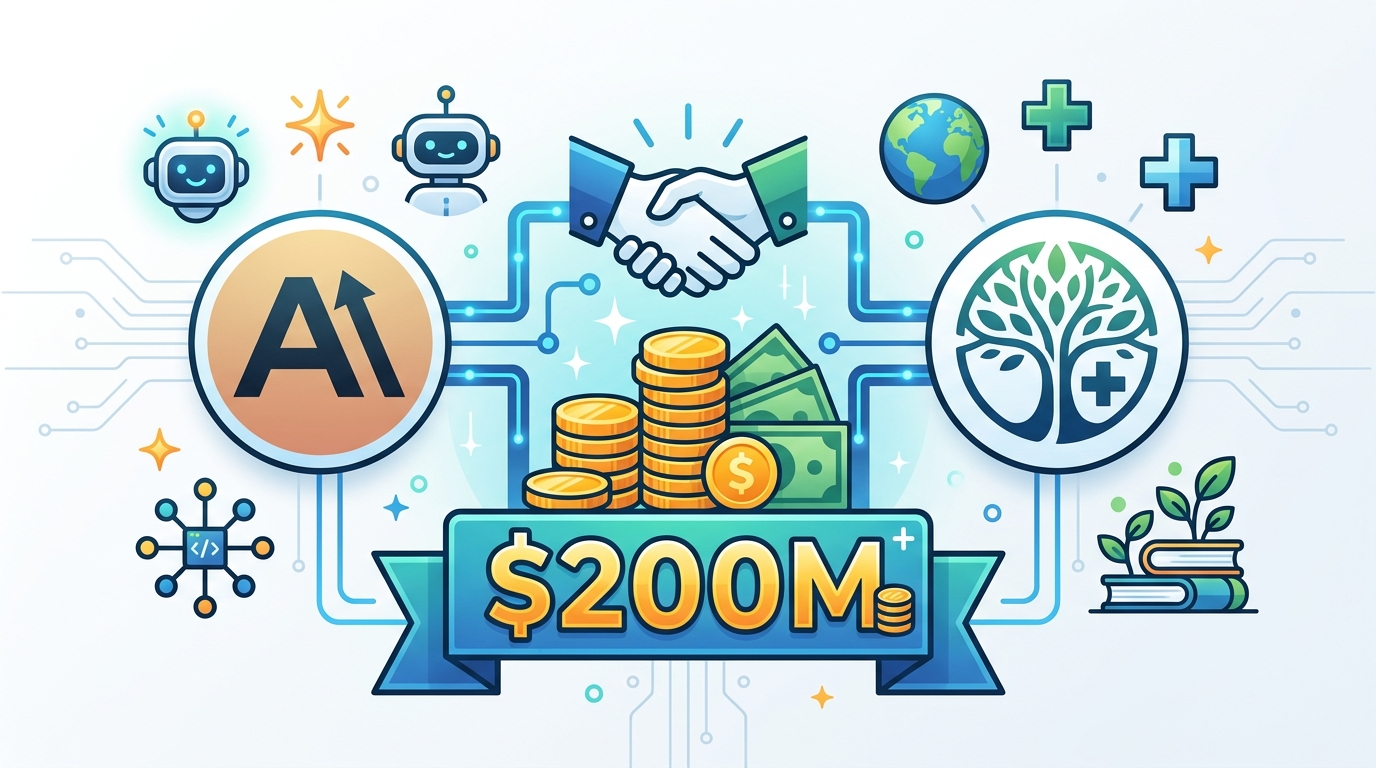
Anthropic is putting $200 million into a four-year partnership with the Gates Foundation, and the money is going toward global health, life sciences, education, and economic mobility. The deal mixes grant funding, Claude usage credits, and technical support, which makes it more than a press-release alliance and less than a pure commercial contract.
The timing matters. Anthropic says the work will run over the next four years, and the company is using its Beneficial Deployments team to push Claude into areas where market demand alone does not pay for deployment. That includes public health systems, research workflows, classroom tools, and labor-market programs.
| Item | Figure | Why it matters |
|---|---|---|
| Partnership value | $200 million | Signals a large, multi-year commitment |
| Timeframe | 4 years | Sets the pace for rollout and measurement |
| Education focus | K-12 in the U.S., sub-Saharan Africa, and India | Shows the geographic scope |
| Health focus | Polio, HPV, preeclampsia, malaria, tuberculosis | Targets high-burden diseases |
What the partnership is actually trying to do
Get the latest AI news in your inbox
Weekly picks of model releases, tools, and deep dives — no spam, unsubscribe anytime.
No spam. Unsubscribe at any time.
The health side is the most practical part of the announcement. Anthropic and the Gates Foundation want to speed up vaccine and therapy development, help governments work with health data faster, and build healthcare-focused AI connectors, benchmarks, and evaluation frameworks. That last piece matters because healthcare AI is full of demos and short on reliable measurement.
The companies also want Claude to help with frontline work, including diagnosis support, treatment navigation, workforce deployment, supply chain management, and outbreak detection. That is a broad list, but it maps to real bottlenecks in public health systems: too much data, too few trained workers, and too little time.
Anthropic says Claude is already being used by scientists to analyze large datasets, spot research patterns, and screen potential drug and vaccine candidates. The new partnership expands that work into diseases such as polio, HPV, and preeclampsia, which gives the initiative a concrete research target instead of vague “AI for good” language.
- Computational screening before pre-clinical development could shorten early research cycles
- Disease forecasting work with the Institute for Disease Modeling will cover malaria and tuberculosis
- Claude integrations are meant to make forecasting tools easier for researchers and public health teams to use
Why the Gates Foundation matters here
The Gates Foundation has spent years funding global health systems, education programs, and development work, so this deal fits its existing playbook. What changes now is the toolset. Instead of funding only studies or pilot programs, the foundation is pairing its grants with model access and technical support from a major AI lab.
That matters because AI projects often fail at deployment, not at demos. A model can look impressive in a lab and still be useless in a clinic, a district education office, or a ministry of health. The partnership is trying to close that gap by funding the data, connectors, and benchmarks needed to test whether Claude can do useful work in the real world.
“We’re partnering with the Gates Foundation to commit $200 million in grant funding, Claude usage credits, and technical support for programs in global health, life sciences, education, and economic mobility over the next four years.”
Anthropic also said the collaboration is meant to extend AI benefits into areas where markets alone will not. That line is doing a lot of work, but it is also accurate. Public health and education often need long-term support, thin margins, and local adaptation, which are not the easiest conditions for a private AI vendor to serve.
The company said it plans to publish more information about the programs and lessons learned as the partnership develops. That is a good sign, because the most useful part of this deal may end up being the evaluation data, not the headlines.
How the education and workforce pieces fit in
The education portion is wider than a single country or age group. Anthropic and the Gates Foundation want to support AI tools for K-12 students in the U.S., sub-Saharan Africa, and India. They also plan to build public resources such as benchmarks, datasets, and knowledge graphs for math tutoring, curriculum development, and college advising.
There is a clear reason to focus there. Education AI often gets judged by flashy chatbot behavior, but tutoring quality depends on accuracy, pacing, and alignment with curricula. Public benchmarks can make it easier to tell whether a tool actually helps students or just sounds helpful.
In sub-Saharan Africa and India, the partnership will support literacy and numeracy applications through the Global AI for Learning Alliance. That gives the effort a distribution network and a policy frame, which matters if the tools are meant to reach classrooms rather than stay in pilot mode.
- Education tools will target K-12 learners in the U.S., sub-Saharan Africa, and India
- Public resources will include benchmarks, datasets, and knowledge graphs
- Career guidance tools will aim at students moving from school into work
- U.S. workforce work includes portable skills records and employment-outcome tracking
What this says about Anthropic’s strategy
This deal is a clear signal that Anthropic wants Claude to be more than a general-purpose assistant. The company is building a portfolio of high-trust use cases where model quality can be measured against real outcomes, such as disease forecasting accuracy, tutoring effectiveness, or better job placement data.
It also puts Anthropic in a different position from AI vendors chasing consumer attention. Public sector and nonprofit deployments are slower, messier, and harder to monetize, but they can produce durable relationships, better feedback loops, and stronger proof that a model can do meaningful work.
There is a tradeoff, though. If Anthropic wants this partnership to matter, it will need to show results that are visible outside the AI bubble. Better benchmarks are nice, but the real test is whether health workers, teachers, researchers, and policy teams actually save time or make better decisions.
For now, the key question is simple: can a $200 million AI partnership produce measurable gains in vaccine research, classroom support, and workforce outcomes, or will it mostly generate polished case studies? The answer will depend on the quality of the datasets, the discipline of the evaluations, and whether Claude can hold up under real institutional pressure.
If Anthropic publishes the benchmarks and outcome data it says it will share, this deal could become one of the more useful public examples of how foundation money and frontier AI can work together. If not, it will be remembered as another large promise with a long list of worthy goals and very little proof.
// Related Articles
- [IND]
Why Anthropic’s small-business push is a real threat to SaaS
- [IND]
Oracle: AI doesn’t need another database
- [IND]
How to Follow Gemini and Apple Watch 12 Rumors
- [IND]
Jensen Huang Joins Trump on China Trip
- [IND]
ChatGPT vs Gemini: 9 Tests, 1 Clear Winner
- [IND]
How to Reduce AI Model Serving Friction