Banking Groups Push Senate to Tighten Stablecoin Yield Rules
The American Bankers Association is pressing senators to tighten stablecoin rules in the Clarity Act before a vote this week.

Banking groups are pressing senators to tighten stablecoin yield rules before the Clarity Act vote.
The fight over stablecoin yield is back in Washington, and the timing matters. With the Senate preparing to vote on the Clarity Act, the American Bankers Association is pushing lawmakers to tighten language it says could still let stablecoin issuers pull deposits out of banks.
That argument is simple: if a dollar-backed token can pay yield or otherwise look more attractive than a bank account, money may move away from insured deposits. Banks have been making that case for months, but the pressure is sharper now because the bill is moving and the wording still leaves room for interpretation.
| Item | What it means | Why it matters |
|---|---|---|
| Clarity Act | Senate vote is approaching | Stablecoin rules may change fast |
| American Bankers Association | Leading the push for tighter language | Wants to protect bank deposits |
| Stablecoin yield | Core policy flashpoint | Could make tokens compete with deposits |
Why banks care so much about yield
Get the latest AI news in your inbox
Weekly picks of model releases, tools, and deep dives — no spam, unsubscribe anytime.
No spam. Unsubscribe at any time.
Yield is the part of this debate that turns a payments bill into a banking fight. A plain stablecoin that sits in a wallet is one thing. A stablecoin that pays users for holding it starts to look like a deposit product, even if it is issued by a crypto company rather than a bank.

That matters because banks fund loans with deposits. If money leaves checking and savings accounts in large amounts, banks may have to pay more for funding or shrink lending. The ABA’s concern is less about crypto branding and more about balance-sheet pressure.
There is also a consumer angle. If a token promises yield but lacks the same protections people expect from bank accounts, the risk profile changes quickly. The policy question is whether Congress wants stablecoins to stay close to payments infrastructure or drift into deposit-like territory.
- Stablecoins can already be used for payments and transfers.
- Yield changes the incentive to hold them instead of cash in a bank.
- Banks argue that shift could affect deposit stability and credit supply.
- Lawmakers now have to decide how much competition they want between token issuers and banks.
The Senate vote is forcing a fast decision
When legislation is still moving, every word in the draft matters. The banking lobby is not waiting for a final committee cleanup; it is pushing now because once a bill clears the Senate, the odds of major changes drop.
That urgency explains the tone of the ABA’s lobbying. The group wants senators to tighten the stablecoin sections of the Clarity Act so the final text closes loopholes around yield and deposit substitution. In practice, that means drawing a cleaner line between payment tokens and bank products.
“We need to make sure that stablecoins do not become a backdoor way to drain deposits from the banking system.” — Rob Nichols, American Bankers Association
The quote captures the banking industry’s core fear. If stablecoins become a high-yield parking place for cash, banks lose cheap funding. If banks lose cheap funding, borrowers usually feel it later through tighter credit and higher rates.
Crypto companies see the issue differently. From their point of view, yield is a feature that makes digital dollars more useful and more competitive. That tension is why stablecoin policy keeps colliding with bank regulation instead of staying inside a narrow crypto lane.
What this fight looks like in numbers
The policy debate is easier to understand when you compare the business models side by side. Banks hold deposits, lend against them, and operate under a mature regulatory system. Stablecoin issuers issue tokens that can move quickly across platforms, with the policy framework still being written.
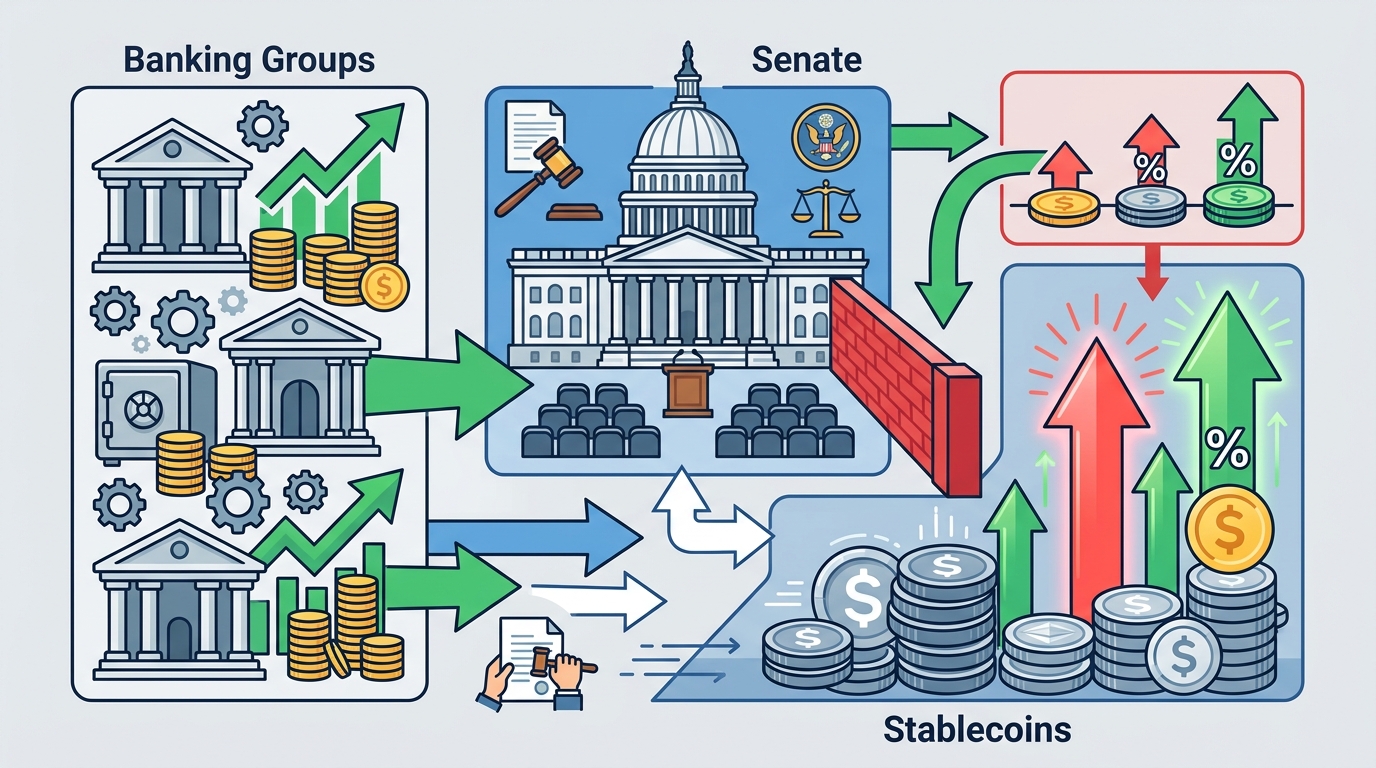
Here is the blunt version of the comparison:
- Bank deposits are protected by a long-standing regulatory model and, for insured accounts, FDIC coverage up to statutory limits.
- Stablecoins can move at internet speed and settle faster than traditional bank transfers.
- Yield on a token can change user behavior faster than a normal payments feature.
- Congress can rewrite the rules for stablecoins in a single bill, while bank regulation usually changes more slowly.
That combination explains why this topic keeps surfacing in hearings and lobbying meetings. Stablecoins are no longer just a crypto trading tool. They are becoming a policy test for how much financial activity lawmakers are willing to let move outside banks.
The Clarity Act debate also shows how quickly crypto policy has matured. A few years ago, stablecoin discussions were mostly about reserves and redemption. Now the argument has moved up the stack to yield, deposit competition, and the health of the banking system.
What to watch after the vote
If senators tighten the language, stablecoin issuers may have less room to offer yield or build products that mimic deposits. If the bill passes with looser wording, banks will likely keep pushing regulators to interpret the law narrowly.
Either way, the next fight is about product design. Issuers want to make stablecoins more attractive to users. Banks want to keep those products from looking and acting too much like savings accounts. That tension will shape the next round of rulemaking, especially if yield-bearing stablecoins keep growing.
The practical takeaway for builders is straightforward: stablecoin products are moving from a crypto-native policy issue into mainstream financial regulation. If your product depends on yield, yield-like rewards, or deposit-style behavior, the Senate vote could affect your roadmap faster than you expect.
Watch the final bill text, not just the headlines. The exact wording on yield may decide whether stablecoins stay a payments tool or become the next major banking headache.
// Related Articles
- [IND]
WebX 2026 turns speaker hype into a conference brief
- [IND]
AI Weekly: 2026-07-06 ~ 2026-07-13
- [IND]
The AI Act should be treated as Europe’s operating system for AI
- [IND]
Booz Allen’s OpenAI Deal Is Real Advantage, Not Hype
- [IND]
OpenSearch’s vector search benchmark in 5 parts
- [IND]
Vector Databases That Work in Production