How to Build an AI Crypto Trading Bot
A practical 2026 guide to AI crypto bots: data, models, risk controls, deployment, and compliance for production use.

Crypto markets never close, but the hard part in 2026 is not speed. It is making decisions that still make sense when liquidity shifts across Binance, Coinbase, perpetuals, and onchain venues. If your bot cannot survive slippage, regime changes, and exchange quirks, it is just an expensive notebook.
This guide breaks down how to build an AI crypto trading bot that can actually run in production: data collection, feature design, model choice, risk controls, execution, and governance. It also explains why the best systems are usually hybrids, combining rules, machine learning, and strict operational limits.
If you want a deeper companion piece, see our guide on AI in crypto trading and our overview of reinforcement learning for crypto trading strategies.
What an AI crypto bot must do
Get the latest AI news in your inbox
Weekly picks of model releases, tools, and deep dives — no spam, unsubscribe anytime.
No spam. Unsubscribe at any time.
A bot in 2026 has to do more than place orders on a timer. It needs to interpret market mood, detect changing conditions, and react when the market stops behaving the way the backtest promised.

The most useful bots usually combine four jobs: sentiment analysis from news and social feeds, pattern recognition across timeframes, adaptive strategy selection, and 24/7 execution with monitoring. The exact mix depends on whether the bot trades spot, perpetuals, or both.
- Sentiment models help when headlines or community chatter move price before the chart catches up.
- Regime detection matters when volatility expands, spreads widen, or correlations break.
- Execution logic matters when fees, partial fills, and rate limits turn a good signal into a bad trade.
- Risk controls matter because a bot that wins 55% of the time can still lose money with bad sizing.
That last point is where many projects fail. Teams often obsess over prediction accuracy and ignore the more boring parts: slippage, position sizing, and exchange behavior under stress. In live trading, those details decide whether the bot survives long enough to matter.
Start with the trading objective
Before you collect a single candle, write down what the bot is supposed to do. A vague goal like “make money from crypto” guarantees a messy build. A specific objective forces tradeoffs around data, latency, and risk.
Think in terms of market type, venue, strategy style, and risk budget. A trend-following bot on spot markets has very different needs from a market-making system on perpetuals. If you do not define those constraints early, the model will optimize the wrong thing.
“The market can stay irrational longer than you can stay solvent.” — John Maynard Keynes
That quote is old, but it fits automated trading perfectly. A bot can be mathematically correct and still be dangerous if it ignores drawdown limits or gets stuck in the wrong regime.
For developers building the stack from scratch, structured learning helps. Blockchain Council’s Certified Cryptocurrency Trader, Certified AI Engineer, and Certified Blockchain Developer track the three skill areas that show up again and again in production systems.
Build the data pipeline before the model
A trading bot is only as good as the data behind it. In crypto, that usually means a mix of price history, order book data, derivatives metrics, and sentiment inputs. The goal is not to collect everything. The goal is to collect the right things with timestamps you can trust.
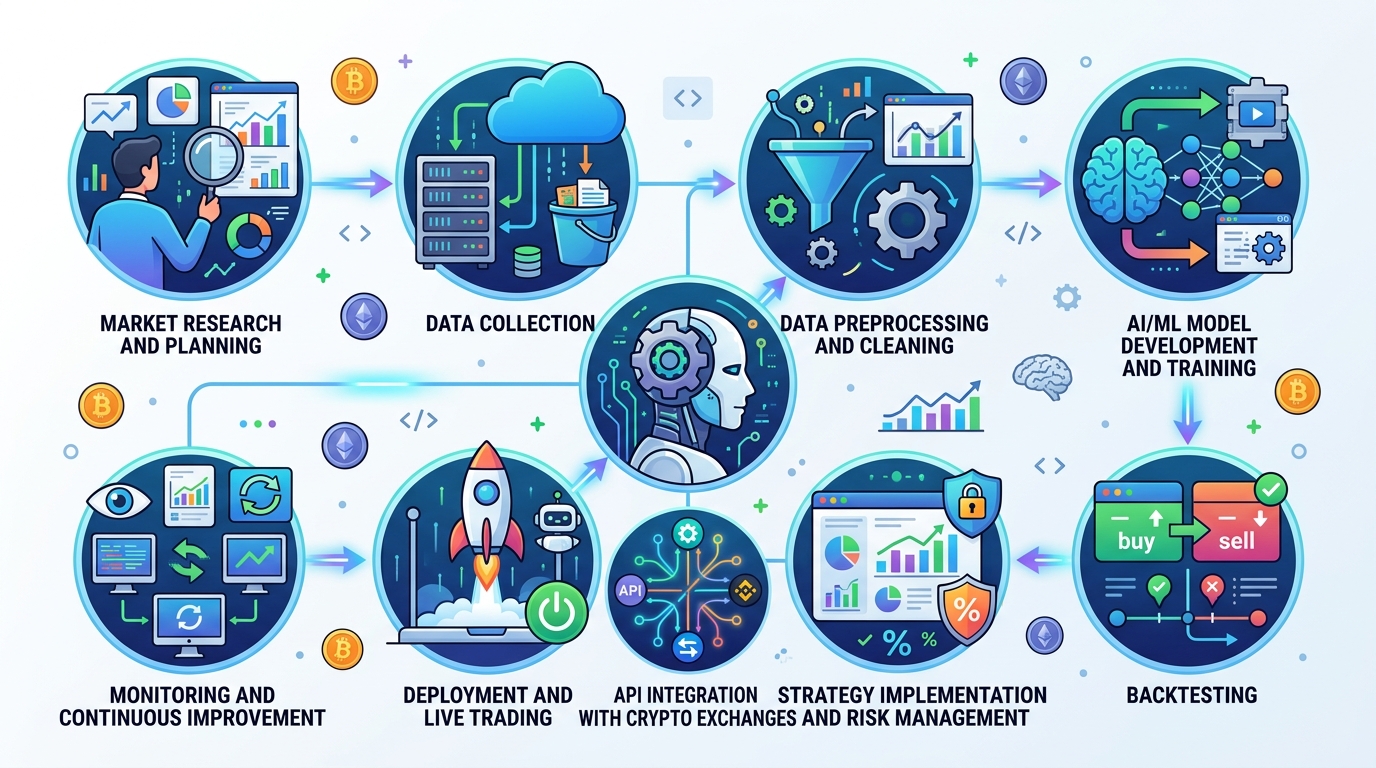
For market data, use OHLCV candles across multiple resolutions, plus trades and order book snapshots if the strategy depends on short-term execution. For derivatives, funding rates, open interest, and liquidation data often tell a more honest story than price alone. For sentiment, news and social feeds can add signal, but only if you clean them and align them with the market clock.
- OHLCV for 1m, 5m, 1h, and 1d views.
- Order book depth, spread, and trade prints for execution-sensitive strategies.
- Funding rates, open interest, and liquidation events for perpetuals.
- News metadata and social sentiment for event-driven models.
- Fee schedules, tick sizes, and rate limits for venue-aware execution.
One practical rule: store raw data as immutable records and derived features as versioned artifacts. That makes it possible to reproduce a training run later, spot data drift, and explain why a model changed its behavior after a venue update or a market shock.
On the sentiment side, the research is promising, but it needs discipline. A number of studies have shown that models such as SVMs and fine-tuned BERT variants can do well on Bitcoin direction prediction when sentiment features are engineered with realistic delays. The catch is obvious: if you let future information leak into the feature set, the backtest turns into fiction.
Choose features that match market regimes
Good features help the bot understand when the market is trending, compressing, or breaking apart. Bad features look clever in a notebook and then fall apart in live trading because they do not connect to a decision.
Useful regime-aware features often include moving average slopes, returns across several horizons, ATR, realized volatility, spread, order book imbalance, depth at the top levels, funding deviations, and open interest spikes. Sentiment features can help too, especially when tied to named assets, exchanges, or macro events.
The important part is mapping each feature to a trading decision. If a feature does not affect entry, exit, sizing, or filtering, it is probably noise. That sounds harsh, but it saves a lot of time.
In practice, the cleanest systems separate signal generation from risk logic. The model can decide whether conditions look favorable. The risk layer decides how much capital is allowed to act on that signal. That split keeps the bot from becoming a giant black box that nobody wants to debug at 2 a.m.
Use a model that fits the strategy
There is no single model that works best for every crypto strategy. A lot of teams do better with a hybrid setup than with an end-to-end policy that tries to do everything at once.
For many teams, the best starting point is a supervised model that predicts the probability of upward movement over a defined horizon. That output can feed a threshold-based decision system, while a separate risk module handles sizing and stops. It is boring, but boring often survives contact with the market.
Reinforcement learning can help when the policy must adapt to changing conditions, but it needs a realistic simulator and a reward function that does not encourage reckless behavior. Sequence models such as GRUs or transformers are useful when price action and sentiment need to be read together, especially when timing matters more than raw direction.
- Supervised learning works well for direction, return buckets, or trade filtering.
- Reinforcement learning helps with adaptive policies, but only with careful simulation.
- Sequence models can combine price history with sentiment and event timing.
- Hybrid systems often win because they keep safety logic separate from prediction logic.
The best model is the one you can explain, monitor, and retrain without breaking the whole stack. That is a much higher bar than leaderboard accuracy, and it is the one that matters when real money is on the line.
Risk control is the product
If there is one lesson worth repeating, it is this: risk control is not a feature. It is the product. A bot that enters great trades and blows up on one bad week is not useful.
Production systems need position sizing tied to volatility and confidence, hard stops, drawdown guards, exposure caps, and slippage modeling inside both backtests and live estimates. A bot that ignores these controls is fragile even if its signal is strong.
Execution reality matters too. Crypto arbitrage can disappear in seconds, and transfer delays, fee changes, or partial fills can erase an apparent edge. That means the bot needs circuit breakers, kill switches, and monitoring that can pause trading automatically when conditions move outside the approved range.
- Position sizing should shrink during volatility spikes.
- Daily loss limits should stop trading before a small problem becomes a large one.
- Exposure caps should apply by asset, sector, correlation cluster, and venue.
- Backtests should include fees, funding, slippage, and partial fills.
That is also why secure deployment matters. Use a secrets manager, limit API permissions, and log every signal, order, fill, and parameter change. If the bot cannot explain what it did, you will not trust it when the market gets messy.
Deploy with governance, not guesswork
Deployment is where a lot of promising projects turn into operational headaches. The answer is to split the system into services: one for data, one for inference, one for risk, one for execution, and one for monitoring. That separation makes it easier to update the model without risking the order router.
Compliance also matters more than many builders expect. If the bot is used for clients or pooled capital, the team needs clear documentation, change control, audit logs, and a plan for rollback. Automated trading is not just a machine learning problem. It is also a governance problem.
For teams that want a stronger security baseline, Blockchain Council’s Certified Cybersecurity Expert covers the kind of operational hardening that keeps API keys, infrastructure, and trading logic from becoming the weakest link.
My read is simple: the winners in this space will not be the teams with the fanciest model. They will be the teams that can measure drift quickly, limit damage fast, and redeploy without breaking trust. If you are building one now, start with a tiny live allocation, instrument everything, and make the kill switch easier to reach than the trade button.
// Related Articles
- [CHAIN]
UAE Web3 setup turns crypto rules into a checklist
- [CHAIN]
Five AI Futurist features shaping Futurist 2026
- [CHAIN]
Regulation Now Moves Bitcoin and Ethereum More Than War
- [CHAIN]
The SEC Crypto Rule Proposal Will Clean Up Crypto, Not Kill It
- [CHAIN]
Web3 platforms need fee discipline, not token theatrics, to make money
- [CHAIN]
Riyadh’s blockchain show proves Web3 is now infrastructure