GitHub's Top 10 Shows Skills as the Coding Agent Form Factor
Seven of GitHub's top 10 trending projects this week directly serve coding agents. From Karpathy's rule distillation to Matt Pocock's skill-sharing and Superpowers' cross-tool methodology, a clear pattern emerges: skills are becoming the distribution unit, while token economics reshape code generation architecture. Anthropic's standard is fast-tracking across all competing agent ecosystems.
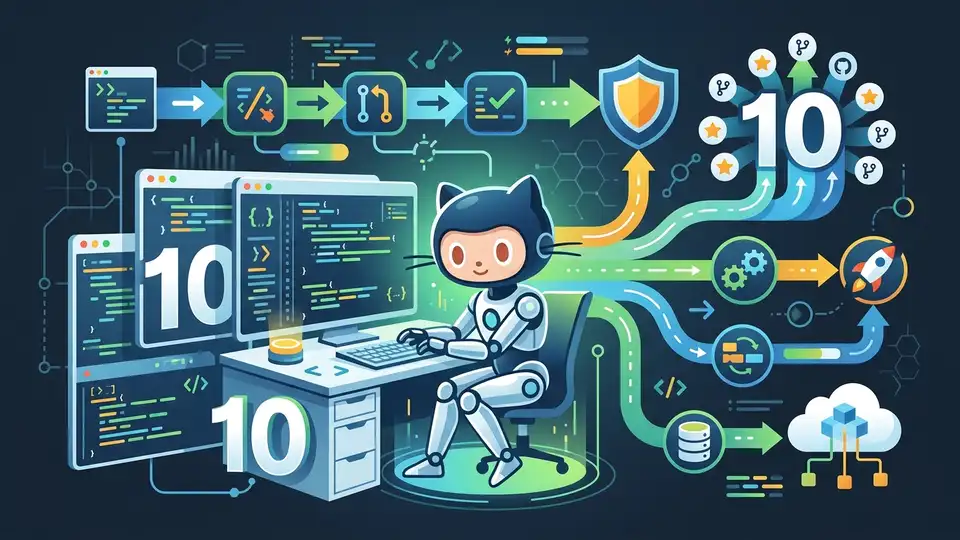
GitHub's top 10 this week documents a transition that goes beyond incremental tooling. The coding agent ecosystem is moving from "better prompts" to "composable skill components." This is not just product-layer refinement—it's a shift in the unit of distribution.
Skills as Personal Brand Artifacts
Get the latest AI news in your inbox
Weekly picks of model releases, tools, and deep dives — no spam, unsubscribe anytime.
No spam. Unsubscribe at any time.
Andrej Karpathy's coding rules (97,658 stars) distill LLM coding pitfalls—wrong assumptions, hidden complexity, implicit trade-offs—into four enforceable rules with a Cursor `.cursor/rules` variant. The insight: when a programmer's coding philosophy gets crystallized into a version-controlled file, it becomes shareable infrastructure.
Matt Pocock's skills library (39,402 stars) takes this further by sharing his `.claude/` directory directly. Architecture refactoring, git safety hooks, pre-commit setup, DDD terminology extraction. The form factor has shifted: your `.claude/` directory is now your dotfiles equivalent. Twenty years ago, engineers shared `.vimrc`. Today they share skills.
Token Economics Drives Structural Change
When API calls have real cost, brevity stops being style. Caveman (49,502 stars) strips 65% of output tokens by removing prose verbosity while preserving technical precision. The March 2026 paper backing it shows forced concision actually improves accuracy. This is not optimization theater; it's a market signal hitting the architecture.
Similar pressure surfaces at the routing layer. Free-Claude-Code (17,806 stars) fronts Claude-tier requests to cost-optimized alternatives (Kimi K2). This is not a compliance hack—it's code expressing an economic reality: token costs now drive architectural decisions.
Anthropic's Gravity Well
Superpowers (172,011 stars) is a methodology built by ex-Anthropic engineer Jesse Vincent and represents this week's largest project. It enforces requirement elicitation, spec generation, implementation plans, and TDD-driven subagent pipelines. But the real signal: it now runs on Codex, Cursor, OpenCode, Copilot, and Gemini CLI. One methodology, every agent framework.

This indicates something deeper. The standard Anthropic established on Claude Code—skills, prompt validation, subagent orchestration—is becoming the industry baseline. Competitors (Google, Cursor, OpenAI) are not just copying; they're conforming. Google Labs' Design.md spec and Pocock's skill sharing both externalize agent instructions as version-controlled artifacts. The playbook is identical.
Relevance for OraCore
Last week: Karpathy LLM Wiki materialized as app, Hermes Agent, Claude system prompt leaks. This week confirms acceleration. The cadence from tooling iteration to ecosystem paradigm shift has compressed to one-week cycles.
OraCore's dev workflow uses Superpowers (transparent disclosure). The pattern we observe in this week's GitHub ranking—methodology over tools, version control over prompt banks, composability over monoliths—reflects a choice architecture for how coding agents will scale. The next wave of agent adoption will be defined not by better models, but by how engineers organize their skill libraries.
For five concrete patterns that emerge after months of running Claude Code as primary daily-driver, see our companion piece Claude Code advanced patterns.
// Related Articles
- [AGENT]
Perplexity should build Teammate as a coding agent, not a copilot
- [AGENT]
HP adopts OpenAI Frontier across global operations
- [AGENT]
Build a production vector DB for RAG
- [AGENT]
Ornith-1 turns agent coding into a server
- [AGENT]
Crypto AI agents are useful, but only for narrow workflows
- [AGENT]
AI Agents in Crypto: 2026 Protocol Guide