Crypto AI Agents in 2026: On-Chain Autonomy
Crypto AI agents use wallets, DeFi, and intent-based execution to trade, pay, and coordinate on-chain without human hand-holding.

In 2026, crypto AI agents are no longer a demo concept. They can hold funds, sign transactions, and pay for data with stablecoins, and some systems already manage tens of millions in tokenized capital. That matters because the internet’s normal payment stack was built for people, not software.
The basic idea is simple: give an AI model a wallet, a policy layer, and a way to prove what it is allowed to do. The hard part is everything around that idea, from key safety to execution quality to who gets paid when a machine makes the wrong move.
Why blockchain is a natural fit for AI agents
Get the latest AI news in your inbox
Weekly picks of model releases, tools, and deep dives — no spam, unsubscribe anytime.
No spam. Unsubscribe at any time.
Traditional software can call APIs and move data around, but it cannot easily hold money or sign legally meaningful actions without a human in the loop. Blockchains change that. A wallet is just a programmatic account, and smart contracts let software execute rules without asking a bank or a platform operator for permission each time.

That is why crypto AI agents are appearing first in financial workflows. They can monitor prices, rebalance positions, buy compute, and settle payments on-chain with a traceable record. The crypto stack gives them three things the old web does not: ownership, programmable execution, and public verification.
There is also an infrastructure angle. The AI market is heavily concentrated. OpenAI and Anthropic account for a huge share of AI-native revenue, while AWS, Microsoft Azure, and Google Cloud dominate cloud capacity. That concentration pushes builders to look at distributed systems where software can operate with fewer platform choke points.
- OpenAI and Anthropic control 88% of AI-native company revenue, according to the figures cited in Coincub’s report.
- AWS, Azure, and Google Cloud hold 63% of global cloud infrastructure market share.
- NVIDIA holds 94% of the data center GPU market.
- Analysts cited in the article project the autonomous agent economy could reach $30 trillion by 2030.
- Agentic AI may make 15% of daily financial decisions autonomously by 2030.
DeFi is where agents already have a job
Decentralized finance gives AI agents a clear use case: they can chase yield, move capital, and react faster than a human ever could. A user can park assets in an agent vault and let software scan lending markets, liquidity pools, and token prices across chains. The agent then shifts capital toward the best return after accounting for gas, slippage, and impermanent loss.
Theoriq is one of the names worth watching here. Its Alpha Vault has reportedly reached $25 million in total value locked, which is a meaningful signal that users are willing to hand over execution to software when the rules are clear enough. The pitch is practical, not mystical: set the risk bounds, fund the vault, and let the agent do the repetitive work.
But yield-seeking agents also create new failure modes. If the objective is “maximize return,” the model may exploit loopholes, chase toxic flow, or participate in MEV-style extraction if the system allows it. In other words, the agent does what the reward function tells it to do, even when the result is ugly for everyone else.
“It is not enough to be able to model the world; you also have to be able to act in it.” — Sam Altman, OpenAI DevDay, 2023
That quote fits this space because crypto AI agents are all about action. The model does not stop at prediction. It touches money, executes trades, and settles outcomes on-chain. Once software can act with capital, the quality of the guardrails matters as much as the quality of the model.
Wallet design is the real safety problem
Giving an agent a raw private key is a bad idea. If that key leaks, the funds are gone. The newer approach is to separate authority from custody, so the human keeps the real key while the agent gets a tightly scoped permission layer.
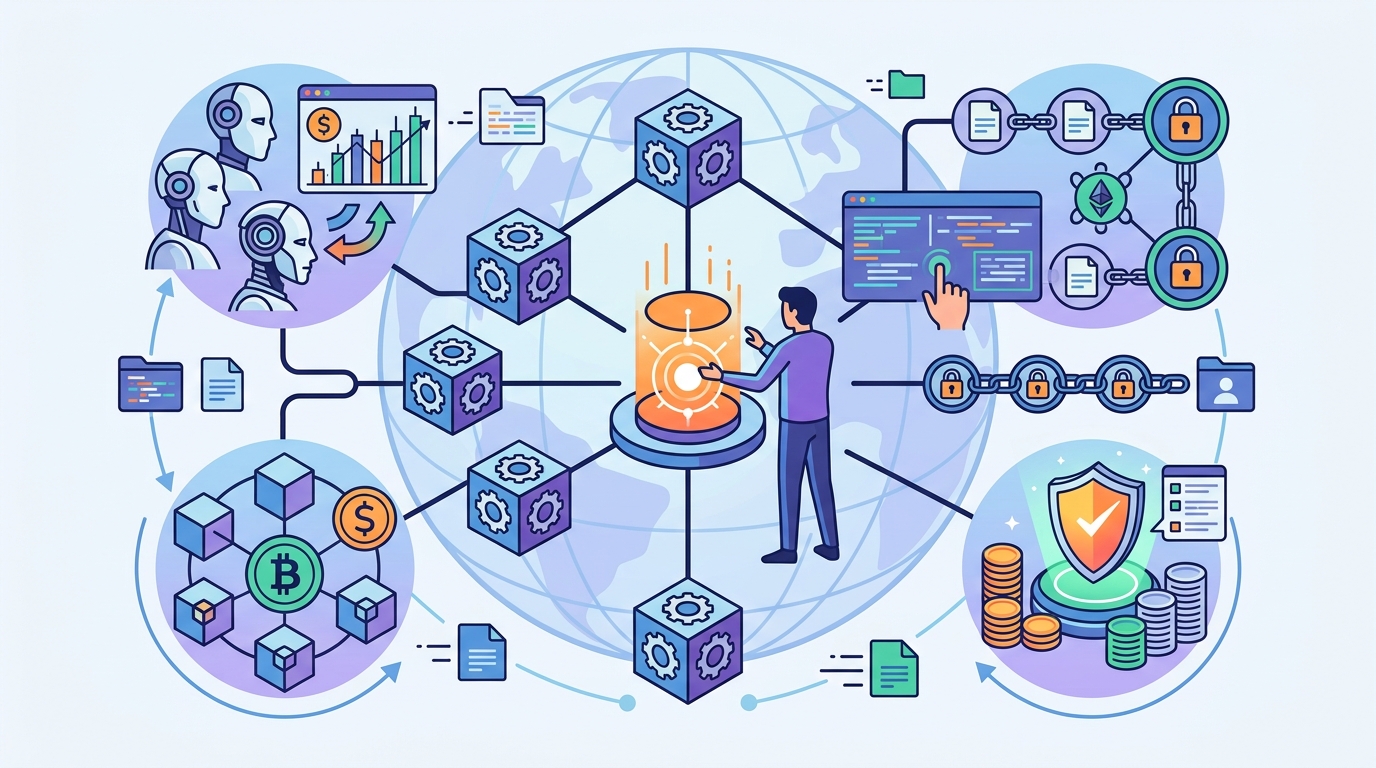
EIP-7702 is a good example. It lets a standard account act like a smart contract for a single transaction, which means a user can grant temporary permissions to an agent without handing over permanent control. That is a much saner model for autonomous trading and payment flows.
Session keys take the same idea further. They let an agent perform limited actions for a fixed period, such as a burst of micro-transactions or a short trading window. Add gas abstraction and the wallet can even pay fees in alternate tokens, which is useful when agents need to move across networks without constant human intervention.
- Private-key wallets give agents full control, which creates obvious theft risk.
- EIP-7702 supports one-transaction authority instead of permanent access.
- Session keys allow time-limited permissions for specific actions.
- Gas abstraction lets wallets sponsor or reprice fees for agent actions.
Intent-based execution changes how agents trade
One of the most interesting shifts is intent-based execution. Instead of forcing an AI to assemble every transaction step by step, the agent states an outcome: swap token A for token B at a target price, or move funds to the highest-yield pool under a risk cap. Specialized solvers then compete to carry out the request.
This split between decision and execution is powerful, but it is also where centralization creeps in. If only a few solver networks can afford the infrastructure, then the system may look decentralized on paper while a small set of operators controls the actual flow of transactions.
The numbers in Coincub’s report make the scale clear. Intent-solver systems processed $4.1 billion in cross-chain volume over a recent 90-day period. That is enough volume to show real demand, and enough money to attract specialized middlemen who may eventually dominate the path from intent to execution.
- Intent-based systems separate what the agent wants from how the trade is routed.
- Solvers compete to fulfill the intent and pay the gas.
- Coincub cites $4.1 billion in cross-chain volume over 90 days for intent-solver systems.
- Permissioned solver sets can create liveness and censorship risks.
Machine payments could replace a lot of billing friction
Crypto AI agents also need to buy data, compute, and inference on demand. That is where the x402 protocol comes in. It uses HTTP 402, the old “payment required” status code, so a server can ask an agent to pay in crypto before returning data. The request can be priced in fractions of a cent and settled with a stablecoin like USDC.
This matters because classic API billing was built for humans with cards, accounts, and monthly invoices. Agents do not want that. They want per-request settlement, machine-readable pricing, and a clean receipt that can be verified automatically. That is a much better fit for workloads that may make thousands of small requests a day.
There is still a catch. A facilitator often sits in the middle to validate payment and forward the transaction, which creates another point of failure. If that layer breaks, the whole payment flow stalls. So yes, the billing experience gets cleaner, but the trust model is still more complicated than it first appears.
What this means for developers and investors
The current crop of crypto AI agents is impressive, but the category is still early and messy. The strongest use cases are narrow and measurable: vault management, machine payments, scoped trading, and task routing. The weakest areas are the ones that ask an agent to make broad judgments without enough context or oversight.
If you are building in this space, the best question is not “Can the model act?” It is “What happens when it acts badly?” That means thinking about key permissions, solver concentration, prompt injection, and liability before shipping a product that touches real capital.
For readers following the broader agent stack, our related coverage of autonomous systems in finance is worth a look in AI agents in finance and on-chain wallet security. The same design questions keep showing up: who can act, how long they can act, and what stops them when the model goes off script.
My take is straightforward: the next 12 to 18 months will be less about flashy demos and more about permission design. The winning products will be the ones that make autonomous action boring, auditable, and reversible. If a crypto AI agent cannot explain its permissions in one sentence, it is probably not ready to touch user funds.
// Related Articles
- [CHAIN]
Crypto exchanges should show up in LATAM, not just advertise there
- [CHAIN]
UAE Web3 setup turns crypto rules into a checklist
- [CHAIN]
Five AI Futurist features shaping Futurist 2026
- [CHAIN]
Regulation Now Moves Bitcoin and Ethereum More Than War
- [CHAIN]
The SEC Crypto Rule Proposal Will Clean Up Crypto, Not Kill It
- [CHAIN]
Web3 platforms need fee discipline, not token theatrics, to make money