Hermes Agent: The Agent Harness Framework to Watch
Hermes Agent aims to make agent testing and orchestration easier, with tool use, evals, and workflow control in one stack.

Most agent frameworks still leave you stitching together prompts, tools, logs, and evals by hand. Hermes Agent tries to pull those pieces into one agent harness so teams can measure behavior instead of guessing at it.
That matters because agent work breaks down in boring places: tool calls fail, retries loop forever, and the model looks smart in a demo but drifts in production. If you are building AI workflows in 2026, the real question is not whether an agent can answer a prompt. It is whether the system can keep working when the prompt changes, the tool returns garbage, or the task takes ten steps instead of one.
Hermes Agent enters that mess with a simple pitch: give engineers a framework for running, observing, and comparing agent behavior under repeatable conditions. That is the kind of infrastructure AI teams need if they want fewer vibes and more evidence.
What Hermes Agent is trying to fix
Get the latest AI news in your inbox
Weekly picks of model releases, tools, and deep dives — no spam, unsubscribe anytime.
No spam. Unsubscribe at any time.
The biggest problem with agent development is that success is often hard to reproduce. A model can look brilliant in one run, then fail on the same task after a tiny prompt edit. Hermes Agent is built around the idea that an agent should be treated like software with inputs, outputs, traces, and test cases.

That approach is especially useful for teams building internal copilots, code assistants, or task runners. Instead of asking, “Did it feel good?” you can ask, “How many tool calls succeeded, how often did the plan change, and where did the run fail?”
The article on Zhihu frames Hermes Agent as an agent harness framework, which is a useful phrase because it points to the real job: not creating intelligence from thin air, but controlling the conditions around it. In practice, that means orchestration, trace collection, evaluation, and recovery paths matter as much as the model itself.
- Agent systems often fail at tool boundaries, where APIs return unexpected formats or time out.
- Repeated runs can produce different outcomes even with the same instruction.
- Debugging gets expensive when traces are missing or incomplete.
- Evaluation becomes more useful when it is tied to task success, latency, and retry behavior.
Why harness design matters more than flashy demos
Anyone who has built with OpenAI function calling, Anthropic tool use, or LangChain knows the gap between a notebook demo and a dependable workflow. The model may choose the right action once, but production systems need retries, state handling, and observability every single time.
That is where a harness matters. It gives you a controlled runner for agent loops, so you can inspect every decision point. You can see when the model called a tool, what came back, and how the next step changed because of that result.
“What gets measured gets managed.” — Peter Drucker
That quote gets used a lot, but it fits agent engineering perfectly. If you cannot measure tool success, planning accuracy, or recovery quality, you are tuning by instinct. And instinct is a weak way to ship software that makes decisions on your behalf.
Hermes Agent appears to lean into that measurement-first mindset. The appeal is less about a single clever trick and more about making agent behavior legible enough that engineers can improve it systematically.
How it compares with other agent stacks
Hermes Agent is entering a crowded field, but the comparison is not as simple as “framework A versus framework B.” Different stacks solve different layers. DSPy focuses on prompt optimization and programmatic LLM pipelines, while LangChain gives you broad building blocks for chains, tools, and integrations. Hermes Agent seems more focused on the execution layer around agent runs.
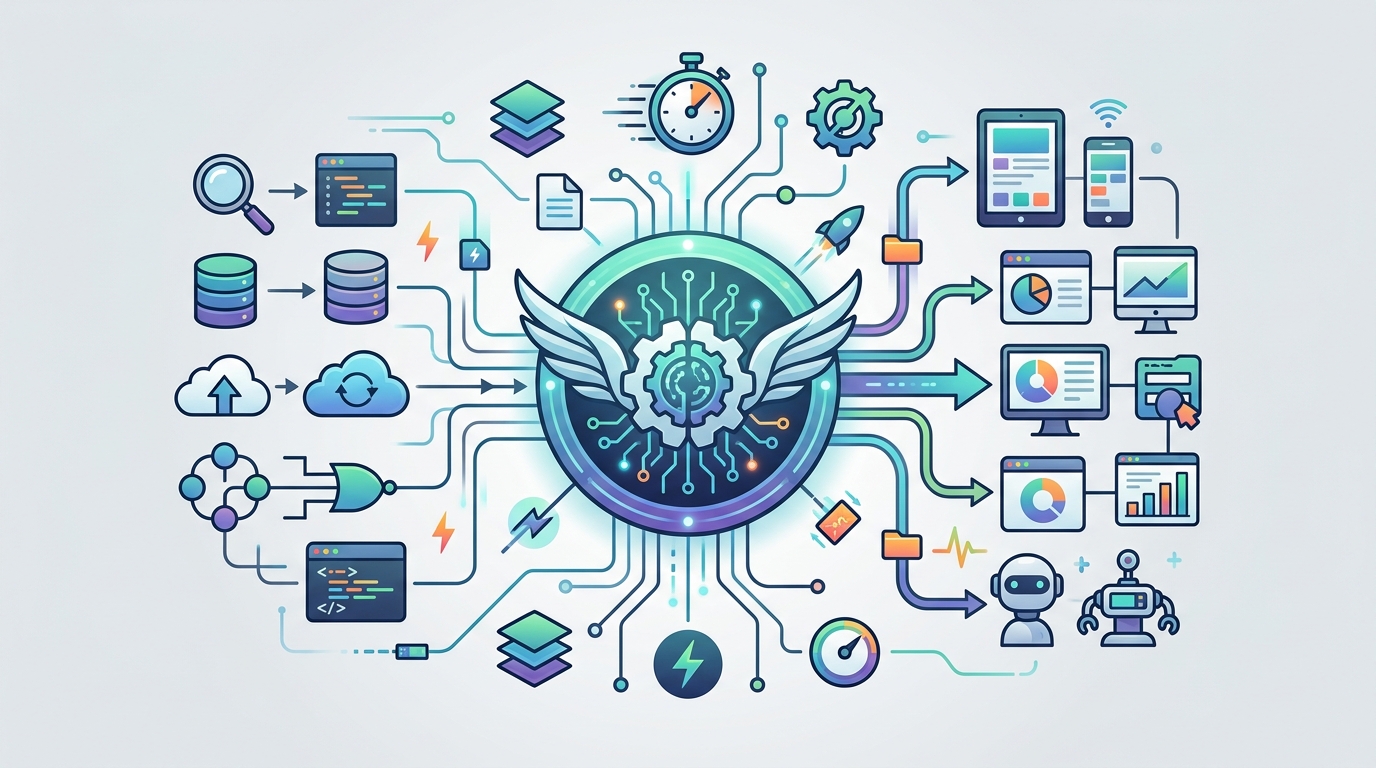
That focus can be a strength. Teams do not always need another giant abstraction. Sometimes they need a cleaner way to run the same agent task 100 times, compare outcomes, and spot failure modes without digging through ad hoc scripts.
Here is the practical comparison that matters:
- LangChain: broad ecosystem, many integrations, more general-purpose.
- DSPy: strong for structured prompt optimization and program design.
- CrewAI: oriented around multi-agent coordination and role-based workflows.
- Swarm: lightweight multi-agent coordination patterns from OpenAI’s experimental work.
- Hermes Agent: appears centered on harnessing, tracing, and repeatable agent evaluation.
The real difference is operational. If your pain is “I need more ways to chain tools,” LangChain may already cover enough. If your pain is “I need to know why this agent failed on run 37,” Hermes Agent’s framing is more interesting.
Why 2026 may reward boring infrastructure
Agent hype tends to reward the flashiest demo, but teams shipping products usually end up paying for boring infrastructure. That includes trace storage, failure classification, deterministic test sets, and replayable runs. Hermes Agent is interesting because it points directly at that layer.
The strongest frameworks in this category will probably be the ones that make experiments cheap and failures visible. A good harness can turn agent engineering from a one-off craft into a repeatable process. That is where the value compounds: faster debugging, clearer benchmarks, and fewer surprises when the model changes underneath you.
There is also a business angle here. As more companies connect LLMs to internal APIs, databases, and code execution, the cost of a bad agent decision rises fast. A framework that helps teams catch failure modes before deployment can save real money, not just engineering time.
My read is simple: Hermes Agent is worth watching if you care about building agents that survive contact with production. The next wave of winners will probably be judged less by how clever their prompts look and more by how well they handle retries, traces, and task-level scoring. If Hermes Agent delivers on that promise, it will matter to anyone shipping serious AI workflows.
The question to ask next is practical: when your agent fails, can you explain exactly why in under five minutes? If the answer is no, the harness matters more than the model.
// Related Articles
- [AGENT]
Perplexity should build Teammate as a coding agent, not a copilot
- [AGENT]
HP adopts OpenAI Frontier across global operations
- [AGENT]
Build a production vector DB for RAG
- [AGENT]
Ornith-1 turns agent coding into a server
- [AGENT]
Crypto AI agents are useful, but only for narrow workflows
- [AGENT]
AI Agents in Crypto: 2026 Protocol Guide