Hong Kong and Korea form Web3 policy alliance
Hong Kong and South Korean lawmakers launched a Web3 policy alliance to study AI, stablecoins, and shared crypto rules across both markets.

Two lawmakers in Hong Kong and South Korea just put policy coordination on the crypto agenda. On March 29, Hong Kong Legislative Council member Ng Kit-chung and South Korean National Assembly members launched the Hong Kong-South Korea Web3 Policy Promotion Alliance, a cross-regional group focused on digital assets, stablecoin rules, AI development, and blockchain infrastructure.
The timing matters. Hong Kong has spent the past two years building a regulated digital asset market, while South Korea remains one of Asia’s most active crypto trading hubs. A formal policy bridge between the two could shape how exchanges, issuers, and AI firms think about compliance across East Asia.
What makes this move interesting is not the press release itself. It is the mix of topics the alliance wants to cover: stablecoin mechanisms, regulatory standards, infrastructure links, and AI governance. That combination says a lot about how policymakers now see Web3. It is no longer treated as a narrow crypto issue. It now overlaps with payments, data systems, and machine intelligence.
Why this alliance matters now
Get the latest AI news in your inbox
Weekly picks of model releases, tools, and deep dives — no spam, unsubscribe anytime.
No spam. Unsubscribe at any time.
Hong Kong has been trying to position itself as a regulated digital asset hub, with a licensing regime for virtual asset trading platforms and a growing list of policy papers on tokenization. South Korea, meanwhile, has tightened market oversight after years of retail-driven trading growth and is still shaping its own rules for stablecoins and token issuers.

A joint policy group between lawmakers from both places may sound symbolic, but in Asia, symbolism often precedes practical coordination. If the group develops shared views on licensing, disclosure, reserve requirements, and cross-border data handling, it could lower friction for companies trying to operate in both markets.
- Hong Kong already licenses virtual asset trading platforms through the Securities and Futures Commission.
- South Korea has one of the highest per-capita crypto trading rates in Asia, driven by retail demand and local exchanges.
- Stablecoin policy is now a live issue in both markets, especially as governments look at payment use cases and reserve backing.
- AI regulation is entering the same policy conversation as crypto, which matters for firms building trading tools, compliance systems, and on-chain analytics.
The alliance is also the first cross-regional non-governmental policy cooperation platform in Asia, according to the report cited by PANews. That detail matters because informal policy groups often move faster than formal intergovernmental talks. They can test ideas, compare drafts, and surface common problems before regulators lock in a framework.
For builders, the practical question is simple: will Hong Kong and South Korea start converging on the rules that matter most for stablecoin issuance, exchange oversight, and AI-assisted financial products? If they do, firms operating in both places will get a clearer compliance map. If they do not, the region stays split into separate rulebooks.
Stablecoins and AI are now being grouped together
Stablecoins and AI may look like separate policy topics, but lawmakers are increasingly treating them as linked infrastructure issues. Stablecoins affect payments, settlement, and treasury management. AI affects fraud detection, customer support, market surveillance, and automated decision-making. Put them together, and you get a picture of the next generation of financial plumbing.
That is why the alliance’s scope is notable. It is not just about token trading or exchange licensing. It includes how blockchain systems connect across borders and how regulators can align standards without copying each other line for line.
"If we do not think about the rules of the road for AI and stablecoins now, we will be writing them in the middle of a crisis." — Christine Lagarde, President of the European Central Bank, speaking at the BIS Annual General Meeting in 2023
Lagarde’s warning was about Europe, but the logic fits Asia too. Once stablecoins begin moving larger payment volumes and AI tools are embedded into financial operations, regulators usually lose the luxury of slow debate. They need a framework before the market hardens around private standards.
That is exactly where Hong Kong and South Korea may have an opening. Both markets have serious financial infrastructure, active fintech sectors, and enough policy capacity to shape regional norms. A coordinated policy alliance can help them compare notes on reserve audits, disclosure rules, custody standards, and the use of AI in compliance workflows.
- The Hong Kong Monetary Authority has already been active on tokenization and digital money experiments.
- South Korea’s Financial Services Commission has pushed tighter market supervision and investor protection rules.
- The Bank for International Settlements has repeatedly warned that stablecoins need clear governance and reserve transparency.
- AI policy is now part of financial regulation, not a side topic, because trading, fraud detection, and onboarding tools increasingly use machine learning.
For companies building in this space, the message is straightforward: policy is catching up with product design. If your stablecoin model depends on vague reserve language, or your AI tooling cannot explain decisions to regulators, the gap will get expensive.
How Hong Kong and Korea compare on crypto rules
Hong Kong and South Korea are similar in one key way: both are trying to support innovation while keeping a tight grip on market abuse and consumer risk. They differ in how they got there.
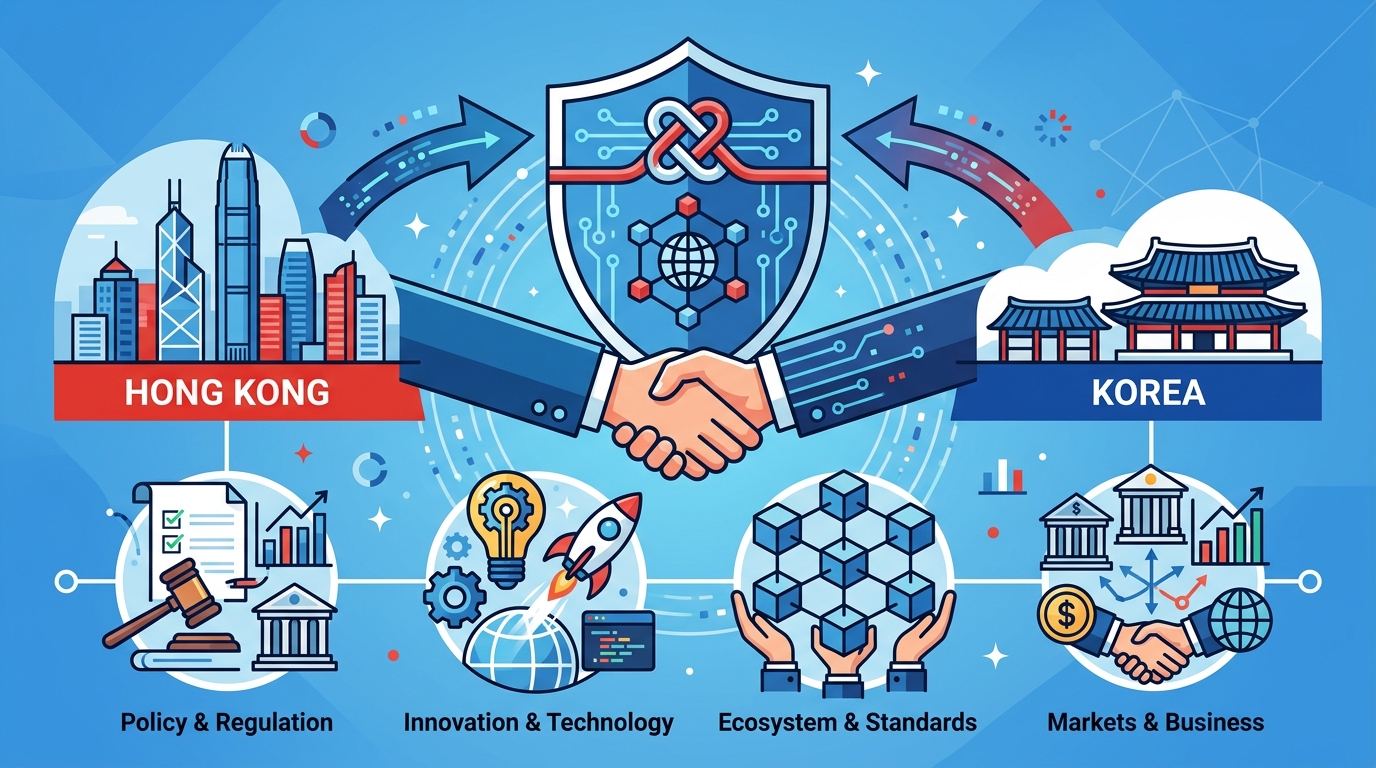
Hong Kong has leaned into a more formalized licensing model. South Korea has focused heavily on investor protection, exchange discipline, and market surveillance after a long period of retail speculation. That difference shapes how each market approaches stablecoins and token issuance.
Here is the practical comparison:
- Hong Kong allows licensed virtual asset trading platforms under a public regulatory framework.
- South Korea has not built the same public crypto exchange licensing model, but it has strong enforcement pressure on local platforms.
- Hong Kong is trying to attract institutional capital and tokenization projects.
- South Korea has a large retail base and a policy debate shaped by consumer protection and political scrutiny.
That split makes a policy alliance useful. If lawmakers can identify where the two systems overlap, they may help companies avoid building separate compliance stacks for every market. That matters for stablecoin issuers, custodians, blockchain infrastructure providers, and AI vendors selling risk tools into finance.
There is also a broader regional angle. Asia still lacks a single digital asset rulebook, and every country is writing its own version of what counts as a compliant token, a reserve-backed stablecoin, or acceptable AI use in financial services. A Hong Kong-Korea channel could become a practical testing ground for shared standards, even if it never turns into a formal treaty-style arrangement.
For readers following the policy side of crypto, this is the kind of development that matters more than a price chart. Rules shape where liquidity moves, where exchanges list products, and which companies can sell across borders without rebuilding their stack every quarter.
What to watch next
The key question is whether this alliance produces actual policy drafts or stays at the level of dialogue. If it starts publishing joint recommendations on stablecoin reserves, AI governance, or blockchain interoperability, it will become a reference point for other Asian regulators.
If it remains a talking shop, it still tells us something useful: lawmakers in two major Asian markets now see digital assets and AI as one policy file, not two. That alone changes how founders, exchanges, and financial institutions should plan for 2025 and beyond.
My read is simple. The next meaningful shift will not come from another token launch or exchange listing. It will come from whether Hong Kong and South Korea can agree on the basic rules that let compliant firms move between both markets without rewriting everything from scratch.
For builders, the takeaway is clear: watch stablecoin reserve rules, AI governance language, and cross-border licensing talks. Those details will matter more than the headline announcement, and they will decide which companies can scale across East Asia first.
// Related Articles
- [CHAIN]
UAE Web3 setup turns crypto rules into a checklist
- [CHAIN]
Five AI Futurist features shaping Futurist 2026
- [CHAIN]
Regulation Now Moves Bitcoin and Ethereum More Than War
- [CHAIN]
The SEC Crypto Rule Proposal Will Clean Up Crypto, Not Kill It
- [CHAIN]
Web3 platforms need fee discipline, not token theatrics, to make money
- [CHAIN]
Riyadh’s blockchain show proves Web3 is now infrastructure