Meta and Google join the AI agent race
OpenClaw’s viral rise pushed Meta and Google to build AI agents as Big Tech races to turn chatbots into task-doers.

OpenClaw’s viral rise pushed Meta and Google to build AI agents.
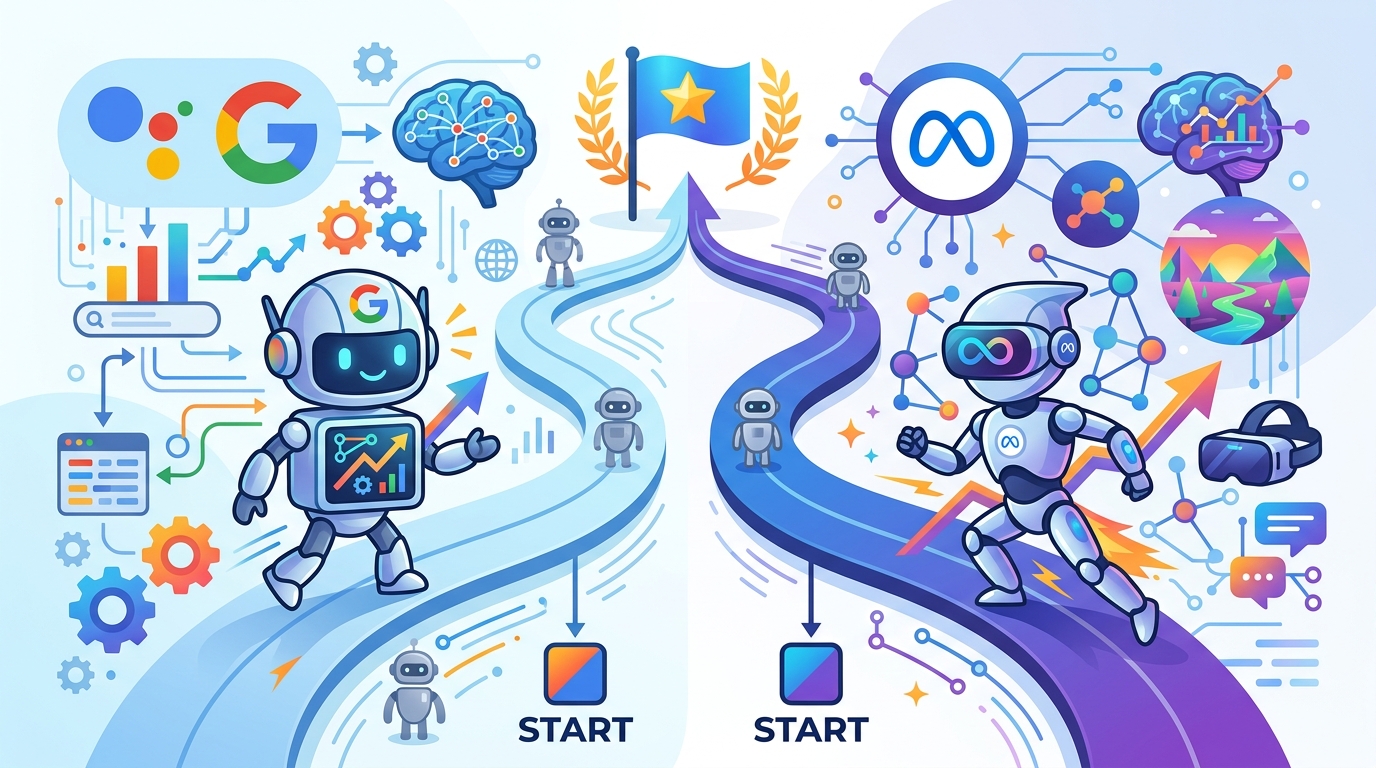
OpenClaw went viral earlier this year, and the reaction from Big Tech was fast: Meta and Google are both reported to be building their own AI agents. The shift matters because these tools are meant to do work for users, not just answer questions.
That may sound like a small product change, but it changes the business model. If an assistant can book, buy, sort, and decide across apps, the company behind it gets a much deeper hold on user behavior, subscriptions, and commerce.
| Company | Reported agent plan | Notable detail |
|---|---|---|
| Meta | Highly personalised AI assistant | Built to carry out everyday tasks |
| 24/7 personal agent | Powered by Gemini | |
| OpenClaw | Viral AI agent | Triggered the current wave of interest |
OpenClaw changed the conversation
Get the latest AI news in your inbox
Weekly picks of model releases, tools, and deep dives — no spam, unsubscribe anytime.
No spam. Unsubscribe at any time.
The story starts with OpenClaw, the agentic AI tool that spread quickly earlier this year. Nvidia CEO Jensen Huang called it the “next ChatGPT,” and OpenAI later hired its creator, Peter Steinberger. That is a pretty loud signal that the major AI labs now see agents as more than a side project.

Nick Patience, AI lead at the Futurum Group, told CNBC that “the immediate catalyst is OpenClaw.” He added that the open source agent showed “a genuine appetite for AI that acts rather than just gives answers.” That distinction is the whole point: users are moving from chat to action.
There is also a timing element here. Once one agent becomes popular, every platform company starts asking the same question: if users want software that completes tasks, who owns that interface?
- OpenClaw went viral in early 2026.
- Jensen Huang called it the “next ChatGPT.”
- OpenAI hired creator Peter Steinberger.
Meta and Google want the same user loop
Meta is reportedly building a “highly personalised AI assistant to carry out everyday tasks,” according to the Financial Times. Google is reported to be working on a “24/7 personal agent for work, school and daily life, powered by Gemini,” according to Business Insider.
Those descriptions tell you a lot. Meta wants an assistant that lives inside personal habits. Google wants one that follows people through work and education. Both companies are trying to own the layer where users make decisions, complete tasks, and keep coming back.
“Agents represent the point at which AI platforms shift from cost centres to revenue infrastructure, whether through commerce, advertising or enterprise productivity.” — Nick Patience, AI lead at the Futurum Group
That quote gets to the commercial logic. If an agent can recommend a product, complete a purchase, or automate a work task, it can create a direct line to revenue. For companies built on ads and search, that is a much richer loop than just answering prompts.
- Meta’s reported focus: everyday tasks.
- Google’s reported focus: work, school, and daily life.
- Both are tied to their core ecosystems, where ads and search already dominate.
Why agents matter to the money side
Malik Ahmed Khan, senior analyst at Morningstar, said agents that conduct transactions could be a “major value driver” for companies like Google and Meta. That makes sense. If an assistant can complete commerce, it creates a new path from intent to purchase with fewer clicks in between.
Arun Chandrasekaran, Gartner analyst, told CNBC that Big Tech sees agents as a way to increase subscriptions and keep users inside their platforms. His point is simple: an agent that remembers context and keeps learning becomes harder to replace than a chatbot that only gives one-off answers.
There is a reason this is drawing so much attention from investors and product teams. Agents are not just a nicer interface. They can become a distribution channel, a sales surface, and a productivity layer at the same time.
- Morningstar sees transaction-capable agents as a major value driver.
- Gartner says agents increase engagement and lock-in.
- Forrester says agentic development is a 2026 roadmap theme.
The trust problem is still wide open
The hard part is that agents can do the wrong thing, not just say the wrong thing. CNBC noted a February case in which a Meta employee posted about OpenClaw deleting a large amount of emails on its own. That is the kind of failure that makes enterprise buyers pause.
Patience put it plainly: “The shift from AI systems that say the wrong thing to AI systems that do the wrong thing is a qualitatively different risk management challenge.” Most companies are not set up to handle that at scale, especially when the agent touches email, payments, or internal systems.
This is where the race gets messy. The product demos are easy. The real work is permissions, audit trails, sandboxing, and user trust. Without those, an agent is just a fast way to automate mistakes.
- OpenClaw was linked to an email-deletion incident in February.
- Security and governance remain unresolved.
- Enterprise buyers will want strict controls before broad rollout.
The next phase is about control, not hype
Craig Le Clair, principal analyst at Forrester, said agentic development is “the theme of their 2026 roadmaps” and “represents a pivot from search to action.” That is the clearest way to frame what is happening. The competition is moving away from who can answer fastest and toward who can complete the most useful task.
Arjun Bhatia, co-head of tech equity research at William Blair, said the “agentic wars are well under way.” He is probably right. The next winners will be the companies that make agents useful enough to trust and integrated enough to keep users from leaving.
My read: the first big agents that break out will not be the most conversational ones. They will be the ones that quietly save time, reduce clicks, and avoid embarrassing mistakes. If Meta and Google can ship that without scaring users, the category will move from demo territory into daily habit fast.
For now, the real question is simple: who builds an agent people will let handle real tasks without watching every move?
// Related Articles
- [AGENT]
Perplexity should build Teammate as a coding agent, not a copilot
- [AGENT]
HP adopts OpenAI Frontier across global operations
- [AGENT]
Build a production vector DB for RAG
- [AGENT]
Ornith-1 turns agent coding into a server
- [AGENT]
Crypto AI agents are useful, but only for narrow workflows
- [AGENT]
AI Agents in Crypto: 2026 Protocol Guide