ROCm vs CUDA: GPU Computing Comparison
ROCm and CUDA trade lower cost and openness against broader support and faster performance.

ROCm and CUDA trade lower cost and openness against broader support and faster performance.
ROCm and CUDA are the two main GPU computing stacks for AI work, and this comparison helps teams choose between AMD’s lower-cost, open approach and NVIDIA’s faster, more mature platform.
At a glance
Get the latest AI news in your inbox
Weekly picks of model releases, tools, and deep dives — no spam, unsubscribe anytime.
No spam. Unsubscribe at any time.
| Dimension | ROCm | CUDA |
|---|---|---|
| Typical performance lead | Often 10% to 30% behind CUDA; some memory-bound jobs narrow the gap | Usually 10% to 30% faster in 2025 benchmarks |
| Hardware cost | 15% to 40% lower on comparable AMD datacenter cards | Premium pricing, but strong resale and enterprise demand |
| Hardware coverage | Full support for MI series; consumer RX 7000/9000 support is improving | Broad NVIDIA support from GTX 1650 to H100 and beyond |
| Framework support | PyTorch official on Linux, plus TensorFlow and JAX support | Broader support across major AI frameworks and libraries |
| Setup complexity | Higher; driver and kernel tuning often needed | Lower; package managers and containers simplify installs |
| Best fit | Teams optimizing for cost, openness, and AMD hardware | Teams optimizing for speed, compatibility, and developer time |
ROCm
ROCm’s main appeal is economic and architectural: you can buy into AMD’s stack at a lower hardware cost, then keep more control over the software layer because it is open source. In the June 2026 landscape, that matters more than it did a few years ago, because ROCm now has official PyTorch support on Linux and a much wider hardware story than before.
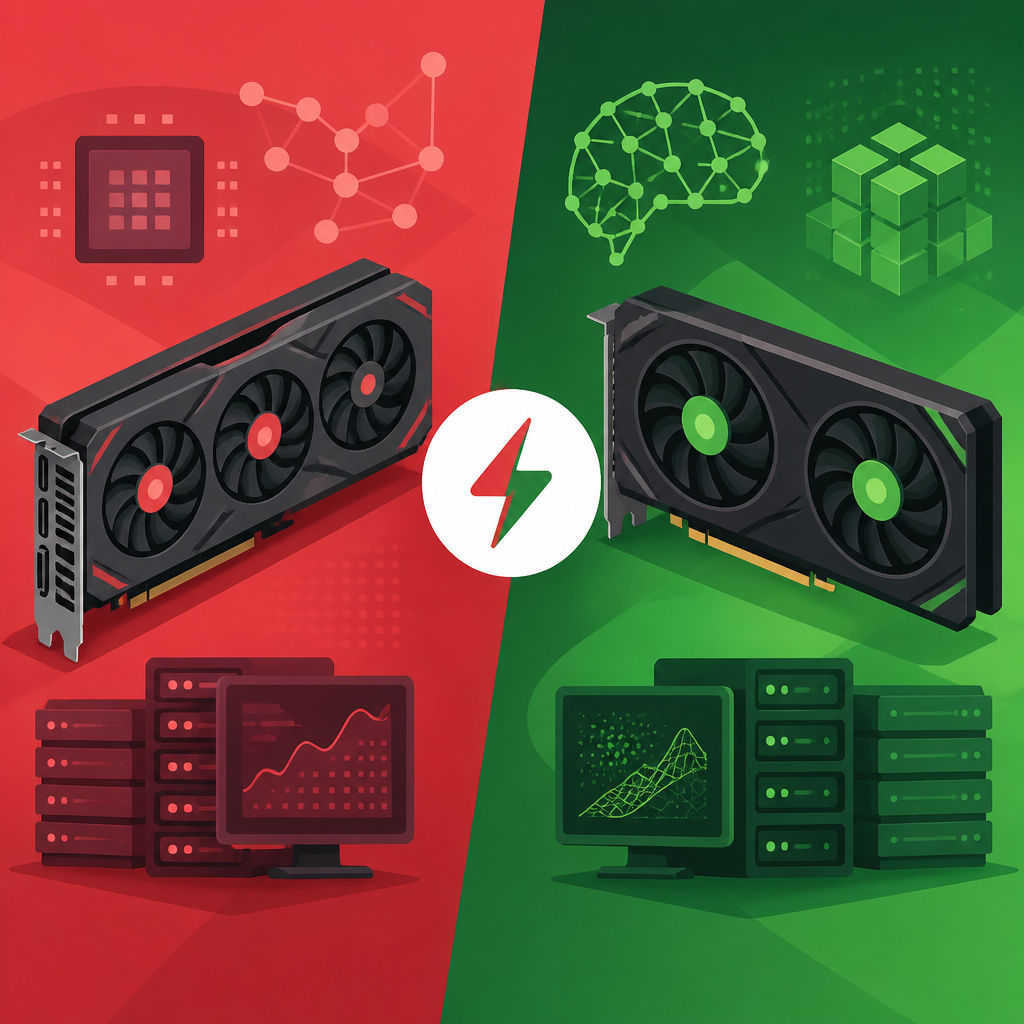
The catch is that ROCm still asks more from the team. Setup can involve driver checks, kernel parameters, and more manual debugging than CUDA, and the ecosystem is thinner when you need niche libraries or the fastest possible path to production. For groups with strong Linux skills and a willingness to tune, that trade can be worth it.
CUDA
CUDA remains the safer default because it combines performance, compatibility, and tooling in one package. NVIDIA’s ecosystem has had nearly two decades to mature, so the path from laptop prototype to datacenter deployment is smoother, and the library depth around cuDNN, cuBLAS, and related tools still gives it an edge in many AI workloads.
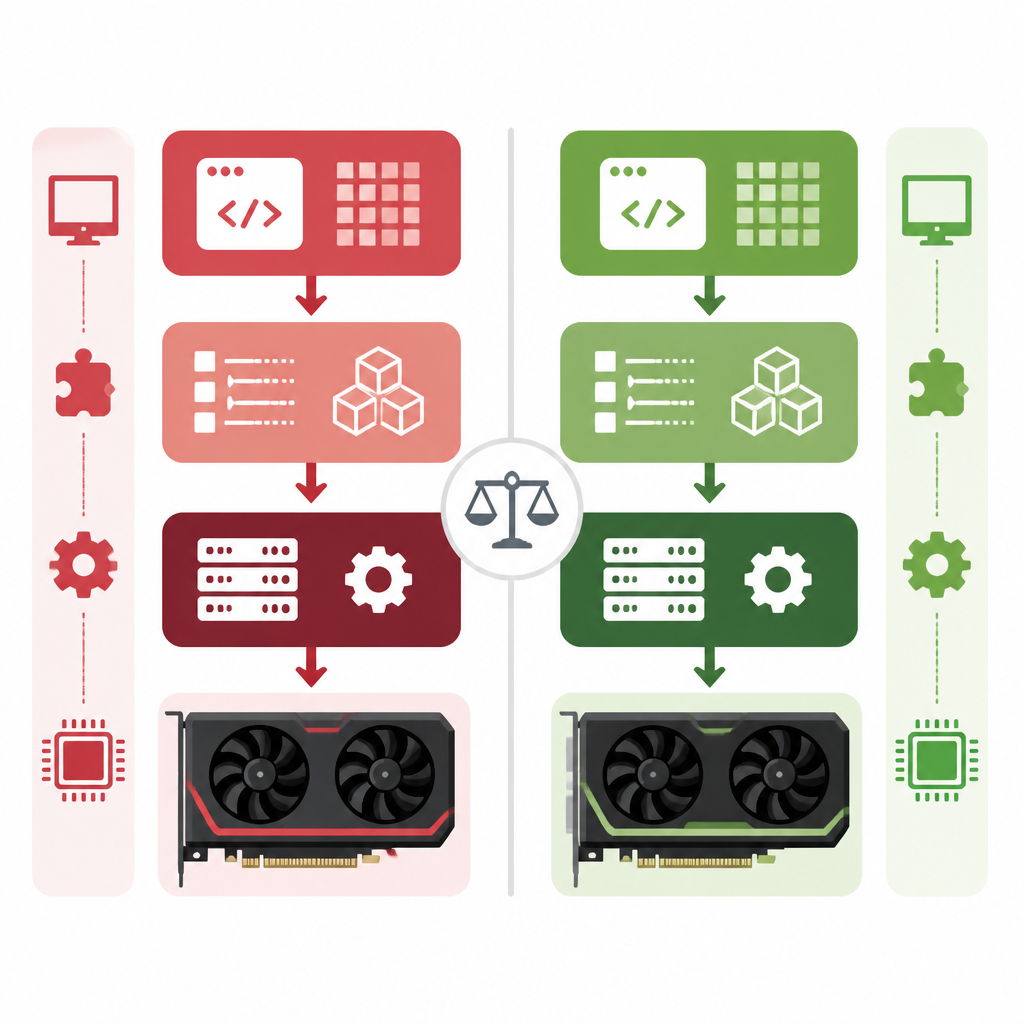
That maturity comes with a cost. NVIDIA hardware is usually more expensive, and the closed stack creates vendor lock-in that some teams want to avoid. If your roadmap depends on predictable deployment across many frameworks, CUDA is still the least risky choice, but it is not the cheapest one.
Performance and portability
On raw speed, CUDA usually wins today, especially in training and heavily optimized deep learning pipelines. The article’s benchmark summary puts the gap at roughly 10% to 30%, and even where AMD’s MI300X has impressive theoretical compute, real-world inference can still land well below H100 or H200 results depending on the workload.
ROCm narrows that gap in memory-heavy or cost-sensitive scenarios, and HIP makes code portability much better than it used to be. That means the decision is no longer “can ROCm run this?” so much as “is the performance delta worth the extra spend and the easier operations CUDA gives me?”
When to pick what
If you are a startup, research lab, or internal platform team with tight budgets and solid Linux expertise, pick ROCm when hardware cost matters more than shaving every last millisecond off inference.
If you are shipping production AI systems, need broad framework compatibility, or want the least painful developer experience, pick CUDA, because the time saved on setup and troubleshooting often outweighs the higher GPU bill.
If you are already invested in NVIDIA hardware or rely on specialized CUDA libraries, stay with CUDA unless cost pressure is severe enough to justify migration work.
If you are building on AMD datacenter cards or want to avoid vendor lock-in, ROCm is the better long-term bet, especially for teams willing to validate workloads carefully.
Default to CUDA, but switch to ROCm when lower hardware cost and openness are more valuable than peak performance and ecosystem breadth.
// Related Articles
- [IND]
Xiaomi MiMo Code tops Claude Code on 200-step tasks
- [IND]
OpenAI’s Ona buy adds more reach to Codex
- [IND]
The US should set tokenization rules now, or lose the market
- [IND]
SEC Rule Changes Could Unlock Tokenized Stocks
- [IND]
Kalshi adds Solana perpetual futures after XRP
- [IND]
MLOps is not optional if you want ML in production