SEC and CFTC Clarify Crypto Asset Classification
The SEC and CFTC issued joint guidance on March 17, 2026, clarifying when crypto asset transactions fall under federal securities laws.
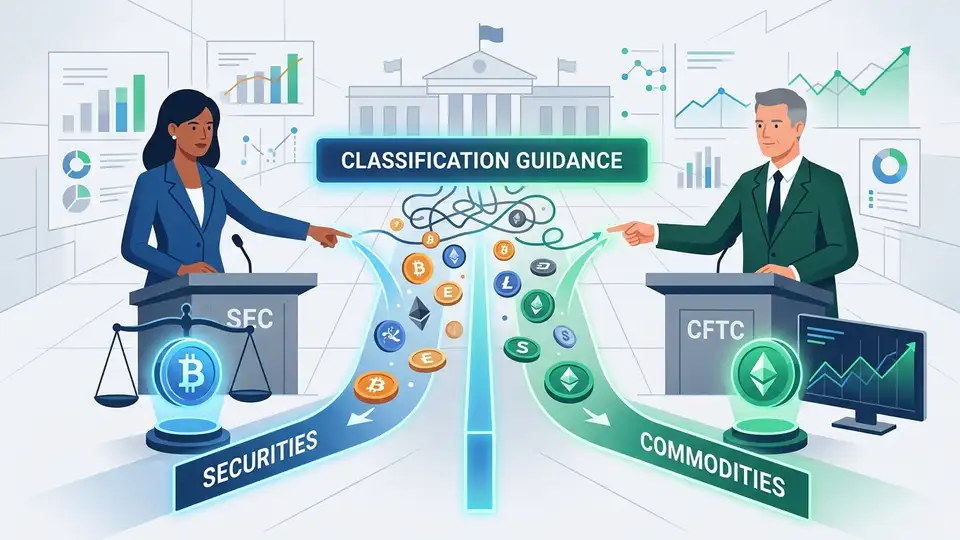
On March 17, 2026, the Securities and Exchange Commission and the Commodity Futures Trading Commission put out joint guidance that finally gives market participants a clearer line on when crypto asset transactions fall under federal securities laws. For an industry that has spent years arguing over whether a token is a security, a commodity, or something in between, that matters immediately.
The guidance arrives after years of enforcement-led ambiguity, and it gives lawyers, exchanges, issuers, and trading platforms a new reference point for structuring products. It does not erase every gray area, but it does narrow the range of excuses for guessing wrong.
What the joint guidance changes
Get the latest AI news in your inbox
Weekly picks of model releases, tools, and deep dives — no spam, unsubscribe anytime.
No spam. Unsubscribe at any time.
The core issue is classification. If a crypto asset transaction is treated as a securities transaction, then registration, disclosure, broker-dealer rules, exchange rules, and anti-fraud provisions can apply. If it falls outside that bucket, the compliance path changes fast.

The agencies’ release focuses on when the facts around a crypto asset transaction trigger federal securities laws. That means the analysis is less about branding a token once and more about looking at how the asset is sold, marketed, distributed, and traded.
That shift matters because a token can behave differently across its lifecycle. A project may start with capital-raising sales that look like securities offerings, then later trade in a way that looks more like a commodity product or a spot market asset.
- March 17, 2026: joint SEC-CFTC guidance released
- Two federal agencies involved instead of one, which matters for cross-market products
- Focus on transaction facts, not just token labels
- Implications for issuers, exchanges, brokers, and custodians
- Likely impact on token listings and compliance reviews
Why this matters for crypto companies
For crypto companies, the biggest practical effect is uncertainty reduction. That does not mean regulatory risk disappears. It means legal teams now have a more concrete framework for deciding whether a token sale, a secondary market listing, or a structured product needs securities-law treatment.
This will affect more than headline-grabbing token launches. It also affects treasury teams holding digital assets, trading venues deciding what to list, and startups planning incentive programs that include token distributions.
In plain English: if your business touches a token, you need to know whether the transaction looks like an investment contract, a trading product, or a plain-vanilla transfer. The answer may differ depending on the exact facts.
- Token issuance documents may need a fresh legal review
- Exchange listing committees may tighten due diligence
- Broker-dealers may revisit custody and routing workflows
- Funds may update offering memoranda and risk disclosures
What the agencies are signaling
The SEC and CFTC have fought over digital asset jurisdiction for years, so a joint release is a meaningful signal on its own. It suggests both agencies see value in a shared framework rather than forcing market participants to guess which regulator will act first.

That said, this guidance is still a regulatory document, not a court ruling. Companies will still need to map their own facts against the standards in the release, and the hardest cases will remain the hybrid ones: assets with utility features, governance rights, and fundraising history all wrapped together.
“We are committed to providing clarity and certainty to the market,” said SEC Chair Gary Gensler in a statement on the SEC’s website in 2023, when discussing digital asset oversight.
That quote is older than the March 2026 release, but it captures the policy logic that has now moved into joint guidance: regulators want fewer surprises, and they want the market to do more of the legal work before launching products.
For compliance teams, the important takeaway is that the agencies are no longer acting like crypto is a one-regulator problem. That alone changes how firms should build internal review processes.
How this compares with past crypto enforcement
Before this guidance, much of U.S. crypto law was shaped by enforcement actions and speeches. That created a messy environment where firms had to infer policy from litigation and settlements. The new release gives the market something more concrete to work from.
Compared with the old approach, the main difference is the emphasis on joint interpretation. A token project that once had to guess whether the SEC or the CFTC would take the lead now gets a better sense of where the lines may be drawn.
That matters because the costs of getting it wrong are high. Securities-law violations can lead to rescission risk, registration problems, trading restrictions, and civil penalties. For a startup, any one of those can slow fundraising or block an exchange listing.
- Past approach: enforcement cases and speeches
- New approach: joint agency guidance
- Past result: token teams built around uncertainty
- New result: more structured legal analysis, but still fact-specific
- Past risk: inconsistent agency signals
- New risk: firms that ignore the guidance will have a harder defense
There is still a long way between guidance and full statutory reform. Congress has not rewritten the core federal framework for digital assets, and courts still matter when disputes turn into lawsuits. But this release gives the industry a cleaner starting point than it had last month.
What to do next
If you run a crypto business, the practical move is simple: review every product, token, and distribution flow against the new guidance before the next launch or listing. Do that now, while you can still change the structure, not after a regulator asks questions.
If you are an investor, the new guidance should make diligence a bit sharper. Ask how a token was sold, who bought it, what rights it carries, and whether the trading venue has actually checked the securities-law angle.
My read is that this release will push the market toward more careful product design and fewer casual token launches. The firms that adapt fastest will probably spend less time in regulatory cleanup and more time building. The ones that ignore the details may discover that “we thought it was fine” is not a compliance strategy.
For developers and founders, the next question is simple: if your token were reviewed line by line tomorrow, would you be able to explain why it is not a securities transaction? If the answer is fuzzy, the new guidance gives you a reason to fix that before launch day.
// Related Articles
- [CHAIN]
UAE Web3 setup turns crypto rules into a checklist
- [CHAIN]
Five AI Futurist features shaping Futurist 2026
- [CHAIN]
Regulation Now Moves Bitcoin and Ethereum More Than War
- [CHAIN]
The SEC Crypto Rule Proposal Will Clean Up Crypto, Not Kill It
- [CHAIN]
Web3 platforms need fee discipline, not token theatrics, to make money
- [CHAIN]
Riyadh’s blockchain show proves Web3 is now infrastructure