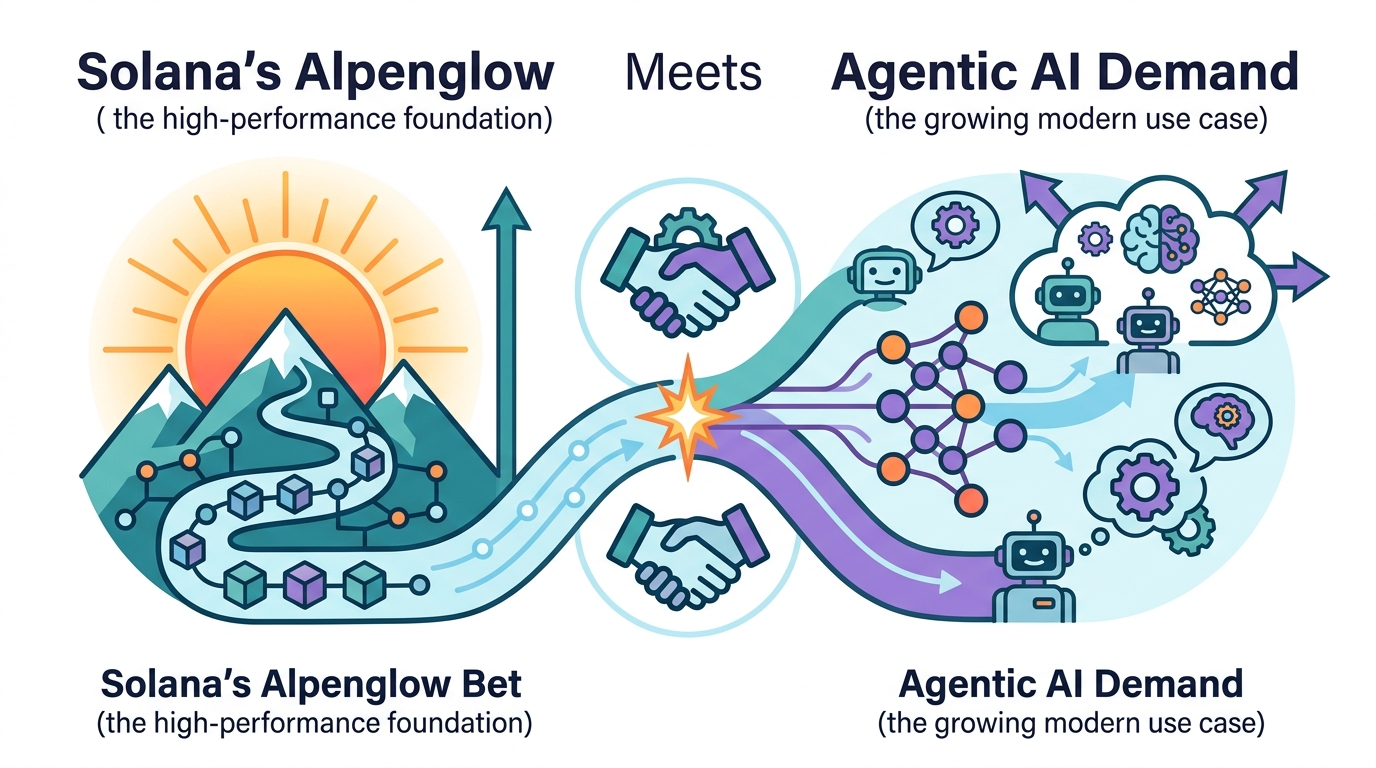
Solana’s Alpenglow Bet Meets Agentic AI Demand
Solana is pushing Alpenglow, while institutional inflows and AI-agent activity test whether faster rails can support real demand.

Solana is making a big bet on its own plumbing. The network is preparing Alpenglow, a core protocol overhaul that community records say won support from about 98% of participating token holders in a 2025 vote. At the same time, SOL has been trading above $90 and recently gained 3.3% in 24 hours, with a seven-day rise of 2.8%.
That combination matters because Solana is trying to do two things at once: keep attracting institutional money and prove it can handle a new class of on-chain software, especially autonomous AI agents. If the network can improve throughput, reduce congestion, and keep fees predictable, it has a better shot at becoming useful infrastructure rather than just a high-activity chain with a loud meme cycle.
Solana is trying to move past the meme trade
Get the latest AI news in your inbox
Weekly picks of model releases, tools, and deep dives — no spam, unsubscribe anytime.
No spam. Unsubscribe at any time.
For a long stretch, Solana was the chain traders associated with fast tokens, speculative launches, and frantic retail activity. That still exists, but the newer narrative is much more practical: AI agents, tokenized assets, and automated strategies built directly on-chain. The article’s framing around an “Agentic Economy” is a good shorthand for this shift.

In plain English, this means software agents can hold treasuries, execute strategies, and interact with other programs without a human clicking every button. Some of these projects use Token Extensions, often called Token-2022, to add logic to tokens. That lets developers build features like transfer hooks, confidential balances, and custom controls that standard SPL tokens do not provide.
The market has started to price this in, at least partially. The network’s recent price action reflects two competing forces: optimism around technical upgrades and caution from traders who remember how fast congestion and outage headlines can sour sentiment. Solana’s current move above $90 is encouraging, but the $100 level still matters as a psychological barrier.
- SOL gained 3.3% in 24 hours, based on the cited market data.
- SOL rose 2.8% over seven days, ahead of the broader market’s 1.3% daily rise.
- The token traded above $90 while facing resistance near $100.
- Community governance records showed about 98% support for Alpenglow in a 2025 vote.
Alpenglow is about more than speed
Alpenglow is the technical centerpiece here, and it is not just a cosmetic update. Solana has long sold itself on low latency and high throughput, but the chain has also had to deal with congestion spikes and past outages, especially in 2023. The upgrade is meant to improve decentralization, throughput, and fee behavior while making the network easier to use during busy periods.
That matters because Solana’s biggest selling point has always been that it can handle fast, frequent transactions. If the chain wants to support serious automated trading systems, liquid staking strategies, and agent-to-agent interactions, it needs predictable performance under load. A chain that is fast most of the time is useful. A chain that is fast when volume is low and flaky when volume spikes is much less interesting.
There is also a second layer to this story: infrastructure builders are trying to reduce congestion before it becomes a crisis again. New scaling projects on top of Solana have helped absorb demand during peak periods, and that gives developers more room to ship apps without worrying that a burst of activity will wreck user experience.
“The idea that Solana is just a memecoin chain is over,” said Raj Gokal, Solana co-founder, in a 2024 interview with CoinDesk.
That quote matters because it captures how the team wants the network to be understood now. Solana is still a trading-heavy chain, but the goal is broader: payments, tokenized assets, DeFi, and agent-driven automation. The upgrade path is trying to match that ambition with actual capacity.
Institutional flows are giving Solana a second tailwind
The other half of the story is capital. Institutional interest in Solana-linked products has risen, with ETF products recording net inflows since early 2026, according to the source article’s cited market data. That does not mean institutions are suddenly treating SOL like a bond substitute. It does mean the asset remains in professional allocation conversations, which is a meaningful change from the days when it was dismissed as a retail-only trade.
This matters for two reasons. First, institutional demand tends to smooth out some of the wildest price swings, even if it does not eliminate them. Second, capital from larger allocators often pulls attention toward cleaner infrastructure, stronger compliance posture, and more durable use cases. If Solana can keep attracting that money while improving network reliability, the chain becomes more credible for tokenized custody and enterprise-style applications.
There is a direct comparison worth making here. Bitcoin Bitcoin is still the benchmark for passive, store-of-value positioning, while Solana is trying to win on utility and transaction volume. Bitcoin uses Proof of Work and mining hardware. Solana uses Proof of Stake plus Proof of History, which gives it a different performance profile and a different economic model.
- Bitcoin relies on mining hardware and energy-intensive Proof of Work.
- Solana validates through staking and Proof of History, with transaction timing baked into the chain.
- Solana is designed for millisecond-level processing, which suits trading and app activity.
- Staking SOL with a validator is the main passive-reward path, not mining.
That technical difference is why institutions are paying attention. They are not buying Solana because it is similar to Bitcoin. They are buying it because it can do things Bitcoin cannot, especially when speed and transaction density matter.
The agentic economy still has real risks
There is a lot of hype around AI agents, and some of it is deserved. On Solana, the more credible projects are the ones that actually execute on-chain logic, manage treasuries, and interact with liquidity pools. But the same openness that makes this exciting also makes it messy. Traders now have to inspect contract code, treasury behavior, and token mechanics instead of trusting a logo and a Discord channel.
That is why tools like DEXTools and security-focused scoring systems matter more than they used to. If an agent token hides mint authority, keeps dangerous permissions, or relies on shaky liquidity, the risk is not theoretical. It can turn into a fast rug pull or a liquidation chain reaction, especially when the strategy depends on leveraged positions in liquid staking tokens like Jito’s JitoSOL.
That risk profile is very different from the old “buy the token because AI is hot” trade. Here are the practical points investors and builders are watching:
- Whether the token uses Token-2022 features for real utility, not just marketing.
- Whether the treasury wallet actually executes strategy logic on-chain.
- Whether liquidity depth can survive a sudden volatility spike.
- Whether the project’s smart contracts have been audited by a credible firm.
In other words, Solana’s AI-agent story is only as strong as the code behind it. If the agents are real, useful, and secure, they can deepen demand for the chain. If they are mostly wrappers around speculation, the narrative fades fast.
What happens next depends on execution, not slogans
Solana is entering a phase where its technical roadmap and its market story are finally pulling in the same direction. Alpenglow, scaling work, and institutional inflows all point to a network that wants to be taken seriously for more than fast retail trading. The interesting part is that the market has not fully decided whether to reward that shift yet.
If Alpenglow improves reliability without sacrificing the speed that made Solana attractive in the first place, the chain could become a stronger base for agent-driven apps and tokenized finance. If congestion returns during a volatile market stretch, traders will remember the old Solana faster than the new narrative.
My read: the next big test is whether SOL can hold above $100 while on-chain activity stays high and the upgrade story keeps delivering measurable improvements. If that happens, the market will stop treating Solana as a speculative venue with good branding and start pricing it like infrastructure that earns its volume.
For developers and investors, the practical question is simple: does the code actually reduce friction, or is the agentic economy just the latest label on top of old speculative behavior?
// Related Articles
- [CHAIN]
Crypto exchanges should show up in LATAM, not just advertise there
- [CHAIN]
UAE Web3 setup turns crypto rules into a checklist
- [CHAIN]
Five AI Futurist features shaping Futurist 2026
- [CHAIN]
Regulation Now Moves Bitcoin and Ethereum More Than War
- [CHAIN]
The SEC Crypto Rule Proposal Will Clean Up Crypto, Not Kill It
- [CHAIN]
Web3 platforms need fee discipline, not token theatrics, to make money