Solana’s 2026 push: institutions, AI, and fixes
Solana is chasing institutions and AI agents while fixing reliability concerns, with SOL near $79 and fresh partnerships from Mastercard and Western Union.

Solana launched in 2020 with a simple pitch: move fast, keep fees low, and make blockchain apps feel less painful to use. Today, CoinDesk’s Solana coverage shows a network trying to do something even harder: win over institutions, support AI-driven apps, and stay credible after years of reliability questions. At the time of writing, SOL is trading around $79.15, with the broader crypto market also in motion.
That price matters less than the direction of the news flow. In the last few days alone, CoinDesk has reported on a Solana Foundation developer platform tied to Mastercard, Western Union, and Worldpay, plus a privacy framework aimed at enterprise users. That is a very different story from the old “fast chain, cheap chain” pitch.
Solana’s pitch is now bigger than speed
Get the latest AI news in your inbox
Weekly picks of model releases, tools, and deep dives — no spam, unsubscribe anytime.
No spam. Unsubscribe at any time.
Solana’s original technical identity came from Proof of History, paired with Proof of Stake, which helped the chain process transactions faster than many early competitors. The network was built to support high throughput, low fees, and applications that would have been too expensive on older chains during peak demand.

That performance story still matters, but the ecosystem has changed. Solana is now trying to be the default chain for consumer apps, tokenized finance, and machine-to-machine activity. CoinDesk’s recent reporting shows the chain moving from “can it handle load?” to “who wants to build real businesses here?”
- SOL launched in 2020
- The chain uses Proof of History plus Proof of Stake
- CoinDesk’s market snapshot shows SOL near $79.15
- Bitcoin is around $66,454.26 and Ethereum around $2,046.78
- CoinDesk’s broader market index shows $1,893.11
Those numbers tell a useful story. Solana is still well below the kind of price levels that usually trigger euphoric headlines, but it remains one of the most watched large-cap networks because its usage story keeps widening. The chain’s identity is no longer tied to one killer app or one speculative cycle.
Institutions are showing up with checkbooks and checklists
The clearest change in Solana coverage is the institutional angle. CoinDesk reported that the Solana Foundation is building a developer platform with Mastercard, Western Union, and Worldpay. That matters because enterprise adoption usually fails for boring reasons: compliance, integration, custody, and privacy.
Solana is also pushing a privacy framework for institutions. The pitch is straightforward: companies want blockchain rails, but they do not want every internal detail exposed to the public by default. That is a practical problem, and Solana is trying to solve it instead of pretending transparency alone is enough.
“The next phase of crypto adoption will depend less on transparency alone and more on giving companies control over what they reveal — and to whom.” — Solana Foundation, via CoinDesk reporting
That quote captures the direction of travel pretty well. Solana is trying to become infrastructure for payments, tokenization, and enterprise apps, not just a venue for trading memes. If that sounds less flashy than a new NFT boom, that is because it is.
AI agents are becoming part of the Solana story
One of the more interesting threads in CoinDesk’s recent Solana coverage is the network’s push into AI agents. The Solana Foundation says the chain is becoming core infrastructure for the “agentic” internet, a term that basically means software agents that can act, transact, and coordinate without a human clicking every button.
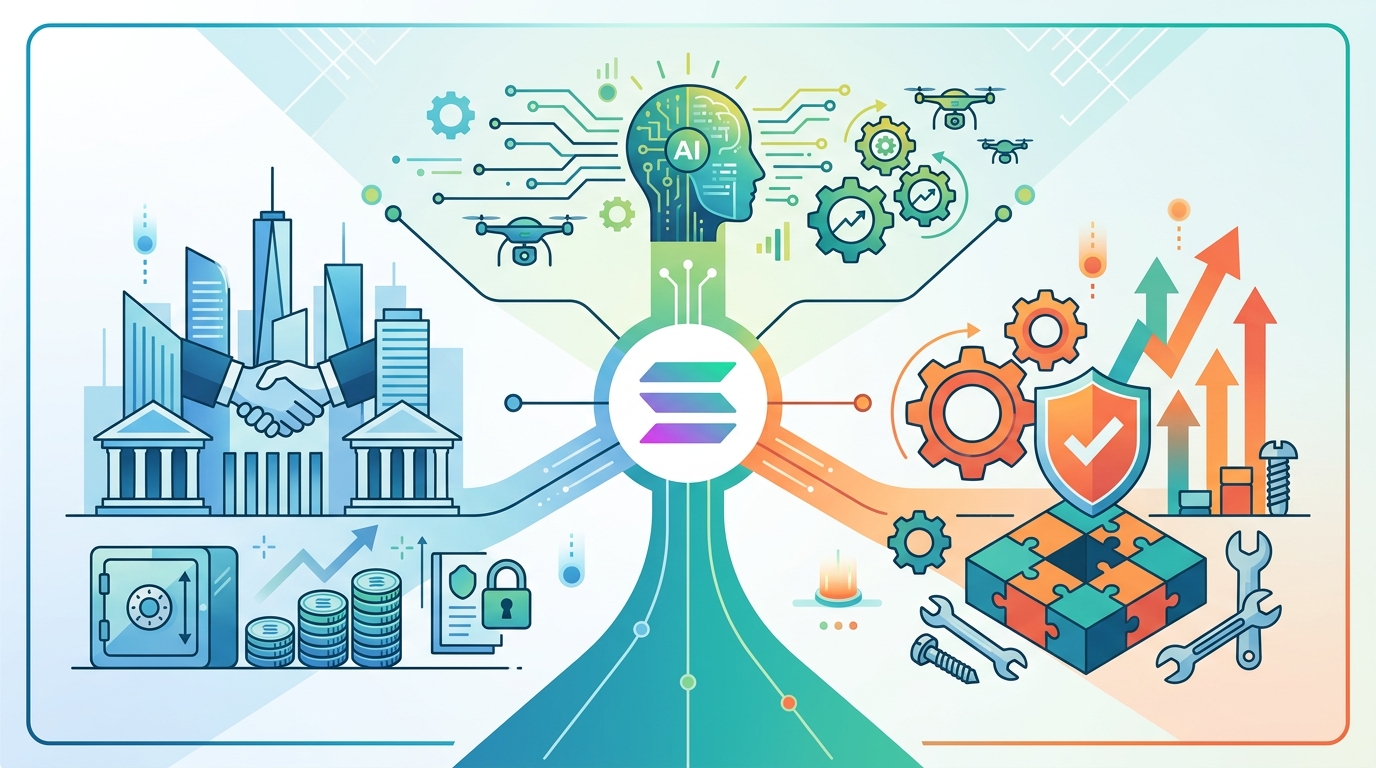
That idea is easy to dismiss as buzzword soup, but the underlying use case is real. If an AI agent needs to pay for API calls, move funds, or settle microtransactions, a chain with low fees and fast confirmation is more useful than one that costs too much to touch. Solana is betting that this kind of activity will matter more than another wave of speculative token trading.
- CoinDesk reported the Foundation’s AI-agent push on Mar. 25, 2026
- CoinDesk also reported a privacy framework for institutions on Mar. 23, 2026
- Backpack launched BP on Solana with a 25% airdrop and no insider allocation
- Solana ETF demand is drawing more institutional interest than XRP products, per CoinDesk’s coverage
The important part here is not the label “AI.” It is whether Solana can become the payment and settlement layer for software that acts on its own. If that happens, the chain’s low-fee design suddenly looks less like a trading perk and more like a business requirement.
Reliability is still the tax Solana pays
For all the new institutional polish, Solana still has to answer the same old question: can it stay online under pressure? CoinDesk recently reported that Drift, a DeFi platform on Solana, confirmed an “active attack” while more than $200 million left the platform and deposits were halted. That was a platform-level incident, not a chain outage, but the optics still matter for a network that sells itself on reliability.
Solana’s history here is complicated. The chain has faced outages before, and every one of them has given critics fresh ammunition. The newer story is that developers kept building anyway. That resilience is part technical confidence, part economic gravity: if enough users, apps, and capital cluster on one chain, it becomes harder to walk away.
- Solana: low fees, high throughput, fast finality
- Ethereum: deeper developer history, higher fees, broader base layer adoption
- Bitcoin: strongest brand, slower payments use cases, more limited app logic
- Solana’s challenge: keep uptime strong while scaling institutional and AI use cases
Compared with Ethereum, Solana still has the cleaner pitch for cheap consumer activity. Compared with Bitcoin, it offers far more room for app logic. The tradeoff is that Solana has to keep proving that speed does not come at the expense of trust. That is a harder sales job than marketing a faster chain, but it is the one that matters now.
What to watch next
Solana is entering a phase where the next big move may come from infrastructure, not hype. If the Mastercard, Western Union, and Worldpay work leads to real enterprise products, and if the privacy framework gives companies a reason to build on-chain without exposing every internal detail, SOL could keep attracting serious capital and developers.
My read is simple: Solana’s next test is not whether it can generate headlines. It is whether it can turn institutional pilots, AI-agent experiments, and DeFi activity into usage that survives a full market cycle. Watch the developer platform rollout, monitor whether AI-agent activity becomes measurable rather than theoretical, and keep an eye on whether reliability issues stay isolated or start to look systemic again.
If Solana can keep the network stable while converting these partnerships into real products, the next year will tell us more about blockchain’s business model than another dozen token launches ever could.
// Related Articles
- [CHAIN]
Crypto exchanges should show up in LATAM, not just advertise there
- [CHAIN]
UAE Web3 setup turns crypto rules into a checklist
- [CHAIN]
Five AI Futurist features shaping Futurist 2026
- [CHAIN]
Regulation Now Moves Bitcoin and Ethereum More Than War
- [CHAIN]
The SEC Crypto Rule Proposal Will Clean Up Crypto, Not Kill It
- [CHAIN]
Web3 platforms need fee discipline, not token theatrics, to make money