Why Microsoft AI Is Wrong to Sell Trust as the Main Product
Microsoft AI is packaging trust as the core product, but enterprises should buy outcomes, control, and integration instead.

Microsoft AI sells trust as the core product, but enterprises should buy outcomes, control, and integration instead.
Microsoft AI is right that enterprises want safer deployment, but it is wrong to make trust the headline and transformation the promise. The company’s own language centers “intelligence + trust,” “enterprise-grade security,” “observability,” and “governance” across Microsoft 365 Copilot, Copilot Studio, Microsoft Foundry, Fabric, and Agent 365. That framing is useful for procurement, yet it also reveals the pitch’s weakness: most businesses do not stall because they lack a trust slogan, they stall because they cannot connect AI to data, workflows, permissions, and measurable work. Microsoft is selling the wrapper around adoption, not the hard part of adoption itself.
Trust is necessary, but it is not the differentiator
Get the latest AI news in your inbox
Weekly picks of model releases, tools, and deep dives — no spam, unsubscribe anytime.
No spam. Unsubscribe at any time.
Every serious enterprise AI buyer now asks the same questions: where does the data go, who can see the outputs, how are actions logged, and how do we revoke access when a model or agent misbehaves. Microsoft knows this, which is why its page emphasizes data protection, privacy, responsible AI, and security controls. That is table stakes, not strategy. If a platform cannot answer those questions, it is dead on arrival. If it can answer them, it has merely earned a seat at the table.
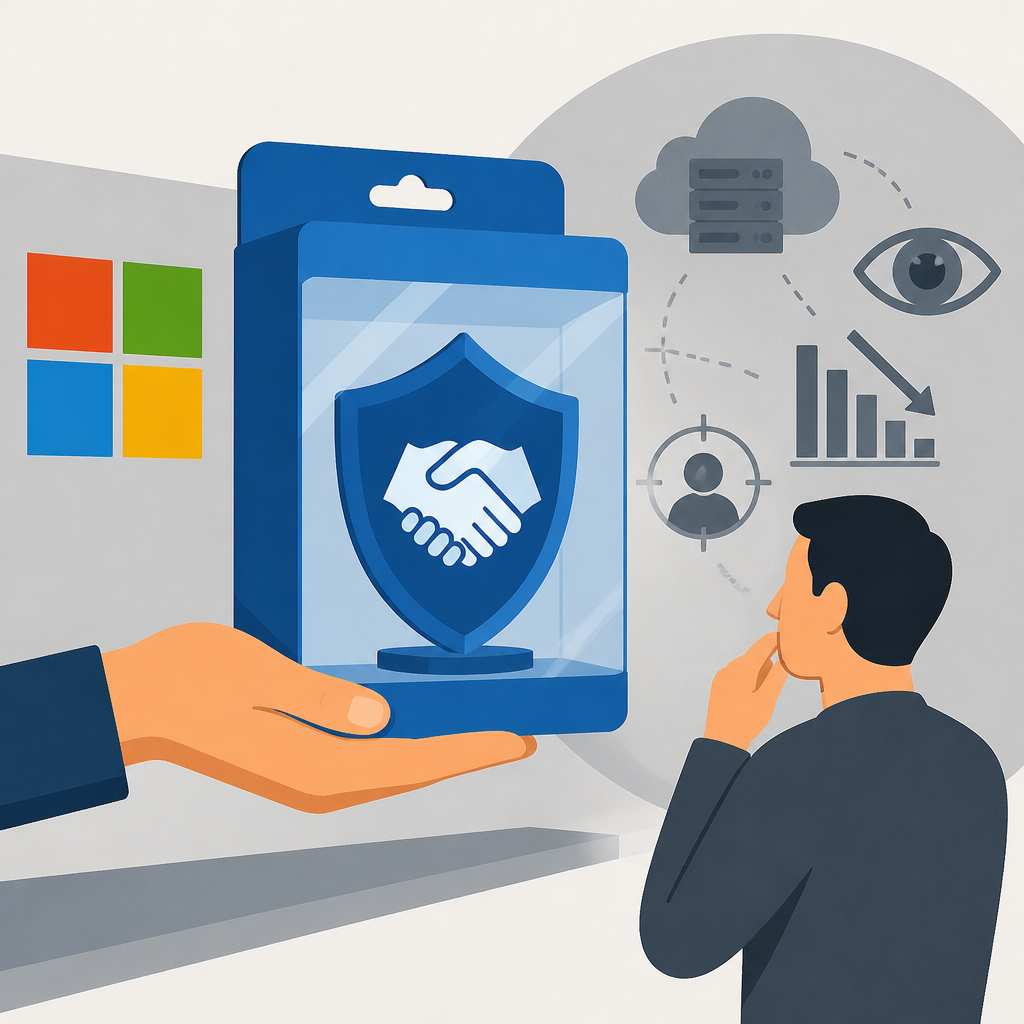
The more telling signal is that Microsoft repeatedly pairs trust with scale and business outcomes. It does not say, “buy us because we are safe.” It says, “bring AI into your business processes,” “move from experimentation to impact,” and “scale intelligence across your organization.” That is the real product. Trust is the admission ticket, but the value comes from embedding AI into the flow of work, connecting it to company data, and making it usable by employees who do not want another standalone AI toy.
Microsoft’s real advantage is distribution, not philosophy
Microsoft’s strongest asset is not its responsible-AI language. It is the fact that it already sits inside the daily operating system of the enterprise. Microsoft 365 Copilot, Fabric, Azure AI, Copilot Studio, and the rest of the stack give it a distribution advantage that most rivals cannot match. A finance team that already lives in Microsoft 365 does not need a new habit; it needs a better way to draft, summarize, search, approve, and automate inside the tools it already uses.
That is why the company’s industry pages matter more than its abstract frontier rhetoric. The site is organized around healthcare, government, manufacturing, retail, financial services, and other verticals because Microsoft understands that AI value lands in specific workflows, not in generic demos. A hospital does not buy “frontier transformation.” It buys clinical documentation support, scheduling help, and secure access controls. A retailer buys inventory insight and associate support. Microsoft wins when it maps AI to those concrete jobs, not when it asks customers to admire the philosophy.
The agent story is stronger than the trust story
The most important shift on Microsoft’s page is not “trust” but “agents.” Copilot Studio, Agent 365, Microsoft Foundry, and Microsoft Agent Factory show where the company is really placing its bet: AI systems that do work, not just answer questions. That matters because the next wave of enterprise software will be judged by orchestration, permissions, and accountability. An agent that can open a ticket, query a database, draft a response, and hand off to a human beats a chat window every time.
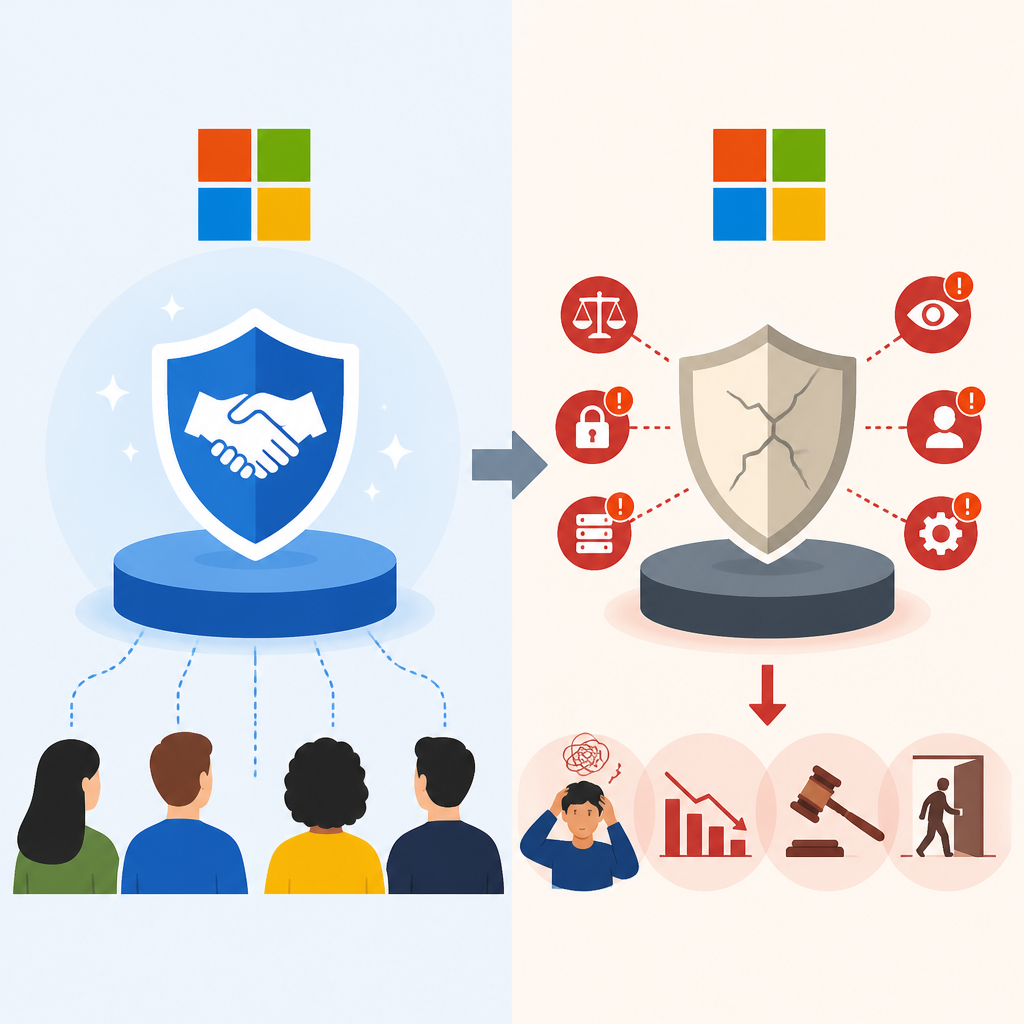
Microsoft also understands that agent adoption creates new operational risks, which is why it is building a control plane around security, observability, access, and compliance. That is the right move. But it also proves the point: the real moat is not “trust” in the abstract. It is governance plus workflow plus distribution. The companies that win in enterprise AI will be the ones that turn agents into managed workers inside existing systems, with clear audit trails and role-based controls. Microsoft is closer to that model than most, and that is why its agent stack matters more than its branding.
The counter-argument
The best defense of Microsoft’s approach is simple: enterprise buyers do not want a flashy AI demo, they want a vendor they can trust with regulated data, identity, compliance, and scale. In that world, trust is not marketing copy. It is the product requirement that unlocks everything else. Microsoft’s decades of enterprise software, its security posture, and its deep relationships with IT departments give it a credibility that newer AI companies do not have. For large organizations, that credibility reduces procurement friction and makes AI deployment possible.
That argument is correct, but incomplete. Trust is necessary, yet it is not enough to create durable demand. If Microsoft stopped at security and governance, it would be just another approved vendor. Its real leverage comes from combining trust with embedded workflows, agent tooling, and a platform customers already use every day. So the right conclusion is not that Microsoft is overvaluing trust as a capability; it is that trust should be treated as the foundation, not the headline. The headline should be business performance.
What to do with this
If you are an engineer, stop judging Microsoft AI by the marketing language and evaluate it by control surfaces, integrations, and auditability. If you are a PM, map each AI feature to a workflow that saves time, reduces error, or improves throughput, then instrument it with hard metrics. If you are a founder, do not compete on “trust” alone unless you can prove a sharper outcome in a narrower use case. Microsoft is building the broad enterprise rails. Your job is to win on specificity, speed, or depth where those rails still leave room for a better product.
// Related Articles
- [IND]
WebX 2026 turns speaker hype into a conference brief
- [IND]
AI Weekly: 2026-07-06 ~ 2026-07-13
- [IND]
The AI Act should be treated as Europe’s operating system for AI
- [IND]
Booz Allen’s OpenAI Deal Is Real Advantage, Not Hype
- [IND]
OpenSearch’s vector search benchmark in 5 parts
- [IND]
Vector Databases That Work in Production