Why Prompt Engineering Is Dead for AI Agents
Prompt engineering is the wrong lever for AI agents; context engineering is what makes them reliable.

Prompt engineering is the wrong lever for AI agents; context engineering is what makes them reliable.
Prompt engineering is dead for AI agents because the real failure mode is not wording, it is context management.
That is the practical lesson behind Chroma’s July 2025 research on 18 models, including Claude 4, GPT-4.1, and Gemini 2.5: performance drops as context grows, and it does so unevenly even on simple retrieval tasks. In other words, the model is not just “getting confused” in some vague sense. It is being starved, distracted, and overloaded by the wrong information at the wrong time.
Context, not phrasing, decides agent quality
Get the latest AI news in your inbox
Weekly picks of model releases, tools, and deep dives — no spam, unsubscribe anytime.
No spam. Unsubscribe at any time.
For agents, the prompt is only the wrapper. The actual product is the bundle of instructions, tools, memory, retrieved documents, and task state that the model sees before it acts. If that bundle is noisy, the agent fails even when the prompt is polished.

The Chroma result matters because it shows degradation is not linear. Longer context does not simply mean “more information, better answers.” It means the model’s attention gets spread across competing tokens, and the retrieval task gets worse even when the underlying task is easy. That is a design problem, not a copywriting problem.
Good agents are built like systems, not messages
The teams that ship dependable agents do not spend their time polishing one magical instruction block. They build pipelines that select, rank, compress, and refresh context before the model ever responds. That is why context engineering is a better mental model: it treats the model as the last step in a system, not the whole system.
A simple example is support automation. An agent that gets the full ticket history, product docs, policy text, and prior tool outputs in one dump often performs worse than one that receives a curated subset: the current issue, the relevant policy snippet, and a short memory of prior actions. Less context, when it is the right context, beats more context every time.
Token budget is a product constraint
Every agent has a hidden budget: not just tokens, but attention. Once you accept that, the design priorities change. You stop asking, “How do I phrase this better?” and start asking, “What should be in memory, what should be retrieved, and what should be summarized away?”
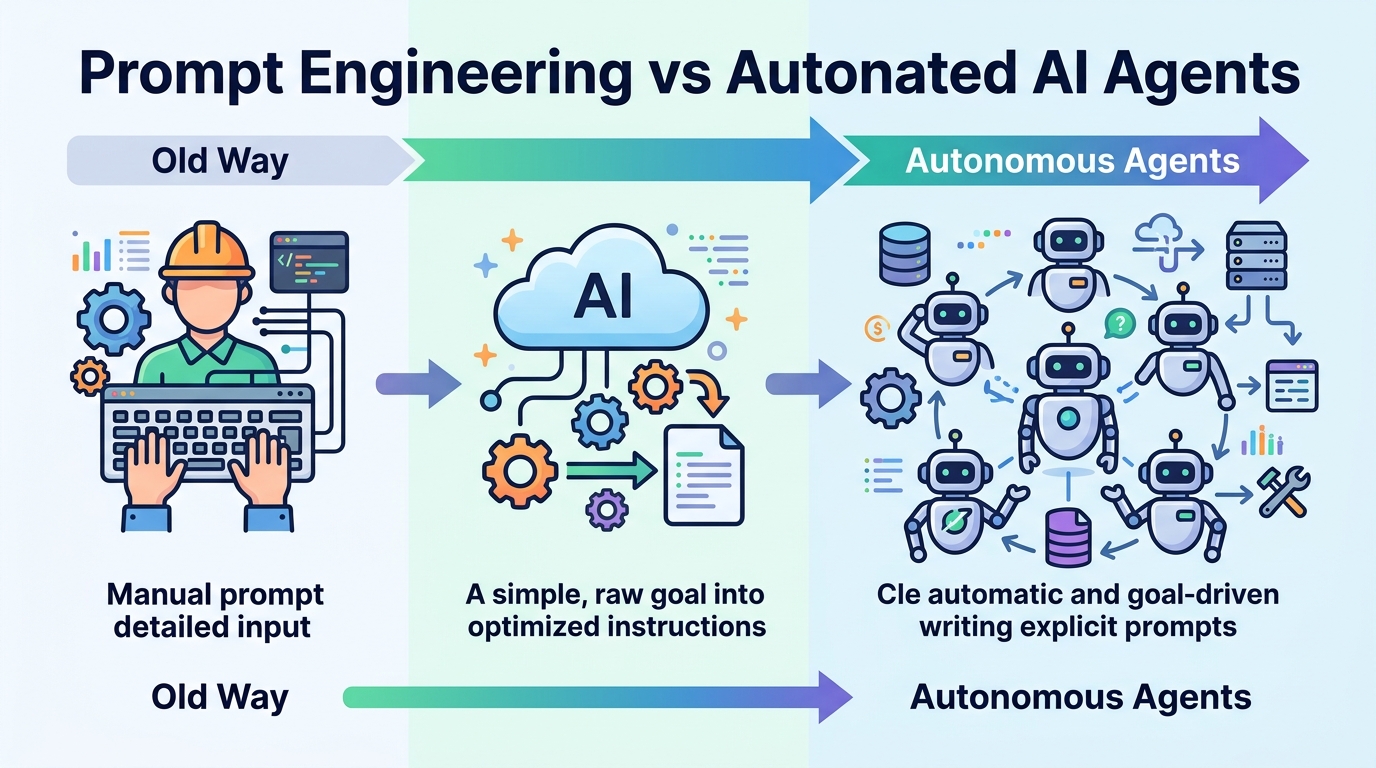
This is where many teams waste time. They keep adding examples, rules, and guardrails to prompts, then wonder why the agent gets slower and less reliable. The answer is obvious once you look at context as a scarce resource. A bloated prompt is not more robust; it is more fragile.
The counter-argument
Prompt engineering defenders are not entirely wrong. For narrow workflows, a precise system prompt can dramatically improve behavior, and many production agents still depend on careful instruction design. Clear formatting, explicit constraints, and well-chosen examples do matter.
There is also a real cost to overcomplicating the stack. If every agent needs a retrieval layer, memory manager, summarizer, and ranking service, teams can drown in infrastructure before they ship anything useful. For small products, a strong prompt is the fastest path to value.
That said, this is a limit, not a rebuttal. Prompt quality is necessary, but it is not sufficient once the agent has to act across multiple steps, tools, or sources of truth. The moment context starts changing dynamically, the core problem becomes selection and control, not wording. Chroma’s findings support that boundary clearly: as context expands, performance falls, so the winning strategy is to engineer the context window itself.
What to do with this
If you are an engineer, stop treating prompts as the main abstraction. Build a context pipeline: retrieve less, rank better, summarize aggressively, and keep a tight memory of what the agent actually needs for the current step. If you are a PM or founder, measure agent quality by task success under realistic context load, not by demo polish. The right question is not “Did the prompt sound smart?” It is “Did the agent receive the right evidence at the right time?”
// Related Articles
- [AGENT]
How to Switch AI Outputs from Markdown to HTML
- [AGENT]
Anthropic’s Cat Wu on proactive AI assistants
- [AGENT]
How to Run Hermes Agent on Discord
- [AGENT]
Why RAGFlow is the right open-source RAG engine to self-host
- [AGENT]
How to Add Temporal RAG in Production
- [AGENT]
GitHub Agentic Workflows puts AI agents in Actions