$292M DeFi hack forces a security reset
A $292 million Kelp DAO exploit pushed DeFi firms to tighten security, governance, and collateral rules as Wall Street keeps moving onchain.

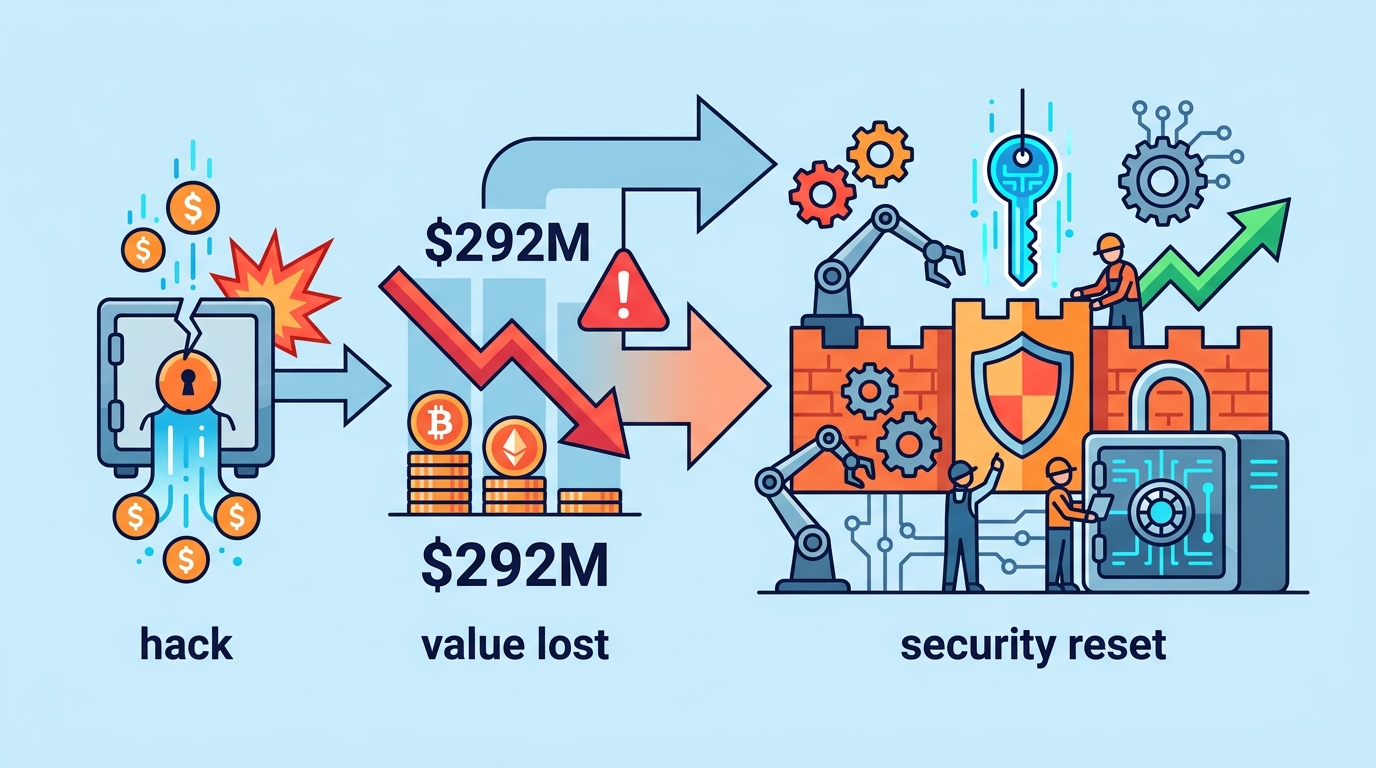
A $292 million Kelp DAO exploit exposed weak spots in DeFi security and governance.
The biggest crypto hack of 2026 did more than drain funds. It hit as Apollo Global Management deepened its work with Morpho and BlackRock pushed a tokenized money market fund onto Uniswap, which made the timing especially awkward for decentralized finance.
CoinDesk reported that the exploit rattled lending markets, but the reaction from security, asset management, and tokenization firms was less panic than triage. The message from people building inside the sector was blunt: if DeFi wants larger institutions to trust it with real capital, the defaults need to get much stricter.
| Metric | Value | Why it matters |
|---|---|---|
| Kelp DAO exploit | $292 million | The incident that exposed the weak points |
| Apollo Global Management assets | $900 billion | Shows the size of the capital now circling onchain finance |
| Janus Henderson assets | About $500 billion | Another large manager saying the hack is a setback, not a stop sign |
| RWA market growth | Sixfold since 2025 | Tokenized real-world assets are becoming a bigger part of DeFi |
Why this hack mattered more than most
Get the latest AI news in your inbox
Weekly picks of model releases, tools, and deep dives — no spam, unsubscribe anytime.
No spam. Unsubscribe at any time.
The Kelp DAO exploit landed in a market that was already changing shape. DeFi is no longer just a playground for crypto-native traders chasing yield. It is increasingly where tokenized funds, credit, and other real-world assets are being tested, which means the failures now matter to asset managers with compliance teams and risk committees.

That matters because the sector’s pitch has always depended on a tradeoff: open access in exchange for code-based trust. The problem is that open access also means attackers can probe every weak link, from governance controls to bridges to collateral design.
- The exploit hit at the same time institutional adoption was picking up.
- Large asset managers are already experimenting with onchain markets.
- Security lapses now affect credibility with firms that allocate billions, not just retail traders.
Nick Cherney, head of innovation at Janus Henderson, framed the incident as part of the normal pain of building new market infrastructure. “This is a speed bump for sure, but not a roadblock,” he said.
“This is a speed bump for sure, but not a roadblock,” said Nick Cherney, head of innovation at Janus Henderson.
That quote captures the mood pretty well. Nobody serious in this part of finance is pretending hacks are harmless, but they also do not view them as proof that onchain markets are dead on arrival. The bigger question is whether the industry can raise its security floor fast enough to keep institutional money interested.
The new baseline DeFi has to meet
Security leaders are pushing for a much stricter minimum standard. Paul Vijender, head of security at Gauntlet, said DeFi and onchain asset management operate in a hostile environment where every weak link can be exploited. His point was simple: one guardrail is not enough.
That means more than patching code after a hack. It means designing systems with multiple layers of protection, so one failure does not cascade into a market-wide mess. In practice, that includes continuous monitoring, tighter permissions, stronger controls around governance actions, and redundancy in places where a single mistake can be fatal.
- Zero-trust architecture, where nothing is assumed safe by default.
- Timelocks on governance actions so changes cannot be rushed through.
- Stricter multi-signature controls for protocol admin moves.
- Tighter collateral rules and better bridge security.
Evgeny Gokhberg, founder of Re7 Capital, said the industry needs to stop treating these as optional best practices. They need to become the floor, especially for protocols that want to handle serious institutional flows.
That distinction matters. “Best practice” is what teams promise when they have time. “Baseline requirement” is what survives contact with a real balance sheet.
What institutions want before they commit capital
Bhaji Illuminati, CEO of Centrifuge Labs, said the sector is compressing decades of financial development into a much shorter window. Traditional finance built its controls slowly, often after painful failures. DeFi is trying to assemble similar protections far faster.
For institutions, the bar is not just lower volatility or higher yield. They want clarity about what they own, legal structures that map to real risk, and systems that behave in ways auditors can verify. They also want liquidity that holds up when markets get stressed, because a product that works only in calm conditions is not useful for large allocators.
Illuminati’s view is that openness and security can coexist, but only if trust becomes explicit and measurable. That is a practical standard, not a slogan.
- Verifiable collateral that can be checked against real assets.
- Predictable smart contracts and oracle behavior.
- Liquidity that does not vanish during stress.
- Legal wrappers that fit institutional compliance needs.
There is also a broader shift underneath all this: tokenized real-world assets are growing fast. CoinDesk cited RWA.xyz data showing the market has grown sixfold since 2025, which helps explain why the security debate is getting louder. If tokenized funds and credit keep scaling, the protocols hosting them will be judged less like crypto apps and more like financial infrastructure.
What changes first, and what to watch next
The most likely near-term change is not a grand rewrite of DeFi. It is a tightening of defaults. More timelocks. More formal governance controls. Better collateral standards. More pressure on protocols to publish how they handle failures, not just how they market yield.
That shift should also accelerate the split between protocols that can handle institutional money and those that cannot. The former will look more conservative, more documented, and probably less flashy. The latter may still attract traders, but they will struggle to win the kind of capital Apollo, BlackRock, and Janus Henderson can move around.
My read: the next big DeFi winners will be the projects that make risk boring. If a protocol cannot explain its controls in plain English, it is probably not ready for serious institutional flow. The real test now is simple: which teams treat this hack as a warning, and which ones keep shipping like nothing happened?
// Related Articles
- [CHAIN]
Crypto exchanges should show up in LATAM, not just advertise there
- [CHAIN]
UAE Web3 setup turns crypto rules into a checklist
- [CHAIN]
Five AI Futurist features shaping Futurist 2026
- [CHAIN]
Regulation Now Moves Bitcoin and Ethereum More Than War
- [CHAIN]
The SEC Crypto Rule Proposal Will Clean Up Crypto, Not Kill It
- [CHAIN]
Web3 platforms need fee discipline, not token theatrics, to make money