AI agents may become crypto’s first real users
Chappy Asel says crypto’s best AI use case is agent payments, where software needs fast, programmable money rails.
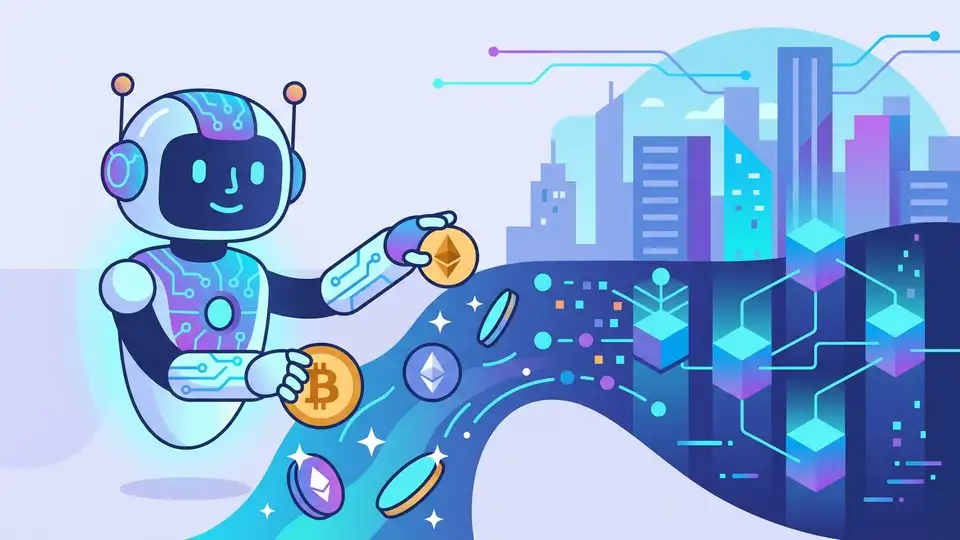
AI agents could become crypto’s first users because they need fast, programmable payments.
At Consensus Miami on May 8, 2026, former Apple engineer Chappy Asel argued that the real crypto-and-AI story is agentic payments, not chatbots. His case is simple: if software is going to make economic decisions on its own, it needs money rails that work in milliseconds, around the clock, and in tiny amounts.
That idea matters because crypto still struggles with a basic question: who actually uses it every day? Asel thinks autonomous software may be a better answer than humans, especially if stablecoins and smart contracts become the default plumbing for machine-to-machine commerce.
| Data point | Figure | Why it matters |
|---|---|---|
| The AI Collective members | 200,000+ | Shows how large the AI community behind Asel’s thesis has become |
| Chapters | 150+ | Signals a wide network for testing AI use cases |
| Consensus Miami date | May 8, 2026 | Places the comments in a live industry setting |
| CoinDesk market snapshot | BTC $80,386.06 / ETH $2,312.60 | Shows the market backdrop when the argument landed |
Why agents fit crypto better than people do
Get the latest AI news in your inbox
Weekly picks of model releases, tools, and deep dives — no spam, unsubscribe anytime.
No spam. Unsubscribe at any time.
Asel’s core point is that humans are messy payment users. They forget passwords, worry about wallet security, and do not want to approve every tiny transaction. Software agents, by contrast, can be built to transact continuously, with rules baked in from the start.
That is why he framed crypto’s role in AI around infrastructure, not consumer apps. Stablecoins already offer 24/7 settlement, and smart contracts already allow automated execution. Put those together, and you get a system that can support micro-payments without a human clicking “confirm” every time.
Asel put it bluntly on stage: “When agents make the majority of financial decisions, economic decisions, how do they transact with each other?” He added that the ideal system would be “highly systematic, mechanistic” with “very small, micro transactions” and “very low latency.”
“When agents make the majority of financial decisions, economic decisions, how do they transact with each other?” — Chappy Asel
That quote gets to the heart of the thesis. If AI agents are going to buy API calls, rent compute, pay for data, or settle between services, they need payment rails that look more like machine code than consumer finance.
Asel also said the phrase “agentic payments” had already become the buzzword he kept hearing at the conference, even among people who knew little about blockchain. That matters because it suggests the idea is spreading beyond crypto-native circles.
The gap between the pitch and reality
For all the excitement, this is still mostly a thesis looking for demand. Asel admitted that AI agents are nascent, and the current market still depends heavily on centralized APIs and standard payment systems. In other words, the plumbing for autonomous commerce is not here yet at scale.
That mismatch is important. Crypto has a habit of moving faster in narrative than in actual usage, and “agentic payments” may be another example. The concept is elegant, but the commercial evidence is thin.
- AI agents still need to become reliable enough to manage money without constant human oversight.
- Most companies already rely on centralized payment rails that are familiar and easy to integrate.
- Few agent-payment products have shown meaningful commercial traction so far.
- Stablecoins and smart contracts are ready in principle, but adoption depends on real machine demand.
That does not make the idea weak. It means the market has to prove it. If machine-to-machine commerce grows, the first winners may be the teams building payment primitives, not flashy AI assistants.
Asel’s broader point was that crypto and AI may meet first in infrastructure markets such as compute, data centers, and energy. That is where the money is moving now, and it is where the bottlenecks are most obvious.
Compute, power, and the new AI bottleneck
Asel pushed back on the idea that model quality is the main constraint holding AI back. His view was much more physical: compute, data centers, and energy are now driving most of the decision-making in AI.
That lines up with what the market is already showing. Access to chips and power has become a strategic advantage, and crypto firms are trying to reposition around that demand. Bitcoin miners, in particular, have been exploring AI hosting and high-performance computing because their existing infrastructure can be adapted for new workloads.
This is where the overlap between crypto and AI gets more concrete. Mining operations already know how to manage power contracts, cooling, and specialized hardware. Those are useful skills if the next customer is an AI workload instead of a proof-of-work network.
- Bitcoin miners are repurposing facilities for AI hosting and high-performance computing.
- Data center capacity is becoming a competitive asset in AI, much like hash power was in mining.
- Energy access matters as much as software quality in the current AI race.
- Infrastructure revenue may arrive before consumer-facing agent payments do.
That is a more grounded story than the usual “AI meets crypto” pitch. It is also more believable. The first durable business models may come from renting power, compute, and storage, while agentic payments remain a longer-term bet.
If you want a useful comparison, think of it this way: consumer crypto still fights for attention, while AI infrastructure already has a clear budget line in enterprise spending. The winners are more likely to be the companies that solve a bottleneck than the ones that add another interface layer.
What founders should take from this
Asel closed with a practical message: experiment more. In his view, the world is more uncertain than it has ever been, which means builders should spend more time testing new tools instead of waiting for perfect clarity.
That advice fits the current moment. If you are building in crypto, the question is no longer whether AI will touch the industry. The real question is whether your product helps a machine buy, pay, settle, or compute something faster than the old stack can.
For now, the most useful takeaway is narrow and specific: agentic payments are still early, but they point to a real problem. If software becomes an economic actor, it will need money that behaves like software too. The next big test is whether anyone can turn that idea into a product people, and machines, actually use.
// Related Articles
- [IND]
WebX 2026 turns speaker hype into a conference brief
- [IND]
AI Weekly: 2026-07-06 ~ 2026-07-13
- [IND]
The AI Act should be treated as Europe’s operating system for AI
- [IND]
Booz Allen’s OpenAI Deal Is Real Advantage, Not Hype
- [IND]
OpenSearch’s vector search benchmark in 5 parts
- [IND]
Vector Databases That Work in Production