Jensen Huang Says AGI Arrived. Did It?
Jensen Huang says AGI is already here under a practical definition. The real fight is over what AGI should mean.

Jensen Huang says artificial general intelligence may already be here. His argument is simple: if an AI agent can build something useful, ship it, and make money with limited human help, then the line has been crossed.
That claim matters because Huang is the CEO of NVIDIA, the company whose chips power a huge share of today’s AI boom. It also lands at a moment when OpenAI, Anthropic, and Google DeepMind are all pushing models that can write code, analyze data, and use tools with far less hand-holding than last year’s systems.
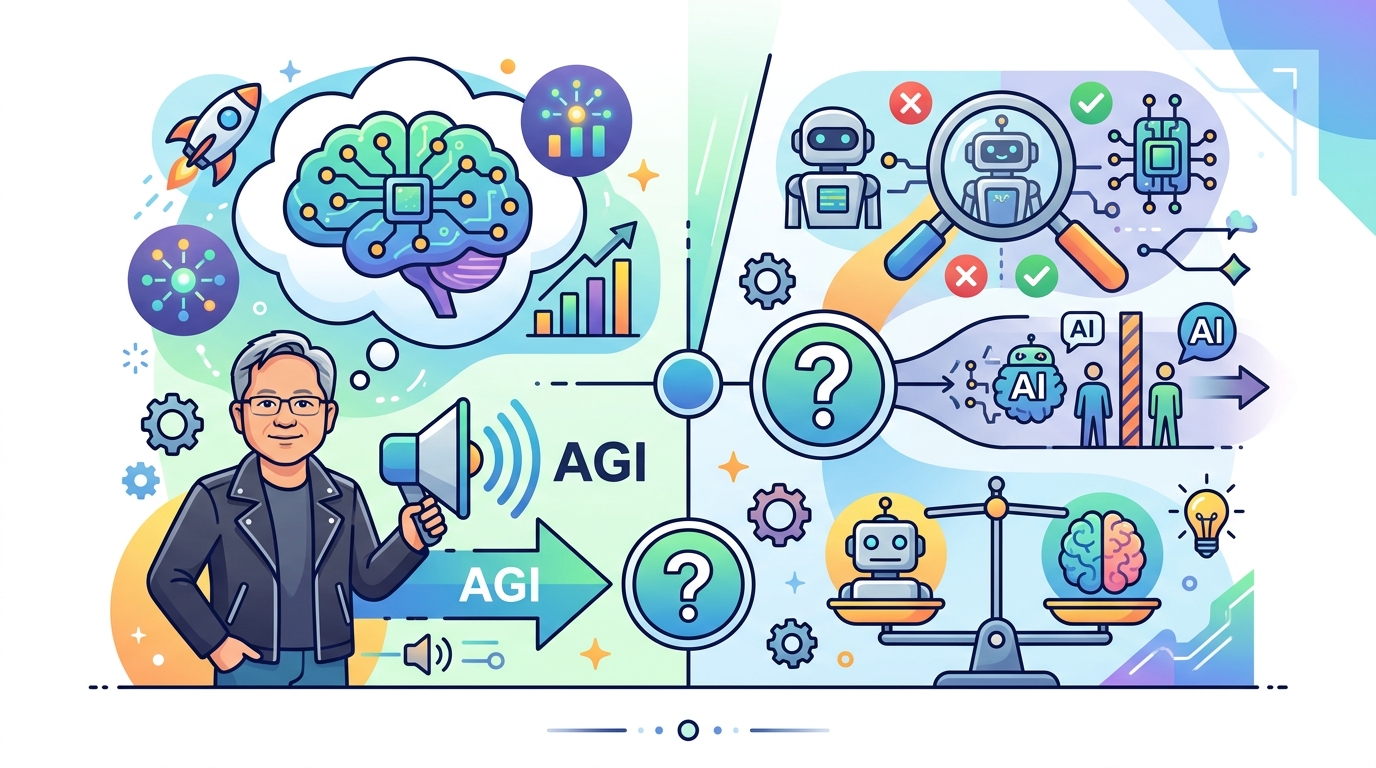
The problem is that AGI has never had one clean definition. Huang is talking about something practical and commercial. A lot of researchers mean something much broader: an AI that can handle most intellectual tasks a human can, across domains, without being retrained for each new job.
What Huang actually claimed
Get the latest AI news in your inbox
Weekly picks of model releases, tools, and deep dives — no spam, unsubscribe anytime.
No spam. Unsubscribe at any time.
Huang’s comments, made on Lex Fridman’s podcast, centered on agentic systems. He pointed to open-source agent platforms such as OpenClaw, where AI agents can take on structured digital work, coordinate steps, and in some cases create products that generate revenue. His benchmark was blunt: if software can independently create a viral app and make even $0.50 per user, that is general intelligence in a practical sense.
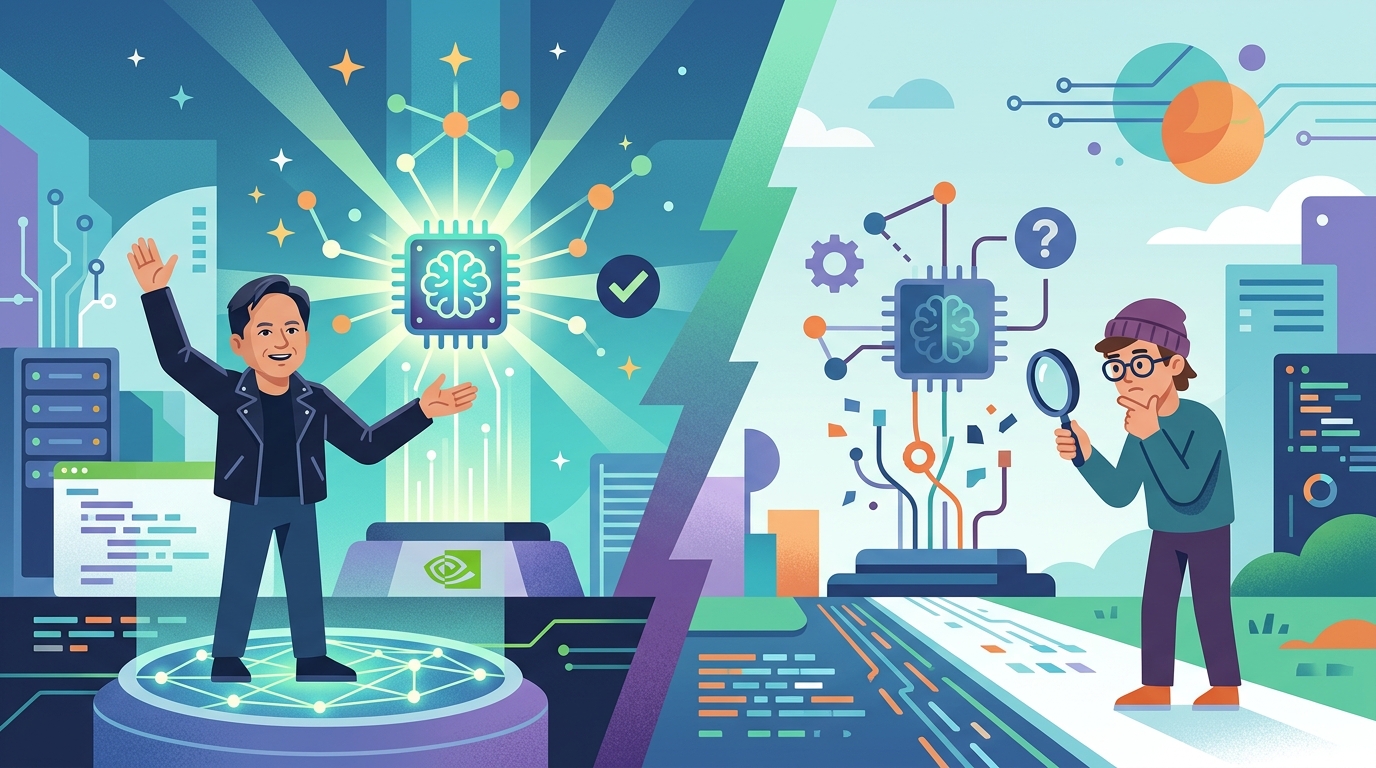
That is a much narrower bar than the one most AI researchers use. Huang is not saying machines now think like humans in every sense. He is saying they are already capable of useful autonomy in business settings, and that may be enough to call the milestone reached.
There is a reason this framing is catching on. The last two years have shown that AI value often comes from workflow automation, coding assistance, customer support, and content generation rather than from some dramatic sci-fi test. If a model can turn a prompt into a working app, handle iterations, and keep going without constant supervision, a lot of companies will call that intelligence even if philosophers disagree.
- Huang’s definition focuses on output: can the system create value?
- Traditional AGI definitions focus on breadth: can it perform across many kinds of tasks?
- Agent platforms matter because they connect models to tools, memory, and actions.
- Revenue is an easy business metric, but it is a weak proxy for human-level reasoning.
Why the definition fight matters
AGI debates often get stuck because people are arguing about different targets. One camp treats AGI as a research milestone, something close to human generality across language, planning, learning, and adaptation. Another camp treats it as an economic milestone, where an AI system is good enough to replace or amplify real work at scale.
Huang clearly belongs to the second camp. For him, an AI that can execute multi-step tasks, make decisions inside a bounded environment, and produce commercial results has crossed a meaningful threshold. That is a practical view shaped by the market NVIDIA sells into. If businesses can use AI to make products faster and cheaper, the label matters less than the capability.
Still, the distinction is important. Calling today’s systems AGI can make people think the hard problems are already solved. They are not. Models still hallucinate, fail on long-horizon planning, and break when a task shifts outside the patterns they learned. They can look smart one minute and completely lose the thread the next.
“This is the worst it’s ever going to be.” — Sam Altman, OpenAI CEO, speaking at an event in 2023
Altman’s line is often quoted because it captures the mood of the industry: even the current flaws may look small compared with what is coming next. But that does not mean today’s systems are already human-level. It means the ceiling is still moving, and fast.
Agentic AI is the real story here
What Huang is really describing is the rise of agentic AI. These systems do more than answer a question. They plan steps, call tools, store context, and act with some degree of autonomy. That is a big shift from the chatbot era, where the model mostly waited for the next prompt.
Agent platforms are also where the money is starting to show up. The more an AI can do inside a workflow, the easier it is to justify charging for it. That is why enterprises care about agents that can file tickets, summarize meetings, search internal data, write code, and trigger actions across software stacks.
Open-source projects have accelerated this trend by making agent orchestration easier to test and modify. The result is a fast-moving ecosystem where startups and large labs are racing to turn language models into systems that can operate with fewer guardrails and more initiative.
- OpenAI’s Cookbook shows how tool use and function calling have become standard building blocks.
- Anthropic’s agent docs show how model behavior changes once tools are added.
- Google DeepMind’s Gemini line is built around multimodal and tool-using capability.
- LangChain became popular because developers wanted model workflows, not just text generation.
That is why Huang’s comments should be read less as a philosophical declaration and more as a market signal. The AI industry is moving from “can it chat?” to “can it do work?” Once that happens, the definition of intelligence starts to look like a product question.
What the numbers say about the gap
If you compare Huang’s claim with what current systems can actually do, the gap is still visible. Today’s best models can write production code, summarize large documents, and pass many benchmark tests. They can also fail badly on simple tasks that require consistency, memory, or real-world grounding.
That mixed performance matters because AGI, in the broader sense, implies reliability across settings, not just flashes of brilliance. A human assistant can learn a new process, remember exceptions, and recover from mistakes. Most AI systems still need guardrails, review, and retries.
Here is a clearer way to think about the comparison:
- Top frontier models can score highly on coding and reasoning benchmarks, but those scores do not guarantee dependable real-world performance.
- Agent systems can complete multi-step tasks, yet they still need supervision when the task chain gets long or ambiguous.
- Human workers make errors too, but they usually understand context better and can explain their decisions.
- Commercial usefulness is rising faster than scientific agreement on what AGI means.
This is why Huang’s statement is both provocative and useful. It forces a cleaner question: are we trying to define AGI as a research ideal, or as an economic threshold? If it is the second one, then the argument gets a lot less abstract.
It also explains why NVIDIA benefits from this conversation. The more AI shifts toward agents, inference, and continuous tool use, the more compute the industry needs. Huang is not just commenting on the debate. He is describing the kind of software that keeps GPUs busy.
Where this debate goes next
The next phase of AI will probably be judged less by benchmark headlines and more by whether agents can handle real work without constant correction. If that happens, Huang’s practical definition of AGI will gain more supporters, even if researchers keep rejecting the label.
My bet: the term AGI will split in two. One meaning will stay academic and broad. The other will become a business label for systems that can independently produce value inside narrow but profitable workflows. Huang is talking about the second one.
So the useful question is not whether AGI has arrived in some absolute sense. It is whether the AI systems you use next year can do enough real work that your team stops caring about the definition fight. That is the test worth watching.
// Related Articles
- [IND]
Why Nebius’s AI Pivot Is More Real Than Hype
- [IND]
Nvidia backs Corning factories with billions
- [IND]
Why Anthropic and the Gates Foundation should fund AI public goods
- [IND]
Why Observability Is Critical for Cloud-Native Systems
- [IND]
Data centers are pushing homeowners to solar
- [IND]
How to choose a GPU for 异环