Local LLM vs Claude for Coding
A $500 GPU can cover routine coding well, but Claude still wins on hard reasoning.

A $500 GPU can cover routine coding well, but Claude still wins on hard reasoning.
Local LLMs and Claude both solve coding tasks, but they differ most on privacy, cost, speed, and hard reasoning.
At a glance
Get the latest AI news in your inbox
Weekly picks of model releases, tools, and deep dives — no spam, unsubscribe anytime.
No spam. Unsubscribe at any time.
| Dimension | Local LLM on RTX 4070 Ti Super | Claude Sonnet 4 |
|---|---|---|
| Upfront cost | $489 GPU + $8-12/month power | $20/month minimum, often $50-100/month for heavy use |
| Routine coding quality | Qwen2.5-Coder-32B scored 4.1/5 on function generation | 4.4/5 on function generation |
| Bug detection | 3.8/5 best local score | 4.6/5 |
| Multi-file context | 2.8/5 best local score | 4.5/5 |
| Average response time | 1.4-3.2s depending on model | 2.1s |
| Best-fit use case | Private, high-volume, routine coding | Complex debugging, refactors, large context work |
Local LLMs on a $500 GPU
Local models are strongest when the task is narrow and repetitive. In the benchmark, Qwen2.5-Coder-32B came close to Claude on function generation and explanation, and the smaller models were often faster than the API because they skipped the network round-trip. That makes local inference attractive for autocomplete-like help, boilerplate generation, and quick explanations.

The trade-off is that local performance depends on quantization, VRAM limits, and setup quality. The tested 32B model had to run in Q4_K_M format to fit 16GB of VRAM, which means you are not comparing full-precision local output against a compressed cloud model. Add in prompt tuning, chunking, and model swapping, and the real cost is more than the GPU price tag.
Claude Sonnet 4
Claude’s advantage shows up when the problem gets messy. It scored higher on bug detection and far higher on multi-file context, where long-range reasoning matters more than raw code generation. If your work involves tracing logic across several files, understanding subtle failures, or making architecture-level changes, Claude is still the safer bet.
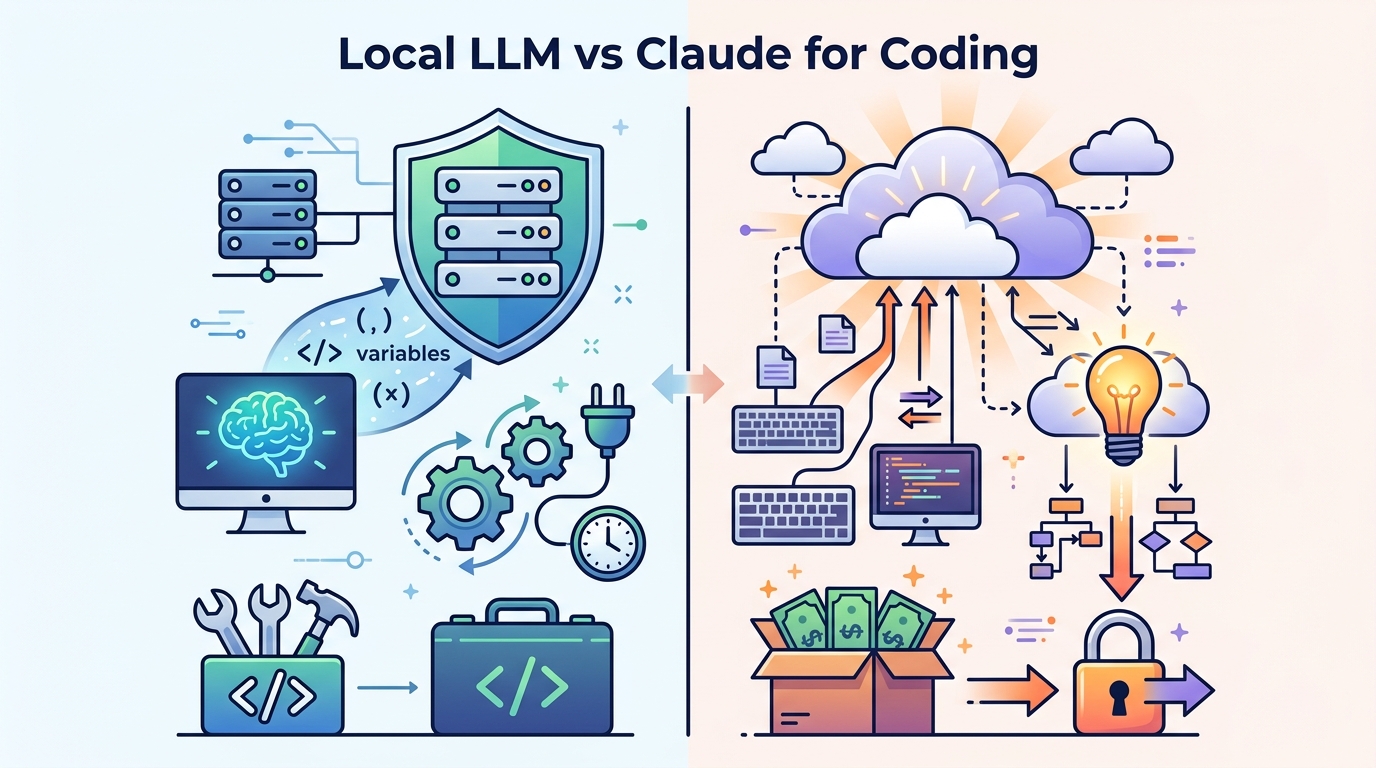
It is also simpler to live with. You do not spend hours tuning quantization settings or wrestling with inference servers, and the cloud infrastructure is much faster at long outputs. For teams that value consistency and low operational friction, that convenience often outweighs the monthly API bill.
When to pick what
Pick a local LLM if you do a lot of routine coding, want your code to stay on your machine, and can tolerate some setup work. It is the better choice for solo developers, privacy-sensitive teams, and anyone trying to reduce recurring API spend.
Pick Claude if you spend more time debugging, refactoring, or working across multiple files than generating boilerplate. It is the better choice when correctness matters more than cost, and when you want the strongest reasoning without maintaining your own inference stack.
The default pick is the hybrid setup, and the answer changes only if your code must stay local or your work is dominated by complex multi-file reasoning.
// Related Articles
- [IND]
WebX 2026 turns speaker hype into a conference brief
- [IND]
AI Weekly: 2026-07-06 ~ 2026-07-13
- [IND]
The AI Act should be treated as Europe’s operating system for AI
- [IND]
Booz Allen’s OpenAI Deal Is Real Advantage, Not Hype
- [IND]
OpenSearch’s vector search benchmark in 5 parts
- [IND]
Vector Databases That Work in Production