Why Microsoft's $80 Billion AI Capital Expenditure Plan Is the Most I…
Microsoft's $80 billion AI buildout is the decade's defining corporate finance bet.

Microsoft's $80 billion AI buildout is the decade's defining corporate finance bet.
Microsoft should spend the $80 billion, because the company that wins AI infrastructure economics will set the rules for enterprise computing for the next decade.
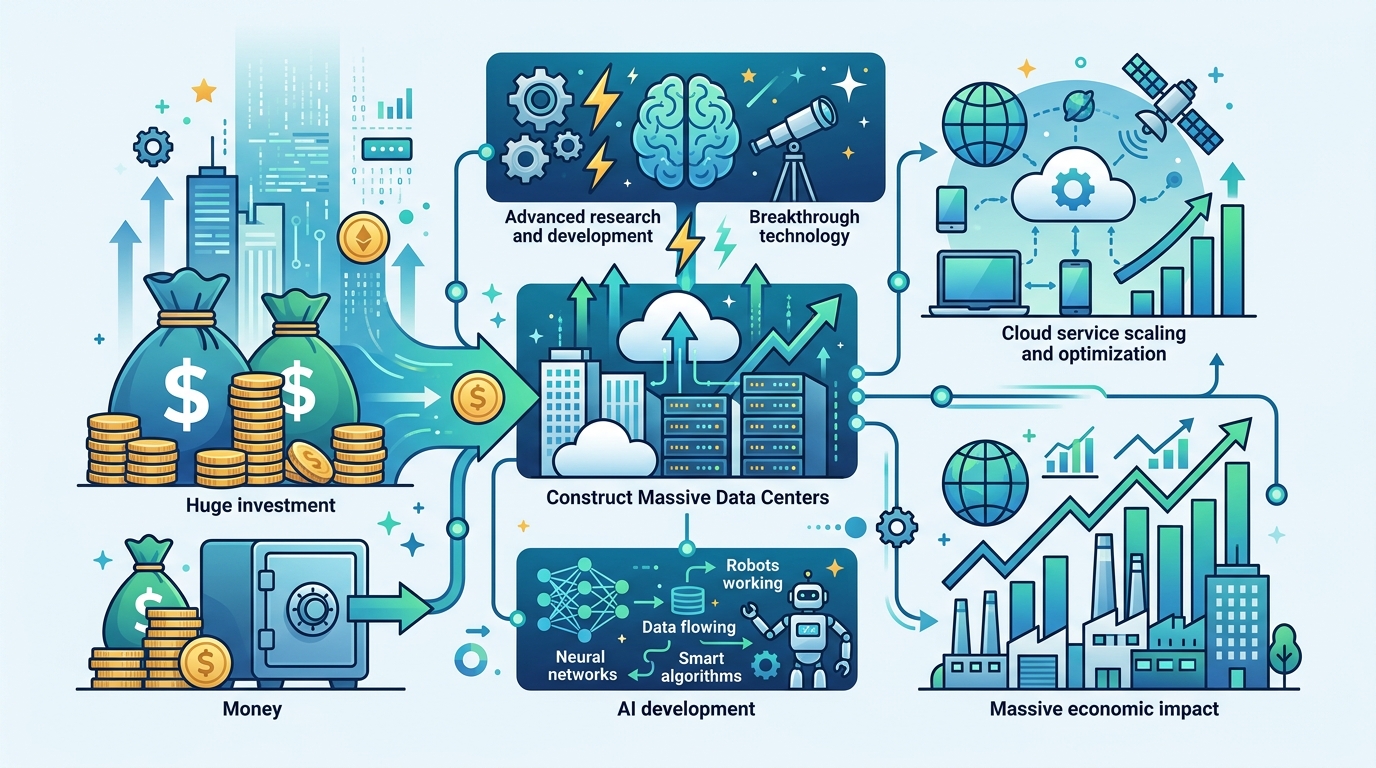
That is not a hype claim. Microsoft has committed roughly $80 billion to AI-enabled infrastructure in fiscal 2025, while hyperscaler capital expenditures for 2026 have climbed above $700 billion. Those are nation-state numbers wearing a software badge. The scale matters because it changes the unit of competition: not just who has the best model, but who can secure power, chips, land, networking, and financing at a rate rivals cannot match. Microsoft is not merely buying capacity. It is buying strategic gravity.
First argument: scale now determines platform power
Get the latest AI news in your inbox
Weekly picks of model releases, tools, and deep dives — no spam, unsubscribe anytime.
No spam. Unsubscribe at any time.
AI infrastructure is a winner-take-most market because customers do not buy isolated servers; they buy reliability, latency, security, and global availability. Microsoft already has the distribution layer through Azure, Microsoft 365, GitHub, and Copilot. If it can attach AI workloads to that installed base faster than competitors, the capex turns into a moat, not an expense. In that world, the company with the deepest buildout controls the default path for enterprise AI adoption.

History offers a clean precedent. Microsoft’s cloud era was initially mocked as a costly land grab, yet Azure became one of the company’s most important growth engines. Satya Nadella is making the same kind of bet, only larger and more capital intensive. If cloud spending was the infrastructure layer for software-as-a-service, AI infrastructure is the layer underneath the next generation of software. The company that underbuilds now risks renting its future from a rival later.
Second argument: the finance structure is already changing
The real story is not only the size of the check. It is the fact that Big Tech is normalizing debt and structured finance to fund AI expansion. AI-related tech companies issued $141 billion in corporate debt in 2025, a record, and major tech firms now carry about $1.35 trillion in total interest-bearing debt. That is a profound shift from the old Silicon Valley model of hoarding cash, minimizing capex, and treating balance-sheet strength as the product. AI is forcing software companies to act more like industrial firms.
Microsoft’s approach is still comparatively conservative, mixing cash flow with issuance rather than leaning fully into leverage. That restraint strengthens the case for the spending, not weakens it. A company that can fund an $80 billion build without shredding its balance sheet is demonstrating financial optionality that competitors lack. Meanwhile, rivals are using off-balance-sheet vehicles and heavier debt loads to keep pace. The message to the market is blunt: AI infrastructure is now a capital allocation contest, and Microsoft has the cleanest weapon.
The counter-argument
The strongest critique is that this is exactly how bubbles begin. Data centers, transformers, and GPU clusters look impressive on a slide deck, but if demand does not arrive at the pace promised, the result is stranded capacity and ugly returns on invested capital. Investors have already shown nerves: Microsoft share pressure followed reports of data center lease cancellations, and software stocks sold off hard when the market began to suspect that supply was outrunning demand. The concern is rational. No management team can forecast global AI utilization with precision.
There is also a valid comparison to the late-1990s fiber overbuild. In that era, companies spent aggressively on infrastructure that took years to monetize, and many never recovered. Microsoft itself added a cautious qualifier, saying it may strategically pace or adjust infrastructure in certain regions. That language is not meaningless. It admits that local demand can diverge from the headline narrative, and it leaves room for overbuild in the wrong geographies.
Still, the counter-argument fails on one decisive point: Microsoft is not betting on a single product cycle, it is buying the backbone of a platform shift already embedded across enterprise software. The risk is real, but it is bounded by Microsoft’s cash generation, diversified revenue, and existing distribution. A bubble story requires blind speculation. This is disciplined overcommitment by a company that can absorb missteps and still win if AI adoption continues to spread. The downside is lower margins and some stranded assets. The upside is control over the most important compute layer in modern software.
What to do with this
If you are an engineer, PM, or founder, treat Microsoft’s move as a signal that AI strategy is now a capital strategy. Stop thinking in terms of model demos and start thinking in terms of power, inference cost, deployment density, and procurement leverage. Build products that assume infrastructure scarcity, not abundance. Design for cost per task, not just capability. And if you are making company bets, remember the lesson Microsoft is teaching the market: in the AI era, the winners will be the firms that can finance scale without losing control of it.
// Related Articles
- [IND]
WebX 2026 turns speaker hype into a conference brief
- [IND]
AI Weekly: 2026-07-06 ~ 2026-07-13
- [IND]
The AI Act should be treated as Europe’s operating system for AI
- [IND]
Booz Allen’s OpenAI Deal Is Real Advantage, Not Hype
- [IND]
OpenSearch’s vector search benchmark in 5 parts
- [IND]
Vector Databases That Work in Production