Microsoft’s AI tracker shows a $80B bet
Larridin’s tracker rates Microsoft 5.0 across AI adoption, proficiency, and impact, backed by $80B in AI spend and Copilot rollout data.

Larridin rates Microsoft 5.0 across AI adoption, proficiency, and impact.
Microsoft is spending like a company that expects AI to touch everything it sells. Larridin’s AI Adoption Tracker gives the company a perfect 5.0 score and ties that rating to hard numbers: nearly 70% of Fortune 500 firms using Microsoft 365 Copilot, $80 billion committed to AI infrastructure, and $34.9 billion in capital expenditures in 2025.
The tracker is useful because it does not treat “AI progress” as a vague branding claim. It breaks Microsoft’s work into adoption, proficiency, and impact, then compares the company with the rest of the technology sector. On that framing, Microsoft is ahead of the pack by roughly one point in each category.
| Metric | Microsoft | Context |
|---|---|---|
| AI maturity score | 5.0 / 5 | Leading across adoption, proficiency, impact |
| Fortune 500 Copilot usage | Nearly 70% | Enterprise penetration across large customers |
| AI infrastructure investment | $80 billion | Fiscal 2025 commitment |
| Capital expenditures | $34.9 billion | 2025, up 74% |
| Azure revenue | $75 billion+ | First time above this mark, up 34% |
Why Microsoft’s AI score is so high
Get the latest AI news in your inbox
Weekly picks of model releases, tools, and deep dives — no spam, unsubscribe anytime.
No spam. Unsubscribe at any time.
Larridin’s scoring model gives Microsoft top marks because the company has moved AI out of the demo stage and into daily work. The tracker says AI is embedded across productivity software, cloud services, and enterprise operations, which matters more than any single product launch.

That breadth is visible in the rollout of Microsoft 365 Copilot. The tracker cites nearly 70% of Fortune 500 companies using it, along with customer ROI figures ranging from 112% to 457%. One cited deployment at UK Power Networks reached 480% ROI and 96% adoption.
Microsoft also gets credit for internal use. The tracker says more than 300,000 Microsoft employees and vendors use Copilot daily, which is the kind of internal adoption that usually separates a real platform shift from a press release.
- Copilot is used across Office apps, not isolated in one workflow.
- Azure AI and Azure AI Foundry give Microsoft a cloud layer for custom builds.
- Copilot Studio lets enterprises build agents and chatbots with less code.
- The tracker says AI is already part of Microsoft’s core operating model.
The money behind the score
The spending numbers tell the real story. Microsoft’s $80 billion AI infrastructure commitment for fiscal 2025 is huge even by hyperscaler standards, and the company’s 2025 capital expenditures hit $34.9 billion, up 74%.
That money is going into data centers, custom chips, cloud capacity, and the plumbing needed to keep Copilot and Azure AI services running at scale. In other words, Microsoft is not just selling AI tools. It is building the infrastructure that makes those tools practical for enterprises with real workloads.
“2026 is the year where tinkering becomes transformation,” Satya Nadella said in Microsoft’s own public comments on the company’s AI push.
That quote matters because it matches the spending pattern. Microsoft is betting that AI adoption will stop being a side experiment and become part of normal business operations, from document drafting to customer service to procurement.
The company’s partnership with OpenAI still sits at the center of that strategy. Larridin says Microsoft holds a 27% stake in OpenAI’s for-profit entity and has exclusive access to technology through 2032, while OpenAI has also committed to large Azure purchases.
How Microsoft compares with peers
The tracker’s peer comparison is where Microsoft really pulls away. Across 71 technology companies, Microsoft scores 5.0 in adoption, 5.0 in proficiency, and 5.0 in impact. The sector average sits at 4.0, 4.0, and 4.1.
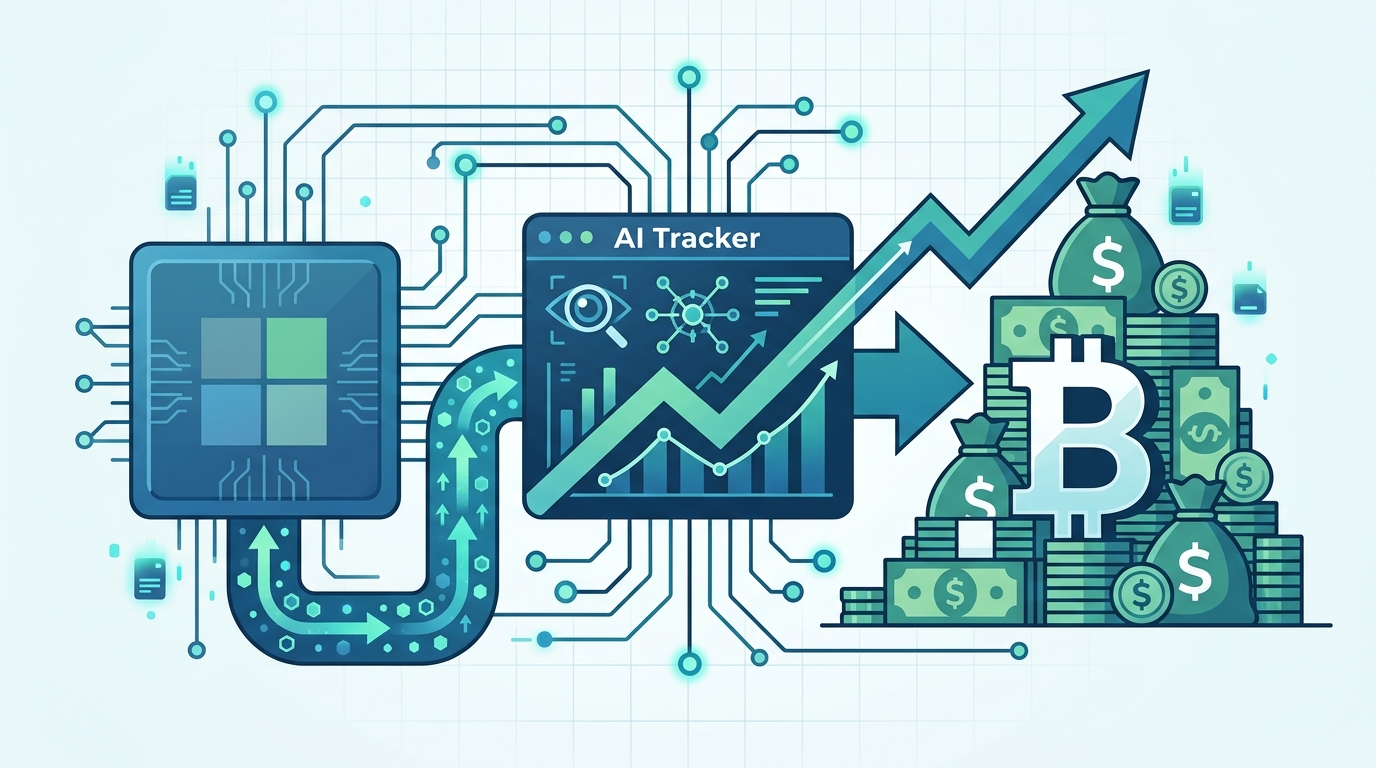
That gap is wide enough to matter. It suggests Microsoft is not merely participating in enterprise AI adoption; it is helping define the default stack for it.
- Adoption: Microsoft 5.0 vs sector 4.0, a +1.0 gap.
- Proficiency: Microsoft 5.0 vs sector 4.0, a +1.0 gap.
- Impact: Microsoft 5.0 vs sector 4.1, a +0.9 gap.
- Overall: Microsoft 5.0 vs sector 4.1, a +0.9 gap.
The comparison also exposes a practical reality for enterprise buyers. Microsoft has a stronger distribution channel than most AI vendors because it already owns the productivity suite, the cloud layer, and much of the enterprise relationship. If Copilot works, it can spread through existing Microsoft contracts instead of requiring a fresh procurement cycle.
That is why the tracker’s numbers feel less like hype and more like a snapshot of market power. Microsoft’s AI advantage is not built on one model or one app. It comes from a stack that reaches into daily office work, cloud infrastructure, and security operations at the same time.
What the tracker says about Microsoft’s next move
Larridin’s AI Tracker also lists five active initiatives, including a community-first data center program, a Copilot checkout agent for shopping, and the Secure Future Initiative, which dedicates 34,000 engineers to security work. That mix is telling: Microsoft is trying to prove that scale, governance, and product expansion can move together.
The biggest test now is whether those AI gains keep showing up in revenue and customer retention, or whether the company runs into the same enterprise problem everyone else does: lots of pilots, fewer full rollouts. Microsoft’s own numbers are strong, but the next question is sharper than “is AI working?” It is whether Microsoft can keep turning distribution into durable usage without letting cost, security, or customer fatigue slow it down.
For developers and enterprise teams, the takeaway is simple. If you build for Microsoft’s ecosystem, AI is no longer an optional add-on to watch from a distance. It is becoming part of the default environment, and the companies that adapt their workflows now will have a much easier time when Copilot-style tools become standard in procurement, support, and internal operations.
// Related Articles
- [IND]
WebX 2026 turns speaker hype into a conference brief
- [IND]
AI Weekly: 2026-07-06 ~ 2026-07-13
- [IND]
The AI Act should be treated as Europe’s operating system for AI
- [IND]
Booz Allen’s OpenAI Deal Is Real Advantage, Not Hype
- [IND]
OpenSearch’s vector search benchmark in 5 parts
- [IND]
Vector Databases That Work in Production