Microsoft Has Spent Over $100B on OpenAI
Microsoft has spent over $100 billion on its OpenAI partnership, highlighting how deeply the company is tied to OpenAI’s growth.

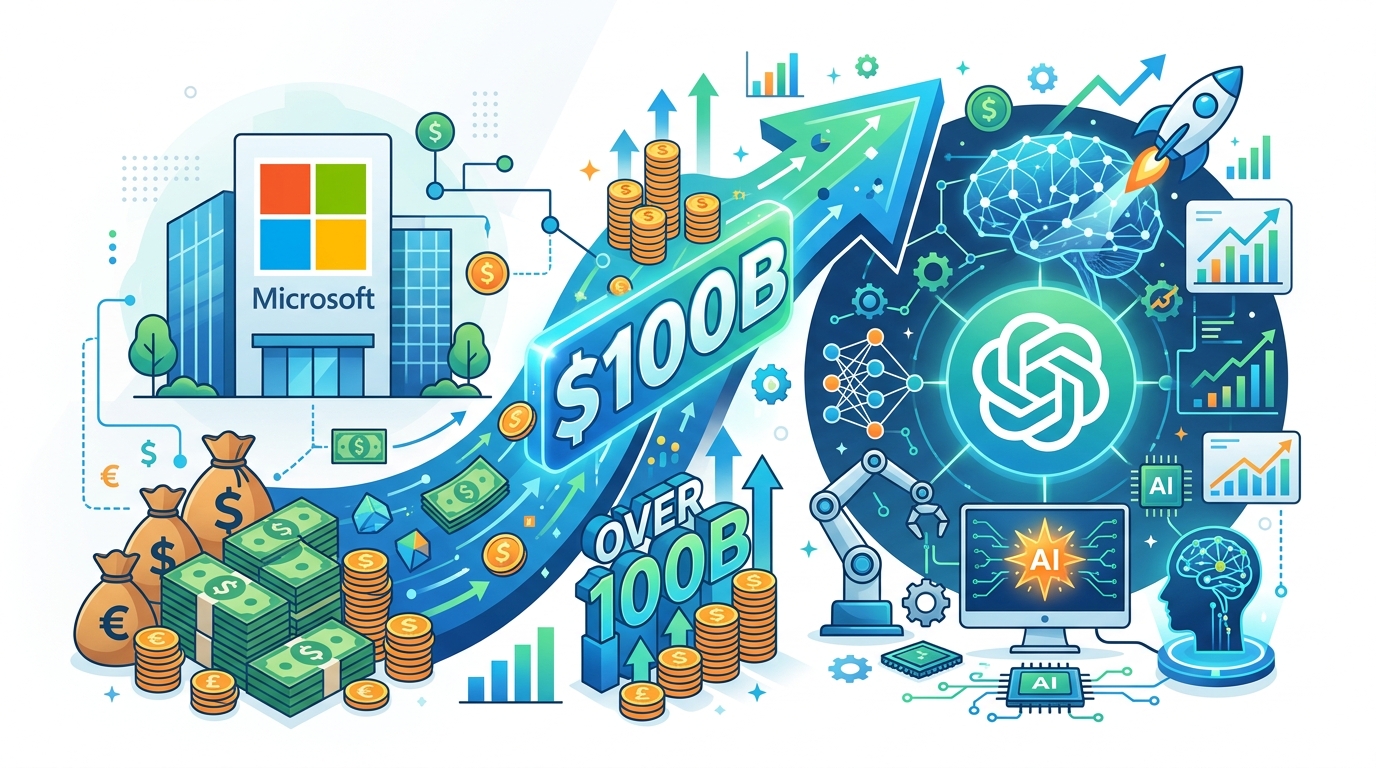
Microsoft has spent more than $100 billion on its partnership with OpenAI.
Microsoft has now put a staggering amount of money into its OpenAI partnership: more than $100 billion, according to testimony reported by Bloomberg. That figure is big enough to change how people think about the relationship. This is no side bet on generative AI; it is one of the largest corporate commitments in the sector.
| Metric | Value | Why it matters |
|---|---|---|
| Microsoft spending on OpenAI partnership | Over $100 billion | Shows the scale of Microsoft’s commitment |
| Source date | 2026-05-13 | Places the testimony in a current legal and business context |
| Company involved | Microsoft Corp. | One of the world’s largest software vendors |
What the $100 billion number changes
Get the latest AI news in your inbox
Weekly picks of model releases, tools, and deep dives — no spam, unsubscribe anytime.
No spam. Unsubscribe at any time.
When a company spends this much on a single AI partnership, it stops looking like a strategic experiment and starts looking like infrastructure spending. Microsoft has tied product plans across Microsoft 365, Azure, and its developer tools to OpenAI models, so the money is doing more than buying access. It is helping shape where Microsoft wants the next decade of computing to go.

The number also gives a clearer sense of scale than the usual vague talk about AI budgets. $100 billion is more than many public companies generate in annual revenue, and it is far beyond the kind of spend most enterprise customers will ever make on a vendor relationship. That makes this partnership a useful proxy for how aggressively Big Tech is backing foundation models.
- Over $100 billion has gone into the Microsoft-OpenAI partnership.
- The disclosure came through executive testimony reported by Bloomberg.
- The investment links Microsoft’s core cloud and productivity stack to OpenAI’s model roadmap.
Why this matters for OpenAI and Microsoft
For OpenAI, Microsoft’s spending helps explain how the company has been able to train and ship large models at the pace it has. Compute is expensive, talent is expensive, and distribution is expensive. Microsoft covers pieces of that stack through cloud capacity, product integration, and financial backing.
For Microsoft, the deal is about control as much as access. The company gets a front-row seat to model improvements, product integration opportunities, and a stronger position against rivals like Google and Amazon, both of which are pouring money into their own AI platforms. Microsoft is betting that the operating system, the office suite, and the cloud layer all get more valuable when AI is embedded everywhere.
“AI is the defining technology of our time,” Satya Nadella said during Microsoft’s 2023 Build keynote.
That quote is useful here because it explains the company’s behavior better than any investor deck. A $100 billion partnership is what “defining technology” spending looks like when a giant software company decides to make the bet real.
How this compares with other AI spending
The scale is easier to understand when you compare it with other major AI commitments. Microsoft’s spending on OpenAI is in a different class from the budgets most startups or enterprise software firms can justify. It is also large enough to influence the market for cloud compute, model access, and enterprise AI distribution.
- Microsoft’s OpenAI spending: over $100 billion.
- Many AI startups raise tens or hundreds of millions, not tens of billions.
- Large cloud and model investments from other tech giants are usually spread across several products, not concentrated in one partner.
That concentration matters. A single partnership can create speed, but it can also create dependency. If OpenAI changes direction, Microsoft feels it. If Microsoft changes pricing or distribution, OpenAI feels it too. The relationship is deep enough that any future restructuring, revenue-sharing dispute, or regulatory challenge could affect both companies at once.
What to watch next
The key question is whether this spending translates into durable product advantage. If Microsoft can keep turning OpenAI models into higher-value software, cloud demand, and enterprise stickiness, the $100 billion figure may look expensive but justified. If rivals close the gap with cheaper models or better distribution, the partnership could become a very costly way to buy time.
For developers, the takeaway is simple: watch how Microsoft prices AI features, how OpenAI model access changes inside Azure, and whether more of the company’s core software starts depending on a handful of frontier models. The next round of competition will be less about who has AI and more about who can make AI pay for itself.
// Related Articles
- [IND]
WebX 2026 turns speaker hype into a conference brief
- [IND]
AI Weekly: 2026-07-06 ~ 2026-07-13
- [IND]
The AI Act should be treated as Europe’s operating system for AI
- [IND]
Booz Allen’s OpenAI Deal Is Real Advantage, Not Hype
- [IND]
OpenSearch’s vector search benchmark in 5 parts
- [IND]
Vector Databases That Work in Production