Why Coinbase’s AI Agent Wallets Matter More Than Another Crypto Featu…
Coinbase’s agentic wallets are a real step toward autonomous crypto payments, not a gimmick.

Coinbase’s agentic wallets are a real step toward autonomous crypto payments, not a gimmick.
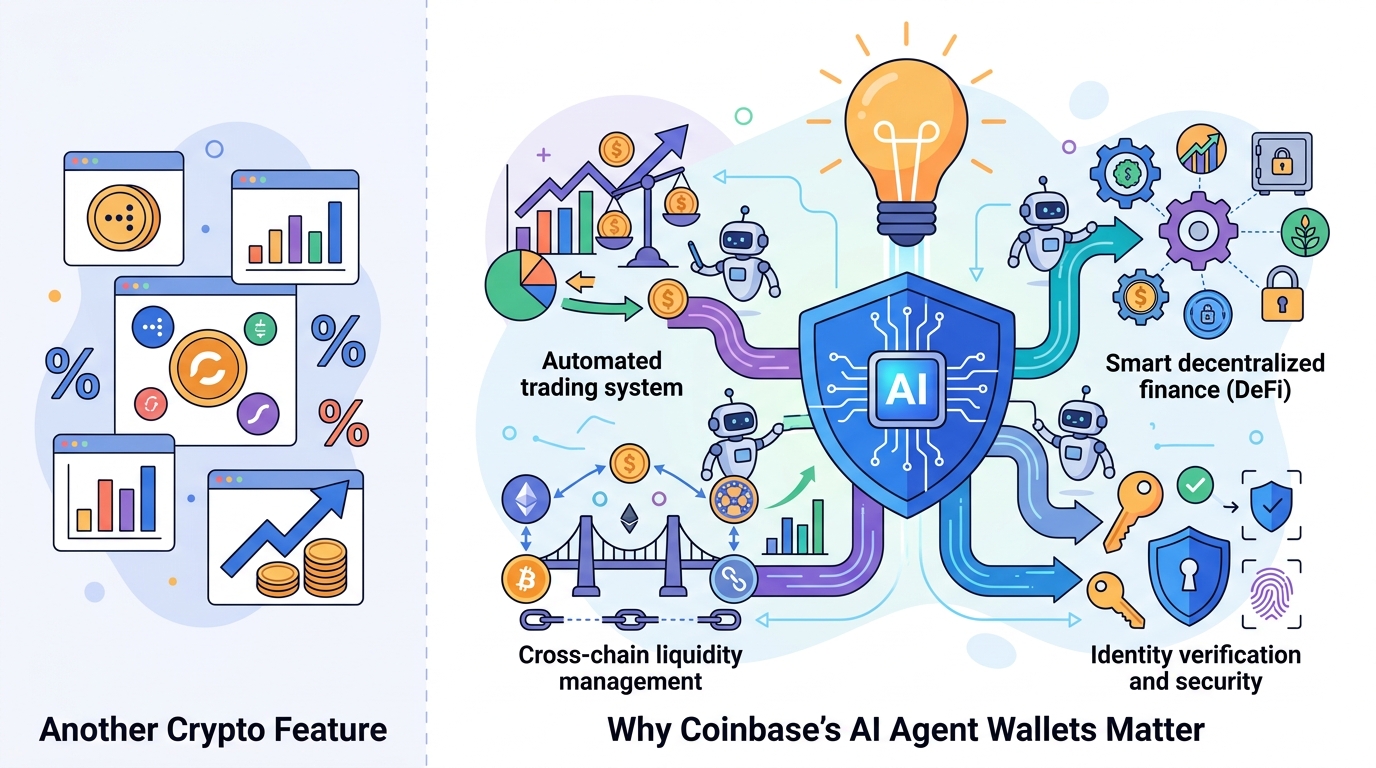
Coinbase is right to push AI agents from “advisers” to actors, because software that can hold permissions, pay for services, and rebalance positions without human babysitting is the first practical use case that gives crypto infrastructure a reason to exist beyond speculation. The company says Agentic Wallets extend AgentKit and let agents transact through x402, while already processing 50 million transactions. That is not a lab demo. It is a payments layer being shaped around machine-to-machine commerce, and that is where the market is heading.
First argument: autonomous agents need native payment rails, not just chat interfaces
Get the latest AI news in your inbox
Weekly picks of model releases, tools, and deep dives — no spam, unsubscribe anytime.
No spam. Unsubscribe at any time.
The strongest case for Coinbase is simple: an AI agent that can recommend an action but cannot pay for it is a half-built product. Coinbase’s own example is the right one. If an agent is monitoring a DeFi position, sees a yield opportunity, and needs to pay for an API key or compute to execute the strategy, forcing a human to approve every micro-step destroys the point of automation. x402 exists to remove that friction, and the reported 50 million transactions suggest the protocol is already past the novelty phase.

This matters because the internet has spent decades making software better at reading, writing, and deciding, while payments remained stubbornly manual. Agentic wallets close that gap. Once an agent can buy storage, access premium data, or pay for compute on its own, the wallet stops being a consumer app feature and becomes infrastructure. That is the correct level of ambition. Crypto has always promised programmable money; Coinbase is finally treating that promise as a product requirement instead of a slogan.
Second argument: the real value is operational, not ideological
Coinbase is also smart to frame this around operations rather than ideology. The article points to agents that can monitor yields across protocols, execute trades on Base, and manage liquidity positions around the clock. That is the kind of use case businesses understand immediately: reduce latency, reduce manual work, and make systems resilient outside business hours. A treasury bot that can move funds when spreads widen is worth more than a thousand theoretical discussions about decentralization.
The same logic applies to Lightning Labs’ L402 toolset for Bitcoin Lightning. An agent that can run a Lightning node and manage a wallet without touching private keys turns crypto into a machine-access layer for real services. That is the pattern worth watching. Whether the rail is Base or Lightning, the winning system is the one that lets software pay for what it consumes with minimal human overhead and clear permission boundaries. That is a practical upgrade, not a marketing one.
The counter-argument
The strongest objection is security. Giving AI agents spending power invites abuse, from prompt injection to bad policy settings to simple model error. If a wallet can sign transactions, then a compromised agent can drain funds fast. Critics are right to say that “autonomous” sounds reckless when the underlying systems still hallucinate, misread context, and fail under adversarial input. In finance, one bad decision is not a bug report; it is a loss.
There is also a governance problem. Users do not want opaque software making open-ended financial moves, and regulators will not accept a world where an agent’s mistake becomes an excuse. The concern is valid, especially for retail users and high-value treasuries. Permissioning, limits, and audit trails are not optional extras. They are the product.
But this counter-argument does not defeat agentic wallets; it defines them. Coinbase is not proposing unbounded autonomy. The article explicitly says users can set controls and permissions, which is the only sane way to build this category. The right comparison is not “AI gets full control of money.” The right comparison is “software already automates trading, billing, and treasury workflows, and agentic wallets make that automation explicit, bounded, and inspectable.” That is safer than the status quo of scattered API keys, brittle scripts, and hidden service accounts.
What to do with this
If you are an engineer, build for constrained autonomy: scope every agent wallet by asset, venue, spend limit, and time window, then log every action as if an auditor will read it. If you are a PM, stop pitching agentic wallets as a futuristic feature and frame them as a workflow win for treasury, trading, and service payments. If you are a founder, focus on one narrow machine economy where autonomous spend is obviously useful, because broad “AI wallet” narratives will fail unless they solve a specific, repeated payment problem with clear guardrails.
// Related Articles
- [IND]
WebX 2026 turns speaker hype into a conference brief
- [IND]
AI Weekly: 2026-07-06 ~ 2026-07-13
- [IND]
The AI Act should be treated as Europe’s operating system for AI
- [IND]
Booz Allen’s OpenAI Deal Is Real Advantage, Not Hype
- [IND]
OpenSearch’s vector search benchmark in 5 parts
- [IND]
Vector Databases That Work in Production