Why Microsoft should stop betting its AI future on OpenAI
Microsoft is right to shop for AI startups because it needs an exit path from OpenAI dependency.

Microsoft should build an AI future that does not depend on OpenAI.
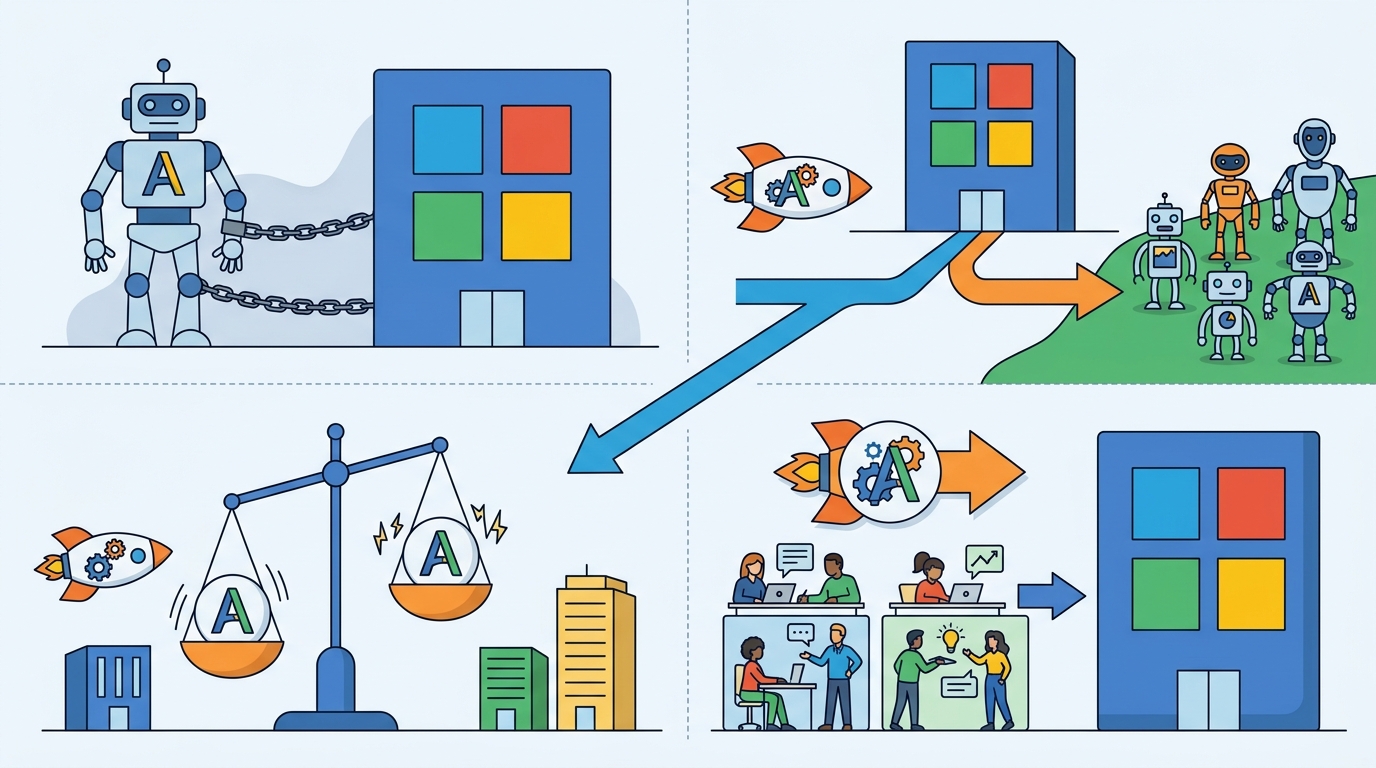
Microsoft is doing the right thing by shopping for AI startups now, because its OpenAI relationship has become a strategic liability, not just a commercial partnership. Reuters reports that Microsoft is already looking at startup deals as it prepares for a future that works even if OpenAI is no longer the centerpiece. That is the correct response to a simple reality: when one partner controls a core capability, pricing, roadmap, and access can all become hostage to someone else’s priorities.
First argument: dependency is now the real risk
Get the latest AI news in your inbox
Weekly picks of model releases, tools, and deep dives — no spam, unsubscribe anytime.
No spam. Unsubscribe at any time.
Microsoft’s AI story has been built around OpenAI for too long, and that concentration has obvious downside. If a single external partner supplies the most visible models, the most important product demos, and much of the market narrative, then every negotiation becomes existential. A company of Microsoft’s size should not let one startup sit in the middle of its cloud, productivity, and developer strategy.

The Reuters report matters because it shows Microsoft acting like a platform company, not a captive customer. Shopping for startups is not a side quest. It is a hedge against a supply chain problem in AI. The lesson from every major tech platform is the same: if your future product depends on a single upstream vendor, you do not have a moat, you have a bottleneck.
Second argument: startup deals buy optionality faster than internal rebuilds
Microsoft can build models in-house, but building alone is slow and expensive, and the market does not reward delay. Buying or backing startups gives Microsoft immediate access to specialized talent, niche model approaches, and product teams that already know how to ship. In AI, speed matters more than elegance because the competitive window closes fast and customers adopt what works today, not what looks best in a five-year plan.
There is also a portfolio logic here. Microsoft does not need one replacement for OpenAI. It needs a set of options across infrastructure, inference, agents, and vertical applications so it can mix and match capabilities as the market shifts. That is exactly what startup deals are for. They let Microsoft spread risk across multiple bets instead of pinning the future on a single relationship that can sour, stall, or simply become too expensive.
The counter-argument
The strongest case against this view is that Microsoft gains more by deepening the OpenAI alliance than by splintering its attention across startups. OpenAI still has brand power, technical credibility, and a product cadence that smaller acquisitions cannot match overnight. From that angle, startup shopping looks like defensive theater: a lot of motion, not much substance.
There is also a real integration cost. Buying scattered startups can create a messy stack of overlapping models, incompatible tooling, and talent churn. A clean partnership with OpenAI may still be the fastest way to keep shipping at scale, especially if Microsoft wants to avoid the distraction of absorbing too many small teams with different architectures and cultures.
That argument is not wrong about the cost of fragmentation, but it misses the larger point. Microsoft does not need to abandon OpenAI to reduce its dependence on OpenAI. It needs leverage. Startup deals create that leverage by giving Microsoft alternatives, bargaining power, and a fallback path if the partnership becomes constrained by economics or governance. The risk of a more complex portfolio is real, but it is smaller than the risk of strategic capture by one partner.
What to do with this
If you are a founder, PM, or engineer, the lesson is blunt: never let one model provider become your entire roadmap. Build with interchangeability in mind, keep your data and orchestration layers portable, and assume model access will change. Microsoft is acting on that principle at enterprise scale, and teams of every size should do the same. In AI, dependency is not efficiency. It is exposure.
// Related Articles
- [IND]
WebX 2026 turns speaker hype into a conference brief
- [IND]
AI Weekly: 2026-07-06 ~ 2026-07-13
- [IND]
The AI Act should be treated as Europe’s operating system for AI
- [IND]
Booz Allen’s OpenAI Deal Is Real Advantage, Not Hype
- [IND]
OpenSearch’s vector search benchmark in 5 parts
- [IND]
Vector Databases That Work in Production