Why Pinterest’s new ad relevance model is a win for advertisers
Pinterest’s hybrid ad model is a better way to serve ads because it uses live intent and past conversion data together.

Pinterest’s hybrid ad model uses live intent and past conversions to serve more relevant ads.
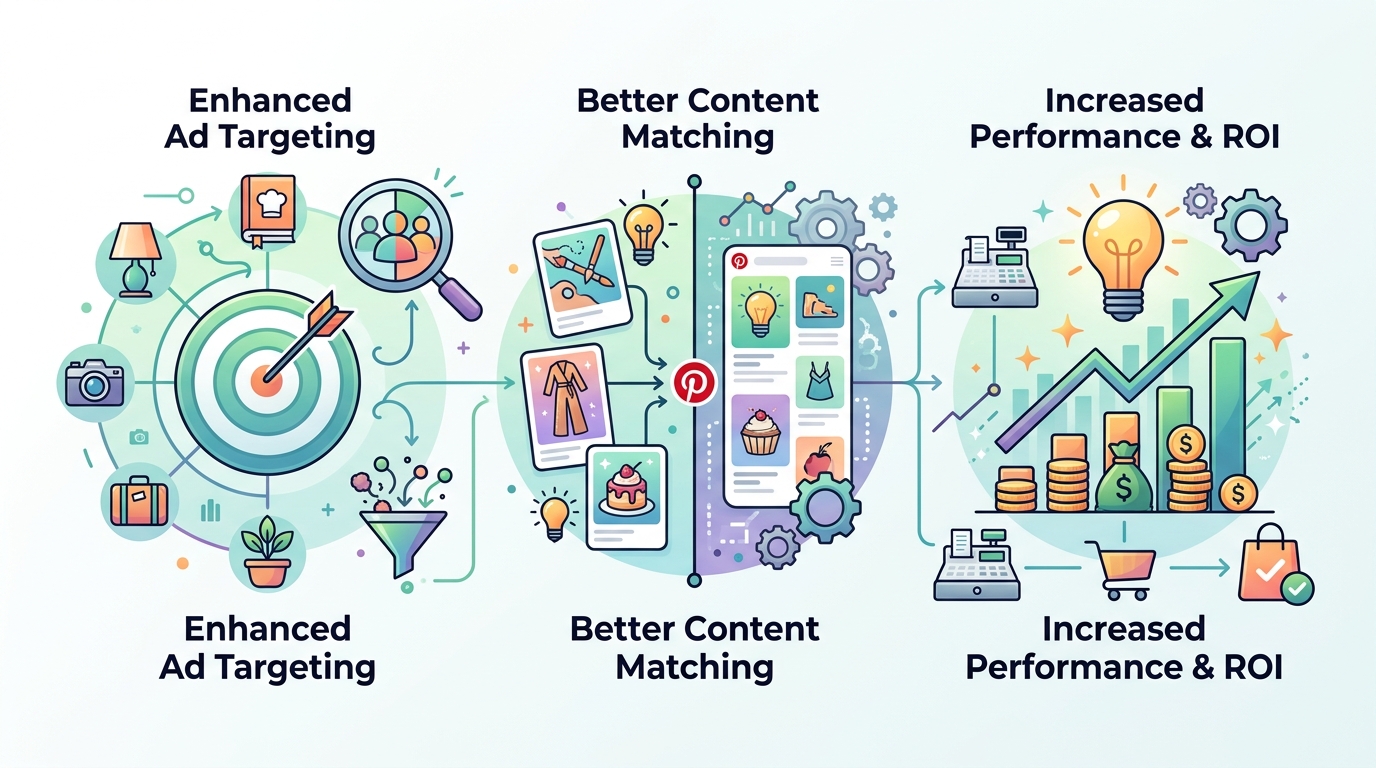
Pinterest is right to fuse off-site conversion history with on-platform search behavior, and advertisers should want more of this, not less. The company says its updated system lifted median candidate relevance by roughly 275% to 300% and doubled the number of ad candidates delivered per impression. That is not a cosmetic tweak. It is a clear sign that ad relevance improves when the platform stops treating a user’s intent as either historical or immediate and instead uses both.
First argument: relevance improves when signal timing improves
Get the latest AI news in your inbox
Weekly picks of model releases, tools, and deep dives — no spam, unsubscribe anytime.
No spam. Unsubscribe at any time.
The biggest weakness in ad targeting is stale intent. A user who bought running shoes last month may still be in market for socks, insoles, or training plans today, but a model that only reads yesterday’s conversion event will miss the next purchase. Pinterest’s update fixes that by combining past off-site conversions with current search behavior, which means the system can distinguish between a casual browser and someone actively signaling purchase intent right now.

The reported performance gain matters because it is tied to candidate relevance, not vanity metrics. A 275% to 300% median uplift means the model is finding more useful ad matches before the auction even starts. That is the kind of improvement that changes campaign economics: fewer wasted impressions, better click quality, and less pressure on advertisers to brute-force performance with broader budgets.
Second argument: better ad systems are better user experiences
Most ad complaints come from irrelevance, not from the existence of ads. Pinterest’s approach reduces that friction by making Promoted Pins track the user’s current session context instead of forcing a generic retargeting loop. If someone is searching for nursery ideas, home office storage, or winter recipes, the ad system should respond to that moment, not to a conversion from weeks ago that no longer reflects the user’s needs.
The platform also says the new serving flow doubled the number of ad candidates delivered per impression. That matters because a richer candidate set gives the ranking system more room to choose a genuinely useful promotion. In practical terms, more candidates mean less dependence on a single brittle signal and more chance of matching creative, category, and intent. For users, that usually feels like better personalization. For advertisers, it means the platform is doing more of the matching work instead of dumping optimization back on the campaign manager.
The counter-argument
The strongest objection is that hybrid targeting can become too invasive. If a platform combines off-site conversion history with on-platform behavior, it starts to look like surveillance with a prettier interface. Privacy advocates will argue that this kind of model deepens the asymmetry between platforms and users, especially when people do not fully understand how their activity across the web feeds ad decisions inside a closed ecosystem.
There is also a legitimate business concern: more relevance can create more dependence. If Pinterest gets very good at predicting intent, advertisers may overfit to the platform’s signals and ignore brand building, creative differentiation, or upper-funnel demand generation. In that view, the system is not just helping marketers; it is steering them toward a narrower definition of performance.
That critique is serious, but it does not defeat the model. The right standard is not whether ad systems use data, but whether they use the minimum data needed to produce materially better outcomes. Pinterest’s reported gains show that the model is doing real work, and the presence of better relevance does not automatically equal abuse. The limit is obvious: platforms must keep consent, data governance, and user controls visible. But rejecting hybrid relevance altogether would preserve a worse experience for users and a weaker return for advertisers.
What to do with this
If you are an engineer, PM, or founder building ad tech, take the lesson seriously: stop optimizing for single-signal targeting and start designing systems that combine historical conversion patterns with real-time intent. Measure candidate quality, not just clicks. Keep the privacy boundary explicit. And treat relevance as a product feature, because on platforms like Pinterest, it is one of the main reasons ads feel useful instead of annoying.
// Related Articles
- [IND]
WebX 2026 turns speaker hype into a conference brief
- [IND]
AI Weekly: 2026-07-06 ~ 2026-07-13
- [IND]
The AI Act should be treated as Europe’s operating system for AI
- [IND]
Booz Allen’s OpenAI Deal Is Real Advantage, Not Hype
- [IND]
OpenSearch’s vector search benchmark in 5 parts
- [IND]
Vector Databases That Work in Production