Why Zyphra Cloud on AMD Matters More Than Another Model Launch
Zyphra Cloud matters because inference, not training, is now the real AI platform battle.

Zyphra Cloud matters because inference, not training, is now the real AI platform battle.
Zyphra Cloud is a smart move, and the market should treat it as a sign that AI infrastructure has shifted from model bragging rights to production economics. The company is not selling another demo layer. It is betting that long-context inference, agent workloads, and open-weight models will reward platforms that can keep more sessions resident in memory, respond quickly, and do it without NVIDIA-only dependency. That is the right bet because the buyers that matter now are not asking which model won a benchmark. They are asking which stack can stay up, stay fast, and stay affordable when real users and real workflows hit it all day.
Inference is where the money and pain live
Get the latest AI news in your inbox
Weekly picks of model releases, tools, and deep dives — no spam, unsubscribe anytime.
No spam. Unsubscribe at any time.
The first reason Zyphra matters is that inference has become the operational bottleneck of AI. Training gets the headlines, but production systems pay the bill every time a user prompts a model, an agent loops through tools, or a workflow stretches across thousands of tokens. Cloud News says Zyphra is targeting workloads like agent programming, in-depth research, and complex automation, and that framing is exactly right. These are not toy use cases. They are the workloads that expose memory pressure, latency spikes, and cache churn, which means the winner is the provider that can keep context alive without wasting compute.

This is why the platform’s emphasis on long-context systems is more important than the launch list of models. Zyphra says its inference stack is built for large MoE models and cache-heavy sessions, where KV and prefix caches consume a major share of memory. That is a concrete technical advantage, not a marketing phrase. When a node can hold more active sessions before degrading, the provider gets better throughput and the customer gets fewer stalled workflows. In a market where every second of lag can break an agent loop or frustrate a knowledge worker, that matters more than another shiny model name.
AMD is no longer a side plot
The second reason this launch matters is that it gives AMD a real production narrative in AI cloud, not just a chip spec sheet. Zyphra is running on AMD Instinct MI355X GPUs through TensorWave, and that pairing tells the market something important: NVIDIA’s dominance is strong, but it is no longer unchallenged by empty promises. AMD’s advantage here is memory density. Each MI355X offers 288 GB of HBM3E and 8 TB/s bandwidth, which is exactly the kind of hardware profile long-context inference wants. When workloads are memory-bound rather than purely compute-bound, more HBM per GPU can translate into fewer recomputations and more resident sessions.
Zyphra’s own comparison makes the point sharply. For Kimi K2.6, the company says an 8-GPU MI355X node can support about 184 active agents at 256K context, versus roughly 100 on an 8-B200 example under its assumptions. That is not an independent benchmark, and it should not be treated as universal truth. But it is still useful because it highlights the real battlefield: not raw peak throughput, but how many useful sessions a system can sustain before performance falls apart. If AMD hardware can carry more of that load per node, then the economics of serving open models changes fast.
Open-weight models are becoming the enterprise default
The third reason to care is that Zyphra is leaning into open-weight models at the exact moment many teams want control more than convenience. DeepSeek V3.2, Kimi K2.6, and GLM 5.1 are not just popular names. They represent a broader shift in how technical teams think about AI deployment. Teams want options that let them tune cost, control data paths, and avoid tying every product decision to a single proprietary API. Zyphra Cloud fits that demand by presenting inference as infrastructure, not as a closed service with opaque limits.
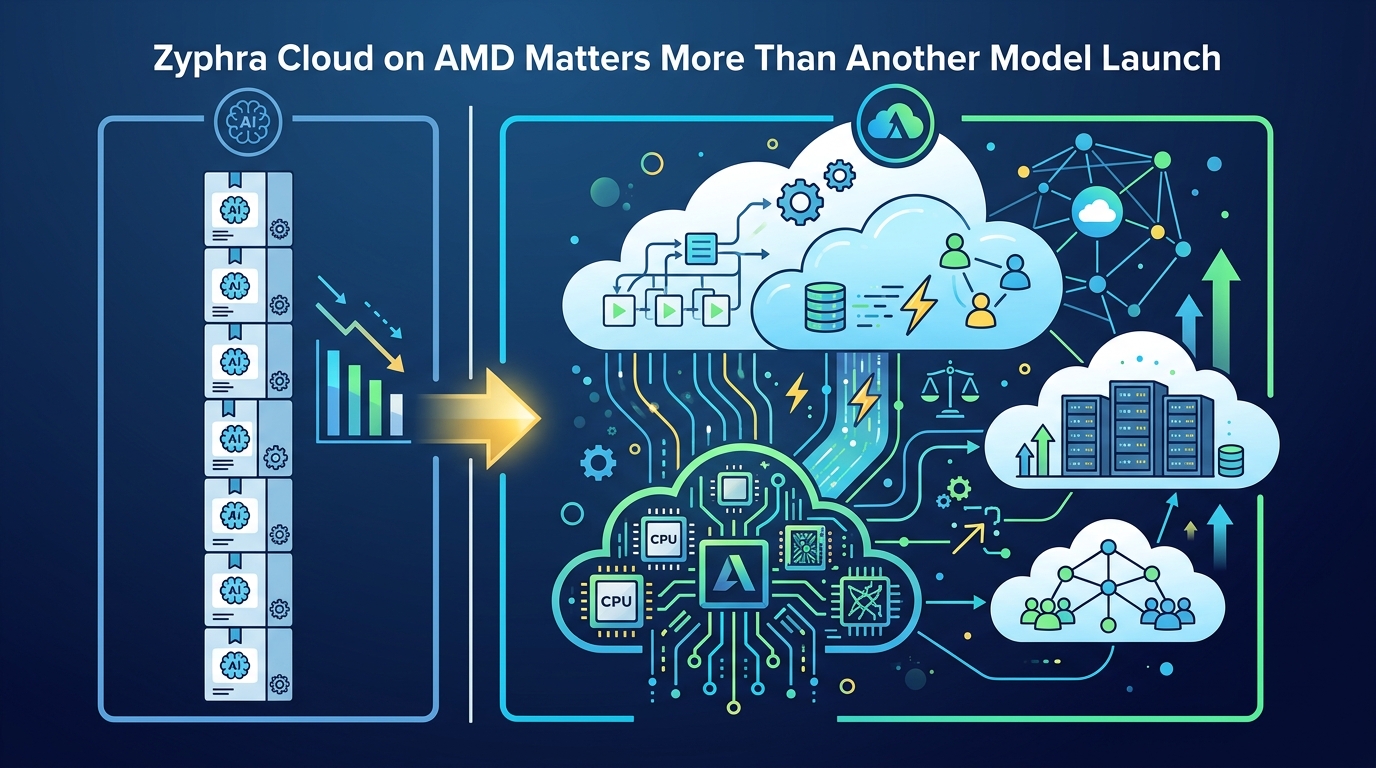
That matters because the open-model story is moving from experimentation to procurement. When a company builds around open weights, it can negotiate around cost, deploy in specific regions, manage compliance more directly, and swap components without rebuilding the entire product. Zyphra’s planned expansion into fine-tuning, reinforcement learning, isolated agent environments, and bare-metal infrastructure shows it understands the direction of travel. Buyers do not want one endpoint. They want a platform that can host inference today and support adaptation tomorrow.
The counter-argument
The strongest objection is simple: this is still a small launch in a market ruled by incumbents. NVIDIA’s software moat remains formidable, and ROCm still has to prove it can match CUDA’s maturity across the messy realities of production. On top of that, Zyphra has not published pricing, SLA terms, or hard limits, which means buyers cannot yet judge whether the platform is truly competitive or just technically interesting. In enterprise AI, good architecture is not enough. Reliability, documentation, support, and predictable billing decide whether a platform gets adopted.
That critique is fair, but it does not weaken the core argument. It only sets the bar correctly. Zyphra does not need to beat NVIDIA everywhere to matter; it needs to win the specific slice where long-context inference and open-weight deployment are the priority. The market is already fragmenting by workload, and that creates room for specialized stacks. If Zyphra can prove stable latency, transparent pricing, and strong operator controls, its technical premise becomes commercially relevant. If it cannot, then the launch becomes a proof of concept instead of a platform. Those are the only two outcomes that matter.
What to do with this
If you are an engineer, PM, or founder, treat Zyphra Cloud as a signal to design for inference-first infrastructure now. Stop assuming the main AI decision is which model to train. Start evaluating how your stack handles long context, cache pressure, agent loops, and vendor flexibility. Build your architecture so model choice is swappable, measure cost per successful workflow instead of cost per token alone, and test whether your workloads really need the NVIDIA default. The companies that win the next phase of AI will not be the ones with the loudest training story. They will be the ones that can serve open models reliably, at scale, on hardware that fits the workload.
// Related Articles
- [IND]
WebX 2026 turns speaker hype into a conference brief
- [IND]
AI Weekly: 2026-07-06 ~ 2026-07-13
- [IND]
The AI Act should be treated as Europe’s operating system for AI
- [IND]
Booz Allen’s OpenAI Deal Is Real Advantage, Not Hype
- [IND]
OpenSearch’s vector search benchmark in 5 parts
- [IND]
Vector Databases That Work in Production