BTC Ecosystem pitches $15 mining contract model
BTC Ecosystem is framing Bitcoin mining as a financial product, with a $15 welcome contract, renewable power, and hash-rate infrastructure.

BTC Ecosystem is recasting Bitcoin mining as a financial product built on hash rate and infrastructure.
Bitcoin mining is being pitched less as coin production and more as a structured business around energy, hardware, and hash-rate products. On 25 May 2026, BTC Ecosystem highlighted a $15 welcome contract that returns $0.53 per day, with withdrawals opening at $100.
| 項目 | 數值 |
|---|---|
| Welcome contract | $15 |
| Daily return | $0.53 |
| Withdrawal threshold | $100 |
| Published date | 25 May 2026 |
| ASIC efficiency cited | <15J/T |
What changed
Get the latest AI news in your inbox
Weekly picks of model releases, tools, and deep dives — no spam, unsubscribe anytime.
No spam. Unsubscribe at any time.
The BTC Ecosystem pitch reframes mining as part of a broader system focused on hash-rate financialization and infrastructure integration. Rather than treating mining as a simple race to mint coins, the model presents capacity itself as something that can be packaged, allocated, and tied to other services in the Bitcoin economy.

That shift shows up in both the operating setup and the product design. BTC Ecosystem is operated by ADAPT ECOSYSTEM PTY LTD, described as Australia-registered and overseen by the Australian Securities and Investments Commission. The company says it runs renewable-powered mining in Texas, Canada, and Australia, while tying the pitch to Bitmain hardware and AntPool operations.
- $15 welcome contract at signup
- $0.53 per day in stated returns
- Withdrawals available at $100 balance
- Supported assets include BTC, ETH, USDT, LTC, BCH, XRP, SOL, and DOGE
Why it matters
The appeal is obvious for operators and investors: if mining can be framed as infrastructure, not just token output, it may be easier to value, finance, and scale. The article argues that the real edge now comes from cheap power, cooling systems, and balance-sheet design, not just from owning more machines.
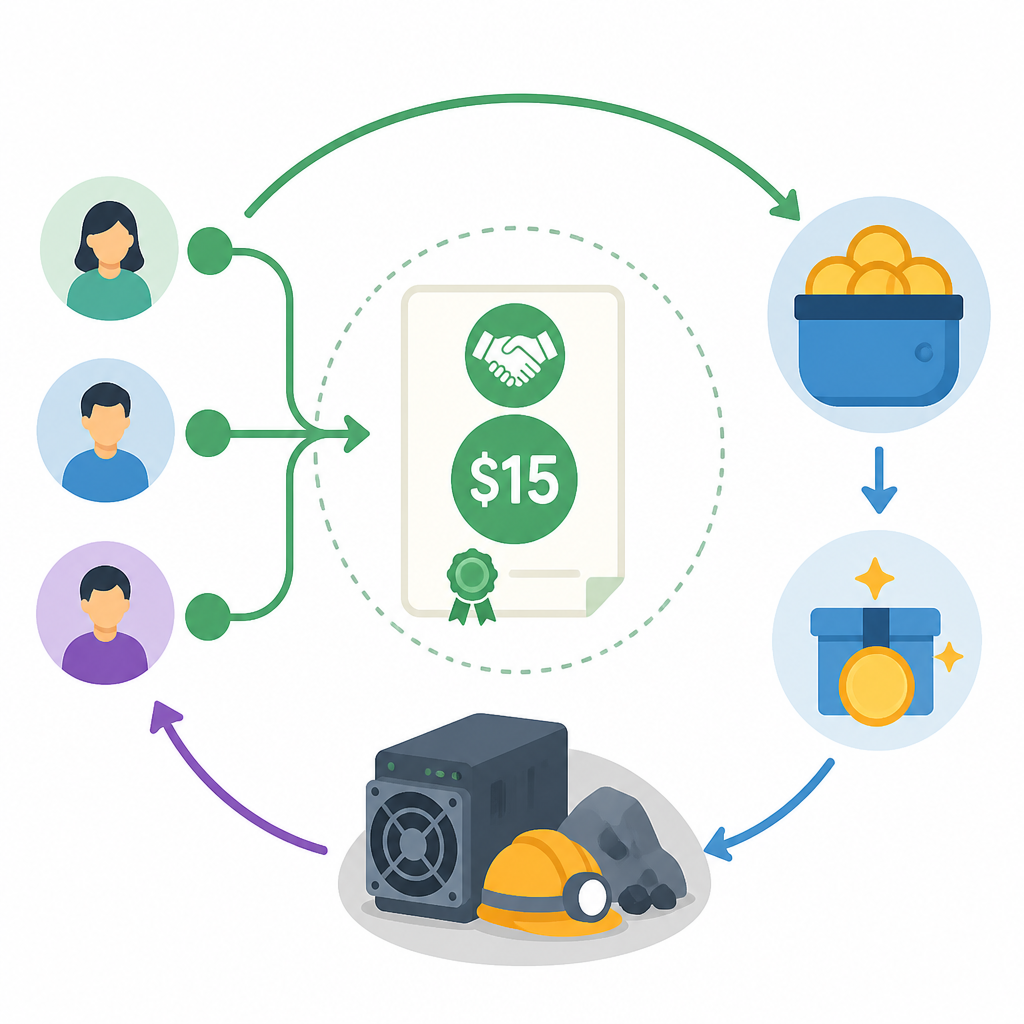
Hardware still anchors the model. BTC Ecosystem cites Bitmain’s Antminer S21 Pro series with efficiency below 15J/T and says liquid-cooling deployment is part of the playbook. That matters because tighter margins make power use and fleet durability central to any mining business that wants to look like a predictable asset class.
Renewable power is also part of the sales pitch. By linking operations in Texas, Canada, and Australia to ESG-friendly mining, BTC Ecosystem is trying to make mining look more acceptable to larger pools of capital. The tradeoff is familiar: as mining becomes more organized and financialized, decentralization concerns stay on the table.
The bigger question is whether hash-rate products will be judged like infrastructure or like speculative crypto offers. BTC Ecosystem is betting that mining’s next phase is a financial one, but the market will decide whether that story holds up.
// Related Articles
- [CHAIN]
MetaMask’s AI Agent Wallet Adds New ETH Demand
- [CHAIN]
MetaMask turns agent wallets into guarded automation
- [CHAIN]
Crypto agents should not get wallet access without hard containment
- [CHAIN]
x402 and agent wallets are moving crypto agents on-chain
- [CHAIN]
7 Solana APIs that cut weeks off integration
- [CHAIN]
Solana Unchained token sale nears Phase 1 close at $0.05