AIML-2026 Is a Bare-Bones Student Lab Repo
AIML-2026 on GitHub lists classic AI and ML lab exercises, but the repo is mostly a syllabus shell with missing files and no community activity.

AIML-2026 is the kind of GitHub repository you can understand in under two minutes. It has 0 stars, 0 forks, and a README that outlines 10 artificial intelligence and machine learning lab exercises, mostly pointing to material hosted in another repository. That makes it less of a software project and more of a course handout published on GitHub.
There is still something useful here. The lab list gives a compact snapshot of what many undergraduate AI and ML courses still teach in practice: Python basics, search algorithms, regression, classification, decision trees, random forests, and k-means clustering. If you want to see what an academic lab sequence looks like in 2026, this repo offers a plain, slightly unfinished example.
What the repository actually contains
Get the latest AI news in your inbox
Weekly picks of model releases, tools, and deep dives — no spam, unsubscribe anytime.
No spam. Unsubscribe at any time.
The README describes the project as “Artificial Intelligence and Machine Learning Labs,” but the contents are thin. Instead of a full codebase, the repository mainly works as an index of assignments and notebooks. Several links point to files in AIML-2025 and AIML-2023, which suggests this repo may be a student mirror or a course-specific copy rather than an original maintained project.
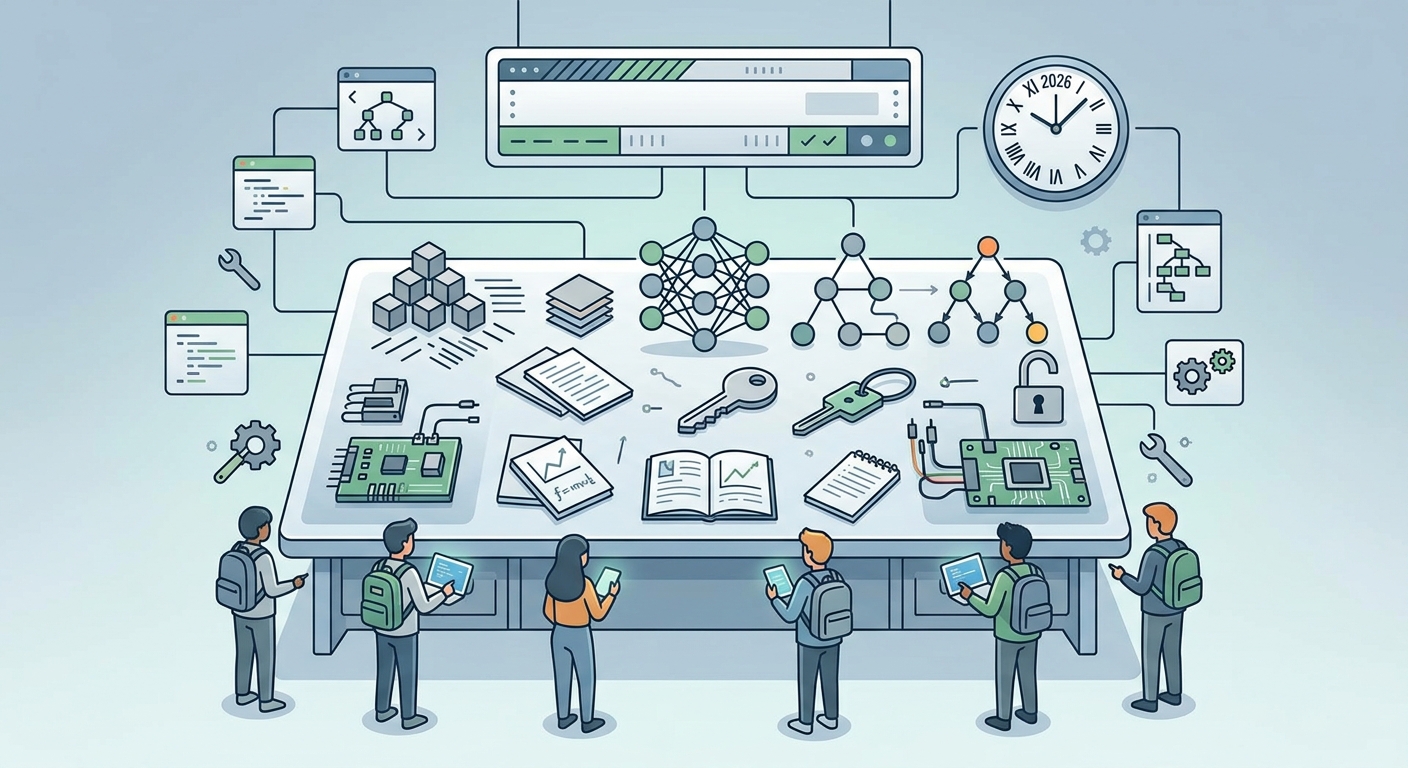
The assignment sequence itself is familiar. It starts with Python data tools such as NumPy, Pandas, and Matplotlib. It then moves into search methods like breadth-first search, depth-first search, and A* before shifting into standard supervised learning tasks built around well-known datasets.
- Repository activity shown on the page: 0 stars and 0 forks
- Number of listed labs: 10
- Number of notebook links listed: 10, with only Lab 01 clearly linked
- Several lab instruction links and project-topic links point to other GitHub repositories, not this one
That last point matters. A repo with external dependency links can still be useful, but only if the links are complete and maintained. Here, multiple entries for Labs 03 through 10 appear empty in the README. So the structure promises more than the repository currently delivers.
The curriculum is old-school, and that is not always bad
If you ignore the missing files for a moment, the course design reflects a very standard AI/ML teaching path. Students begin with data handling, then work through symbolic search, then train classic machine learning models on benchmark datasets. That approach is dated in some ways, especially in a year when students also need exposure to transformers, embeddings, and model evaluation beyond accuracy. Still, there is value in learning the basics before jumping into large language models.
Some of the listed tasks are exactly the kind of exercises that help students understand how algorithms behave under the hood. Writing breadth-first search or minimax from scratch teaches more than calling a library method. The same goes for implementing linear regression or k-nearest neighbors in a notebook before using higher-level tools from scikit-learn.
“All models are wrong, but some are useful.” — George E. P. Box
That quote fits this repository better than it may seem. The labs focus on simplified datasets and textbook methods, which do not mirror production AI work very closely. But they are still useful teaching tools. A student who has implemented A*, logistic regression, an SVM, and a random forest will have a much better sense of what modern abstractions are hiding.
The problem is not the curriculum itself. The problem is packaging. On GitHub, presentation matters. A public repository with empty links, minimal metadata, and no visible code history makes it hard for other students, recruiters, or teachers to assess what was actually built.
Where AIML-2026 falls short on GitHub
As a public repo, AIML-2026 is undercooked. There is no visible language classification, no topics, and no sign of community engagement. That alone does not make a repository bad, but it does limit its usefulness outside the original classroom context. If this is meant to document coursework, it needs actual notebooks, setup instructions, dataset references, and sample outputs.
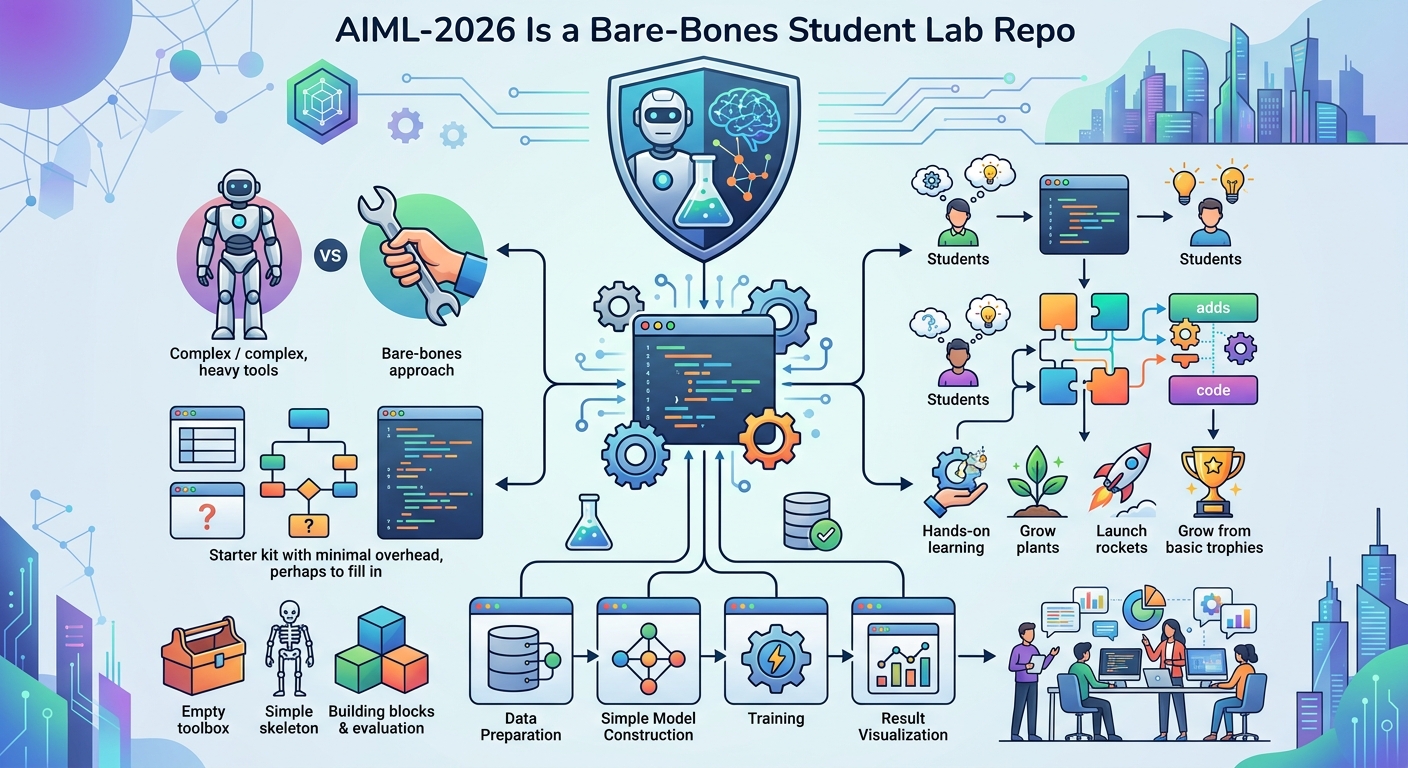
There is also a mismatch between the repository name and the README header. The repo is called AIML-2026, while the README begins with “AIML-2024-25.” That may sound minor, yet it creates immediate confusion about the academic year, ownership, and version history. For educational repositories, consistency is part of credibility.
- A polished student lab repo usually includes environment setup, package versions, and execution steps
- This repo currently exposes mostly a reading list of assignments
- Missing notebook links reduce reproducibility
- Cross-repo links make long-term maintenance harder if the source files move or go private
There is a broader lesson here for students publishing academic work on GitHub. A repository is not just storage. It is also a portfolio artifact. Even a simple lab collection can look far more credible with a complete README, direct links to datasets such as UCI Machine Learning Repository entries, and a short note on what each notebook demonstrates.
How it compares with stronger educational repos
Compared with well-maintained teaching repositories, AIML-2026 feels more like a draft. Strong educational repos usually include complete notebooks, dataset download instructions, expected outputs, and at least a few screenshots or result summaries. Some also add badges, licensing details, and issue tracking so other students can report broken links.
By contrast, this repo gives readers a list of intended exercises. That still has value if you want a quick curriculum outline. But if you are looking for runnable code or a reusable lab manual, you will likely need to follow the linked material in external repositories and reconstruct the workflow yourself.
- AIML-2026 lists 10 labs, but several entries have empty links
- The repository shows 0 stars and 0 forks at the time described in the source material
- Lab topics cover search, regression, classification, ensemble learning, and clustering
- Modern topics such as transformers, embeddings, MLOps, and model monitoring are absent
That absence says something about the gap between classroom ML and current industry practice. A student who completes these labs will understand the basics of classical machine learning. The same student will still need separate exposure to tools and ideas that dominate current AI work, from prompt engineering to vector databases to evaluation pipelines. We recently covered similar gaps in practical AI training in our look at open-source AI agent tools.
If the repository owner updates AIML-2026 with actual notebooks and cleaned-up links, it could become a useful starter archive for classmates. In its current state, it is best read as a syllabus outline published in public.
What to do with it
If you are a student, the smartest move is simple: treat AIML-2026 as a checklist, not a finished resource. Rebuild each lab in your own notebook, document your results, and publish a complete version with reproducible steps. If you are an instructor, this repo is a reminder that posting coursework to GitHub is easy, but making it usable takes another hour or two of cleanup.
My bet is that repositories like this will keep appearing because GitHub has become the default place to park academic work. The ones that matter will be the repos that go one step further and turn a class assignment into something another student can actually run this weekend.
// Related Articles
- [TOOLS]
Aliyun Bailian Token Plan turns credits into agents
- [TOOLS]
One API gateway turns six AI APIs into one
- [TOOLS]
OpenAI FDEs turn broken agents into shipped systems
- [TOOLS]
Anthropic’s daily brief turns news into a workflow
- [TOOLS]
Claude Reflect turns usage into retention
- [TOOLS]
Midjourney turns prompt ideas into art