Mastering AI Prompts: A 2026 Guide for Developers
38.5% of AI conversations need refinement in 2026. Discover strategies to streamline your AI interactions and reduce iterations for better outcomes.

In 2026, AI conversations have become more complex, with a striking 38.5% requiring iterative refinement. This statistic highlights a critical challenge developers face in creating effective AI prompts. As AI models evolve, so must our strategies for interacting with them.
Understanding Prompt Engineering
Get the latest AI news in your inbox
Weekly picks of model releases, tools, and deep dives — no spam, unsubscribe anytime.
No spam. Unsubscribe at any time.
The concept of prompt engineering is not new, but its importance has surged as AI models become more sophisticated. The global prompt engineering market reached USD 505.43 million in 2025 and is expected to grow to USD 6,703.84 million by 2034, with a compound annual growth rate (CAGR) of 33.27%. The U.S. leads this market with a 38% share, followed by China at 11%.

- Global market size in 2025: USD 505.43 million
- Expected market size by 2034: USD 6,703.84 million
- CAGR: 33.27%
- U.S. market share: 38%
- China market share: 11%
Insights from Industry Experts
Sarah Chen, Principal Engineer at Vercel, emphasizes the importance of proper prompt engineering: "We’re seeing a bimodal distribution. Teams that invested in prompt architecture six months ago are operating at 10× velocity. Everyone else is stuck verifying hallucinations." Her insights underscore the necessity of moving beyond outdated practices.
"We’re seeing a bimodal distribution. Teams that invested in prompt architecture six months ago are operating at 10× velocity. Everyone else is stuck verifying hallucinations." — Sarah Chen, Principal Engineer at Vercel
Optimizing AI Conversations
Effective prompt engineering can drastically improve AI task completion times. Research from March 2026 demonstrates that optimized AI prompts can reduce task completion time to just 18.7 minutes, compared to 3.55 hours for human-only efforts.
- Human-only task completion: 3.55 hours
- Poor AI prompts task completion: 47 minutes
- Optimized AI prompts task completion: 18.7 minutes
- Error rate with optimized AI: 8.2%
- Error rate with poor AI prompts: 34.8%
Specific Techniques for Better Prompts
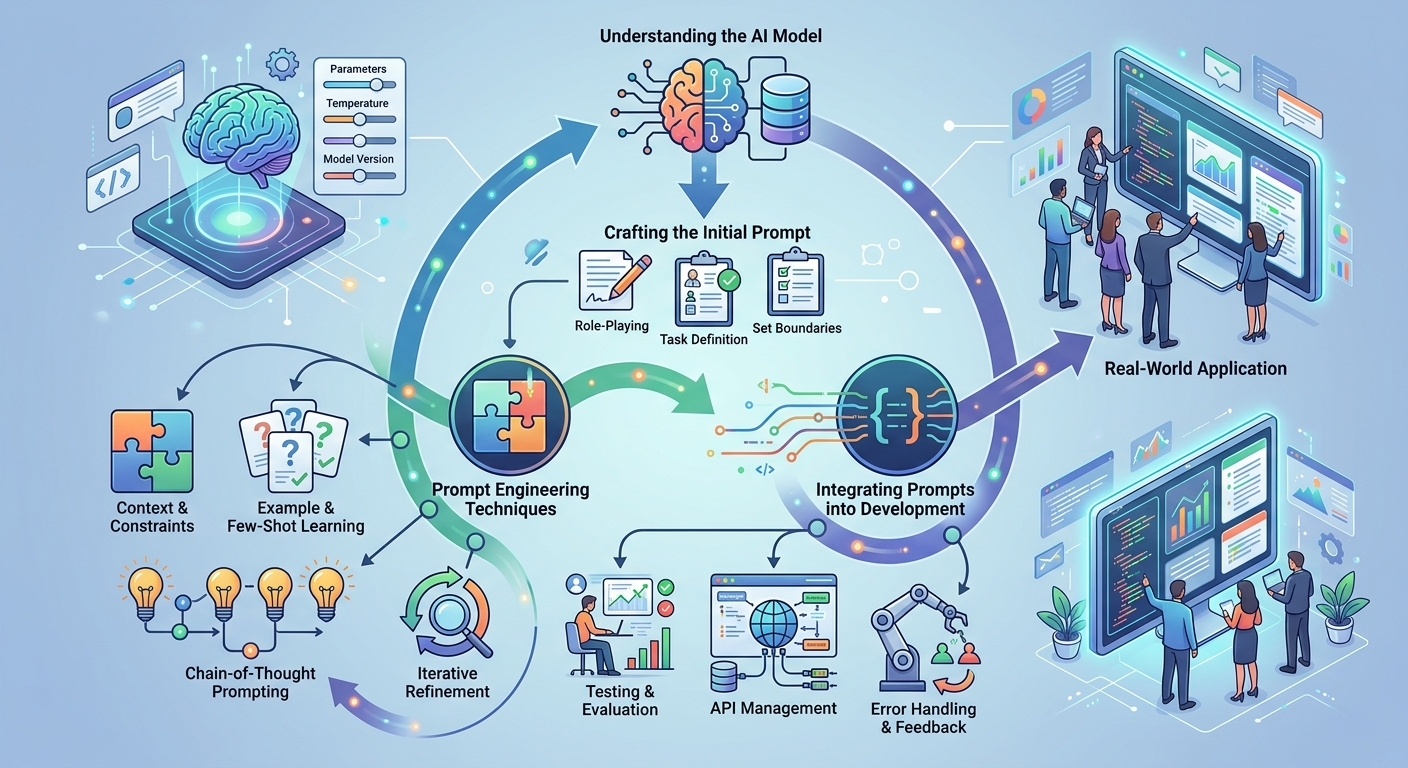
Moving away from vague prompts, constraint-based prompting has proven effective. This involves setting clear parameters and avoiding ambiguity. A structured prompt format known as Role-Context-Constraint-Format (RCCF) is gaining traction:
- Role: Define the AI's role, e.g., "You are a technical writer."
- Context: Provide background, e.g., "For engineers new to our API."
- Constraint: Include specific limitations, e.g., "Include one code example."
- Format: Specify the output structure, e.g., "Markdown with bullet points."
These methods have shown to reduce the need for multiple iterations significantly, enhancing productivity and accuracy in AI outputs.
Conclusion: Adapting to a Changing Landscape
As AI technology continues to advance, developers must adapt their strategies to leverage these tools effectively. By focusing on specific, structured prompts and continually refining their approaches, developers can improve AI interactions and reduce the need for iterative refinement. This shift not only enhances efficiency but also maximizes the potential of AI in various applications. As we progress, the ability to craft precise prompts will increasingly define success in AI-driven projects.
// Related Articles
- [TOOLS]
Aliyun Bailian Token Plan turns credits into agents
- [TOOLS]
One API gateway turns six AI APIs into one
- [TOOLS]
OpenAI FDEs turn broken agents into shipped systems
- [TOOLS]
Anthropic’s daily brief turns news into a workflow
- [TOOLS]
Claude Reflect turns usage into retention
- [TOOLS]
Midjourney turns prompt ideas into art