Why Claude Code’s prompt design beats IDE copilots
Claude Code wins because it is built like a terminal-native agent, not a line-completion plugin.

Claude Code wins because it is built like a terminal-native agent, not a line-completion plugin.
Claude Code is not impressive because it writes code. It is impressive because it changes the unit of work from autocomplete to orchestration, and that is the right design for serious software engineering. The difference shows up the moment you ask it to touch a legacy codebase, inspect logs, or reason through an unclear requirement. A Copilot-style tool predicts the next token. Claude Code behaves like a senior engineer sitting in the shell, using tools, reading context, and deciding what to do next.
It is designed for work, not for typing speed
Get the latest AI news in your inbox
Weekly picks of model releases, tools, and deep dives — no spam, unsubscribe anytime.
No spam. Unsubscribe at any time.
The first mistake in agent design is assuming the problem is keyboard friction. It is not. The real bottleneck in engineering is context switching across files, logs, tests, and shell commands. Claude Code’s prompt design leans into that reality by making the terminal the primary interface. That matters because the terminal is where real debugging happens. When an agent can grep logs, inspect file trees, run commands, and revise its plan based on outputs, it stops being a suggestion engine and becomes a workflow engine.
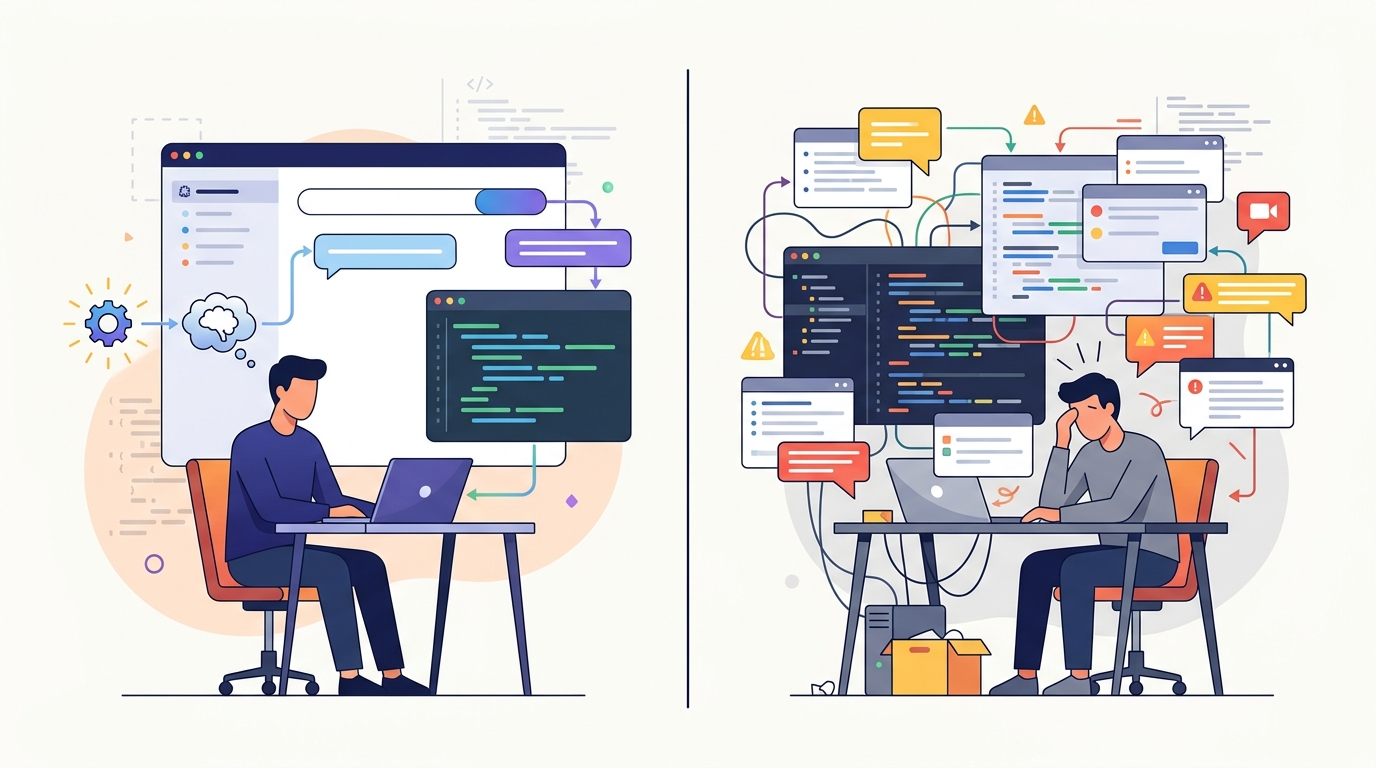
This is why the comparison to IDE copilots is misleading. IDE tools are optimized for local prediction inside one file or one edit span. Claude Code is optimized for multi-step tasks that require state, memory of prior actions, and tool use. In practice, that means it can move from “find the failing service” to “trace the cause” to “patch the code” without forcing the engineer to manually stitch those steps together. The value is not faster typing. The value is fewer handoffs between human intent and machine execution.
Its system prompt pushes the model toward disciplined agency
Good agent behavior does not emerge by accident. It is shaped by the system prompt, and Claude Code appears to use that layer to enforce restraint, planning, and task awareness. That is the right choice. A coding agent that eagerly edits files without checking assumptions is dangerous. A coding agent that asks itself what it knows, what it does not know, and which tools it should use first is useful. The best prompt design does not make the model sound clever. It makes the model behave predictably under pressure.
The example in the source description is telling: when the requirement is vague, Claude Code can enter a slower reasoning mode and help clarify architecture before touching implementation. That is exactly what an engineering assistant should do. Teams do not fail because they lack raw code generation. They fail because they rush into implementation with weak problem framing. A system prompt that encourages deliberate analysis before action is not a luxury. It is a guardrail against expensive rework.
It handles legacy code better because it respects the shape of real repos
Legacy systems are the hardest test for any coding agent. In a greenfield demo, almost any model looks competent. In a mature repository, the problem is not syntax. It is navigation, dependency tracking, and knowing which files matter. Claude Code’s terminal-first approach fits this environment because it can interrogate the repo the way an engineer does: search broadly, narrow the blast radius, and verify behavior with commands. That is a much better match for real software than a chat box that guesses from partial context.

Take the concrete use case of refactoring several thousand lines of old code. A weak assistant will produce plausible edits and stop there. A stronger one will inspect structure, identify coupling, and use tools to confirm the impact of changes. That difference is decisive. In large codebases, the cost of a wrong edit is not one bad line. It is hours of debugging and a broken release. Claude Code’s design earns its value by reducing that risk, not by making the first draft prettier.
The counter-argument
The strongest critique is that terminal-native agents can feel slower and more complex than IDE copilots. That critique is fair. If a developer only wants a quick completion, a lightweight inline assistant is easier. There is also a real risk that tool-heavy agents create overconfidence, where the model appears systematic but still makes bad assumptions. In that sense, the simplicity of a Copilot-style product is a feature, not a flaw.
But that argument only holds for narrow tasks. Once the job involves multi-file changes, debugging, or ambiguous requirements, simplicity becomes a ceiling. A tool that cannot plan, inspect, and revise is not simple in the good sense. It is limited. Claude Code’s approach is justified because software engineering is not a single-keystroke activity. It is a sequence of decisions, and the tool should be built around those decisions. The limit is real for tiny edits, but for serious repo work, the terminal agent model is the superior one.
What to do with this
If you are an engineer, stop judging coding agents by how well they finish your sentence and start judging them by how well they manage a task from start to finish. If you are a PM, define workflows that include inspection, verification, and rollback, not just generation. If you are a founder, invest in agents that understand tools, state, and repo context, because that is where durable productivity gains live. The lesson from Claude Code is blunt: the future of coding assistants is not better autocomplete, it is better execution.
// Related Articles
- [TOOLS]
Aliyun Bailian Token Plan turns credits into agents
- [TOOLS]
One API gateway turns six AI APIs into one
- [TOOLS]
OpenAI FDEs turn broken agents into shipped systems
- [TOOLS]
Anthropic’s daily brief turns news into a workflow
- [TOOLS]
Claude Reflect turns usage into retention
- [TOOLS]
Midjourney turns prompt ideas into art