Why Mvm Is the Right Kind of Go Interpreter
Mvm is the right answer to Go scripting because bytecode VMs beat AST interpreters for broader reuse.

Mvm is a bytecode-based Go interpreter designed for speed, reuse, and future multi-language support.
Go does not need another interpreter that only replays source trees; it needs a compact virtual machine, and Mvm is the better answer. The reason is simple: if the goal is to run code fast, embed it cleanly, and leave room for more than one language, then AST walking is the wrong center of gravity. The newsletter’s framing gets this right by treating Mvm not as a clone of Yaegi, but as a different tool for a different class of problem.
Bytecode is the stronger foundation
Get the latest AI news in your inbox
Weekly picks of model releases, tools, and deep dives — no spam, unsubscribe anytime.
No spam. Unsubscribe at any time.
Yaegi works by interpreting the abstract syntax tree, which makes it a natural fit for plugin-style execution where source structure matters. Mvm takes the other route: it compiles to bytecode and runs that bytecode on a compact VM. That difference is not cosmetic. Bytecode gives you a stable execution format, a tighter runtime loop, and a clearer path to optimization than repeatedly traversing syntax nodes.
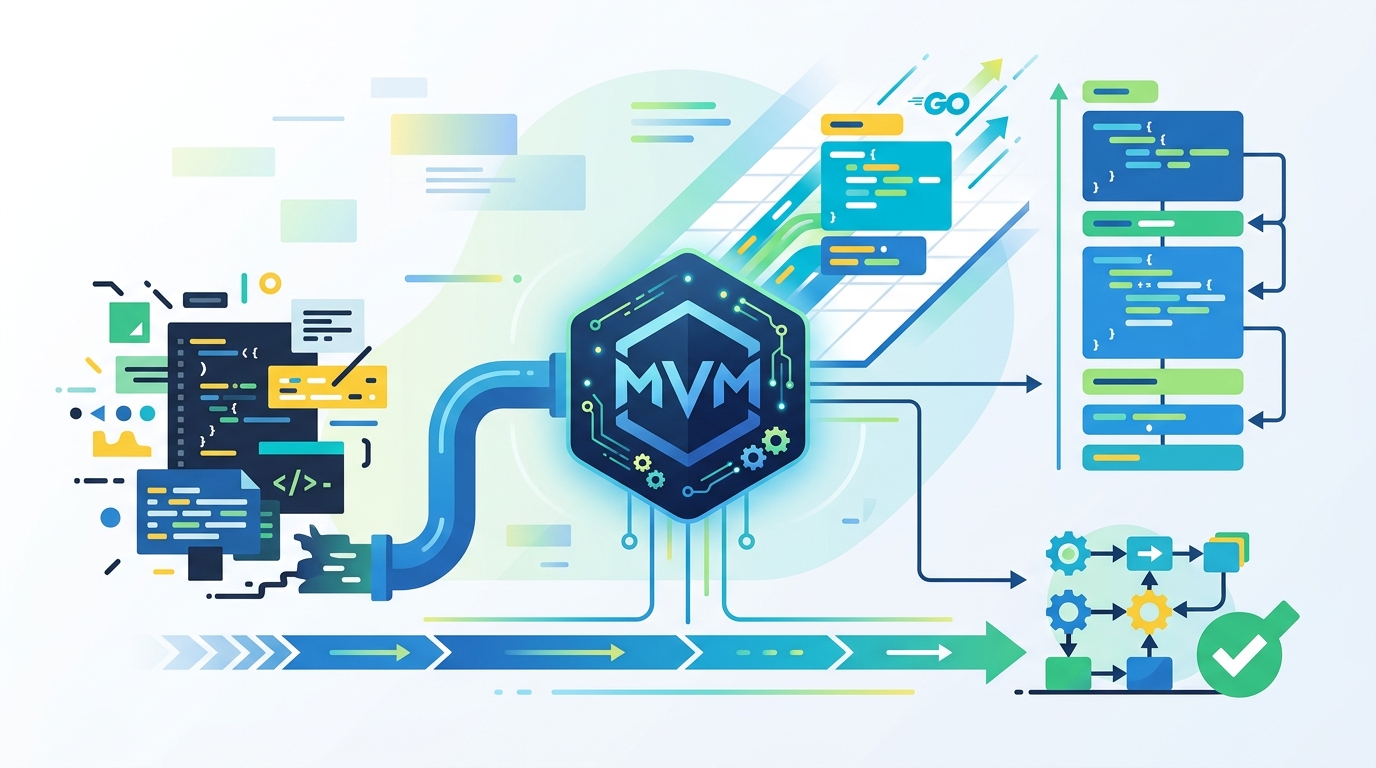
This is why the “another Go interpreter?” reaction is the wrong one. The real comparison is between a system optimized for source-level convenience and a system optimized for execution. If you want a runtime that can become a platform, not just a parser with opinions, bytecode wins. It is the same reason Lua, JVM languages, and many embeddable runtimes lean on a VM instead of evaluating trees forever.
A VM invites reuse beyond Go
The newsletter’s most important line is that the VM may host other languages in the future. That is the real strategic value. Once you have a compact VM, you are no longer building a Go curiosity; you are building an execution substrate. That matters because the hardest part of language tooling is not syntax, it is the durable machinery underneath it.
We already know the pattern from successful ecosystems. Python has its interpreter, JavaScript has engines, and the JVM became a multi-language host because the runtime was designed as a shared target. Mvm is aiming at that same shape on a smaller scale. If the VM can eventually run more than one language, then the project is not competing with Yaegi on its own terms at all. It is competing with the idea that scripting support must stay language-specific forever.
The embedded use case is the real prize
The newsletter says Mvm is “useful well beyond scripting,” and that is exactly why it matters. Embedded execution is where bytecode and a compact VM pay off hardest. In a plugin system, a scripting layer, or a product feature that needs user-defined logic, you want predictable runtime cost and a boundary that is easier to control than raw source interpretation.

Look at the practical appeal of small embedded runtimes across the industry. Teams reach for SQLite, Lua, or WASM when they want a self-contained engine that travels well inside an application. Mvm belongs in that family. If it stays compact and fast, it can become the thing you embed when you need Go-adjacent execution without dragging a full compiler pipeline into your product.
The counter-argument
The best case for Yaegi is that AST interpretation is simpler to understand, easier to connect to Go source, and already aligned with plugin workflows. For many teams, that is enough. If the need is “load some Go-like code and execute it inside a process,” then a source-oriented interpreter feels more direct than introducing a bytecode compiler and VM layer.
There is also a maintenance argument. A bytecode VM adds an extra stage, and extra stages create extra failure modes. For a narrow plugin system, the simpler architecture can be the right trade. That is a real advantage, not a straw man.
Still, that argument stops at narrowness. The moment you want speed, portability, or a path to multiple languages, AST interpretation becomes a ceiling. Mvm accepts the cost of a compiler step precisely because it buys a better long-term shape. That is not overengineering; it is choosing the right abstraction for a runtime that wants to grow up.
What to do with this
If you are an engineer, stop asking whether a new Go interpreter is redundant and start asking what execution model your product actually needs. Choose AST-based tooling when you want source transparency and plugin convenience. Choose a bytecode VM when you want performance, embeddability, and a future where your runtime can host more than one language. That is the decision Mvm forces, and it is the more useful one.
// Related Articles
- [TOOLS]
OpenClaw with Ollama turns Telegram into a bot
- [TOOLS]
Aliyun Bailian Token Plan turns credits into agents
- [TOOLS]
One API gateway turns six AI APIs into one
- [TOOLS]
OpenAI FDEs turn broken agents into shipped systems
- [TOOLS]
Anthropic’s daily brief turns news into a workflow
- [TOOLS]
Claude Reflect turns usage into retention