Google puts Gemini at Android’s center before WWDC
Google is turning Gemini into Android’s control layer across phones, cars and laptops before Apple’s AI reset at WWDC.
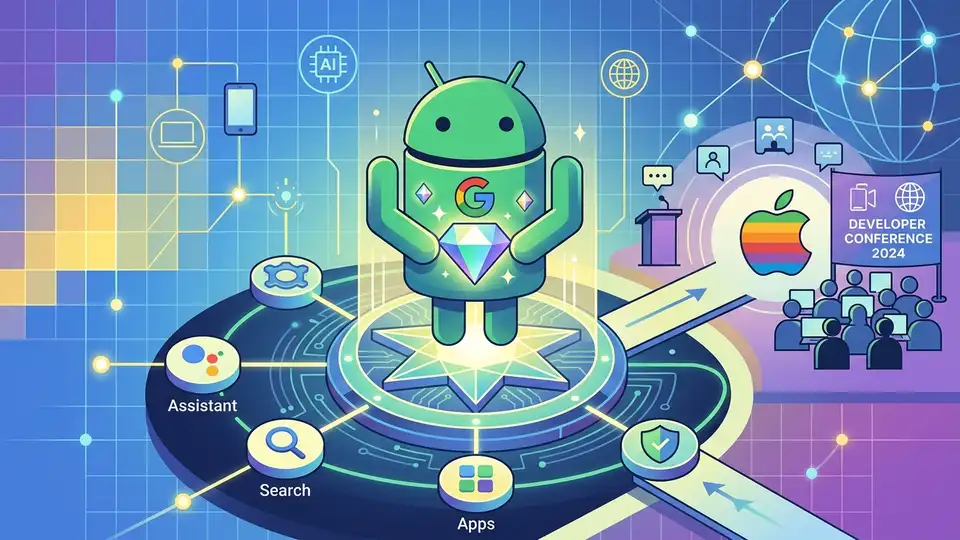
Google is turning Gemini into Android’s control layer across phones, cars, and laptops.
Google is moving fast: it previewed a new wave of Gemini-powered Android features on May 12, 2026, just days before Google I/O and weeks before Apple’s WWDC. The pitch is simple and aggressive. Gemini should do more than answer prompts; it should act across apps, screens, and devices.
| Metric | Value | Why it matters |
|---|---|---|
| Google I/O timing | Next week | Sets up a major Android AI reveal |
| Android Auto reach | More than 250 million cars | Huge installed base for Gemini features |
| Alphabet stock gain | More than 140% in the past year | Shows investor confidence in Google’s AI strategy |
| Apple stock gain | About 40% in the past year | Highlights the market gap Google is trying to widen |
| Rollout start | This summer | First wave lands on Galaxy and Pixel phones |
Google wants Gemini inside the workflow, not beside it
Get the latest AI news in your inbox
Weekly picks of model releases, tools, and deep dives — no spam, unsubscribe anytime.
No spam. Unsubscribe at any time.
The biggest shift in this rollout is philosophical. Google is treating Gemini as an operating layer, not a chat window. That means the model can look at what is on screen, pull data from apps like Gmail, and carry out multi-step tasks that used to require a lot of tapping and app switching.
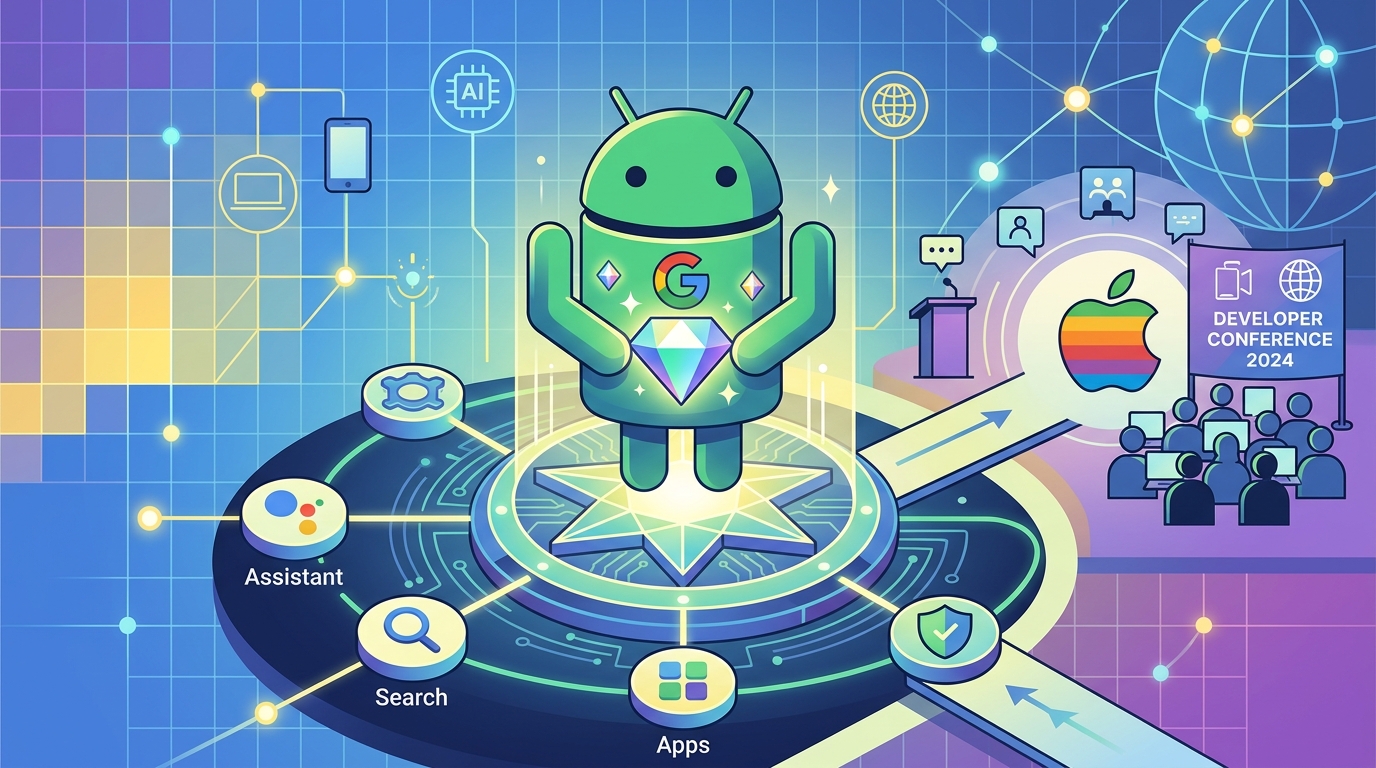
That is a meaningful change for Android. If Gemini can move from app to app, build a shopping cart, and prepare a reservation flow before asking for confirmation, then Google is no longer competing only on model quality. It is competing on usefulness inside daily phone behavior.
Sameer Samat, who oversees Google’s Android ecosystem, told CNBC, “We’re transitioning from an operating system to an intelligence system.” He also said, “the human is always in the loop.”
- Gemini can understand screen context.
- Gemini can complete multi-step tasks across apps.
- Gemini can return to the user before checkout or any final action.
The Android rollout is broader than phones
Google is not limiting this push to handsets. The company said the new app automation features will start on the latest Samsung Galaxy and Google Pixel phones this summer, then expand to watches, cars, glasses, and laptops later this year. That matters because Google has spent years trying to make Android feel like one connected system instead of a pile of separate products.
Chrome on Android is getting a smarter version too, and Google is redesigning Android Auto around Gemini. In practice, that turns the car into another surface where Google can keep users inside its own software stack while giving them a more capable assistant.
There is also a security angle here. Google said the new Android release includes a broad set of security features, which is important because agent-style software raises obvious trust issues. If a model can act on your behalf, users need clearer permission boundaries than the old “ask and answer” assistant model ever required.
- Android Auto is in more than 250 million cars.
- The new version includes Google’s biggest Maps update in a decade.
- Gemini can help with tasks like ordering dinner while driving.
- Google says the first rollout wave begins on the newest Pixel and Galaxy devices.
Apple is in the frame, whether Google says it or not
The timing here is no accident. Google is making this move just weeks before Apple is expected to show its own AI reboot at WWDC. Apple has already said part of its AI strategy will involve Gemini, which gives Google an unusual role in the iPhone maker’s plans even as the two companies compete for the same users.
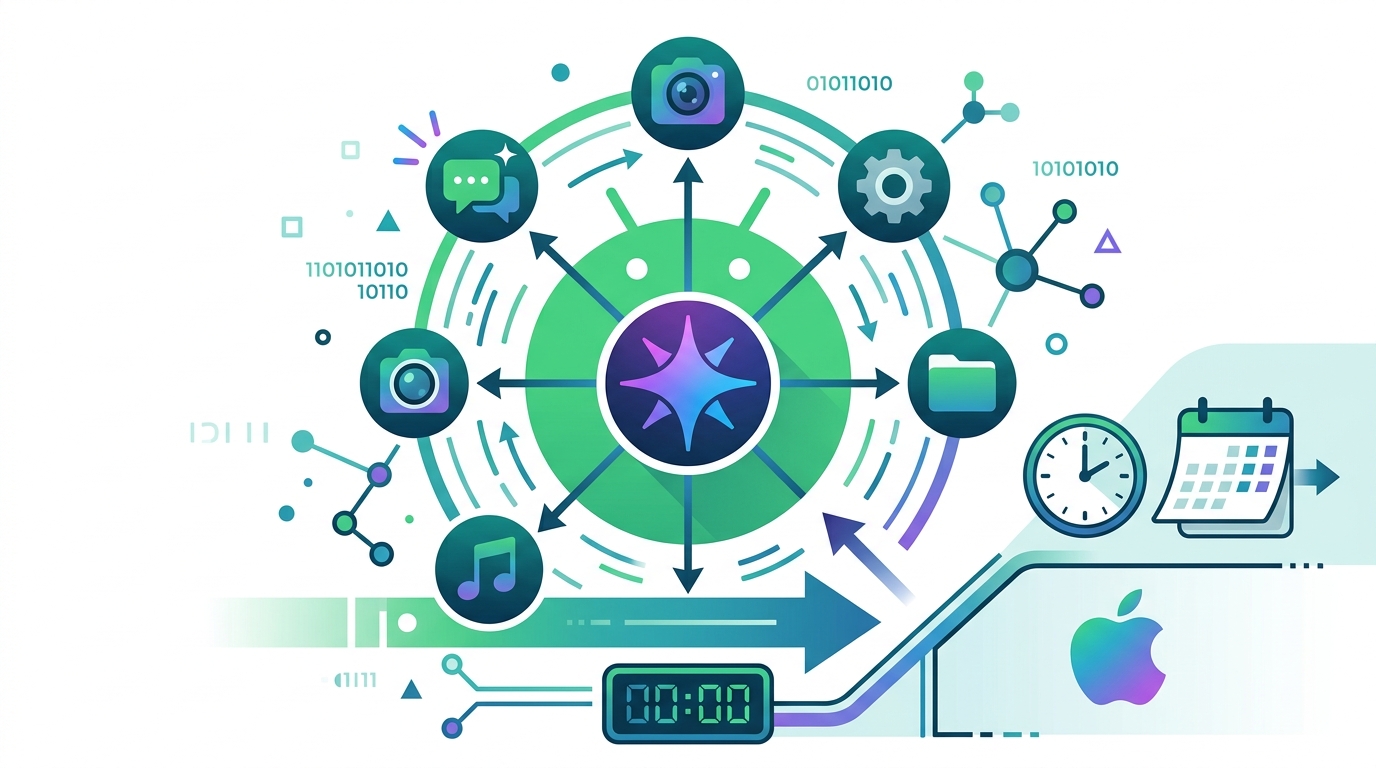
That creates a strange split-screen moment. Apple still sells privacy, hardware integration, and control as its strongest advantages, while Google is trying to prove that its AI is already woven into the everyday phone experience. The competition is no longer about who has the flashiest demo. It is about whose AI actually changes how people use the device.
“We’re transitioning from an operating system to an intelligence system,” Sameer Samat told CNBC.
Google’s position is stronger than it was a year ago, at least in the market’s eyes. Alphabet shares have risen more than 140% over the past year, while Apple is up roughly 40%. That gap does not prove product superiority, but it does show where investors think the AI momentum is right now.
The numbers show where Google thinks the battle will be won
Google’s strategy is built around distribution. It has Android, Chrome, Maps, Gmail, Google Drive, YouTube, and a huge car footprint. That gives Gemini more entry points than a standalone chatbot ever could. If the model can live inside all those products, Google gets a shot at making AI feel like part of the default user flow.
Here is the comparison that matters most: OpenAI and Anthropic can build impressive models, but they do not control Android, Android Auto, or Chrome for hundreds of millions of users. Google does. That is why this rollout is so important. It is less about one feature and more about turning AI into the thing that quietly runs through the whole device experience.
Google also appears to be learning from the limits of the old assistant era. Voice assistants were good at quick answers, bad at complex work. Gemini’s new role is to read context, combine services, and ask for permission only when it matters. If Google gets that balance right, it could make Android feel smarter without making users feel boxed out of the process.
- Alphabet is up more than 140% over the past year.
- Apple is up roughly 40% over the same period.
- Android Auto reaches more than 250 million cars.
- The first Gemini automation features arrive this summer.
Google is betting that AI wins when it disappears into the product
The real test is not whether Gemini can impress in a keynote. It is whether people keep using it after the novelty fades. If Google can make the model reliably handle small errands, planning tasks, and in-car requests without becoming annoying or risky, Android could feel very different by the end of the year.
My read: Google wants Gemini to become the layer people stop noticing because it is already doing the work. If the rollout lands cleanly across phones, cars, and laptops, Apple will have to answer with more than a prettier demo at WWDC. The next question is simple: can Apple match the depth of Google’s integration, or will Gemini become the AI feature users actually bump into every day?
// Related Articles
- [IND]
WebX 2026 turns speaker hype into a conference brief
- [IND]
AI Weekly: 2026-07-06 ~ 2026-07-13
- [IND]
The AI Act should be treated as Europe’s operating system for AI
- [IND]
Booz Allen’s OpenAI Deal Is Real Advantage, Not Hype
- [IND]
OpenSearch’s vector search benchmark in 5 parts
- [IND]
Vector Databases That Work in Production