Robinhood’s agentic trading account lets bots trade
Robinhood’s new agentic accounts let AI bots buy and sell stocks, with limits, pauses, and manual approval options.

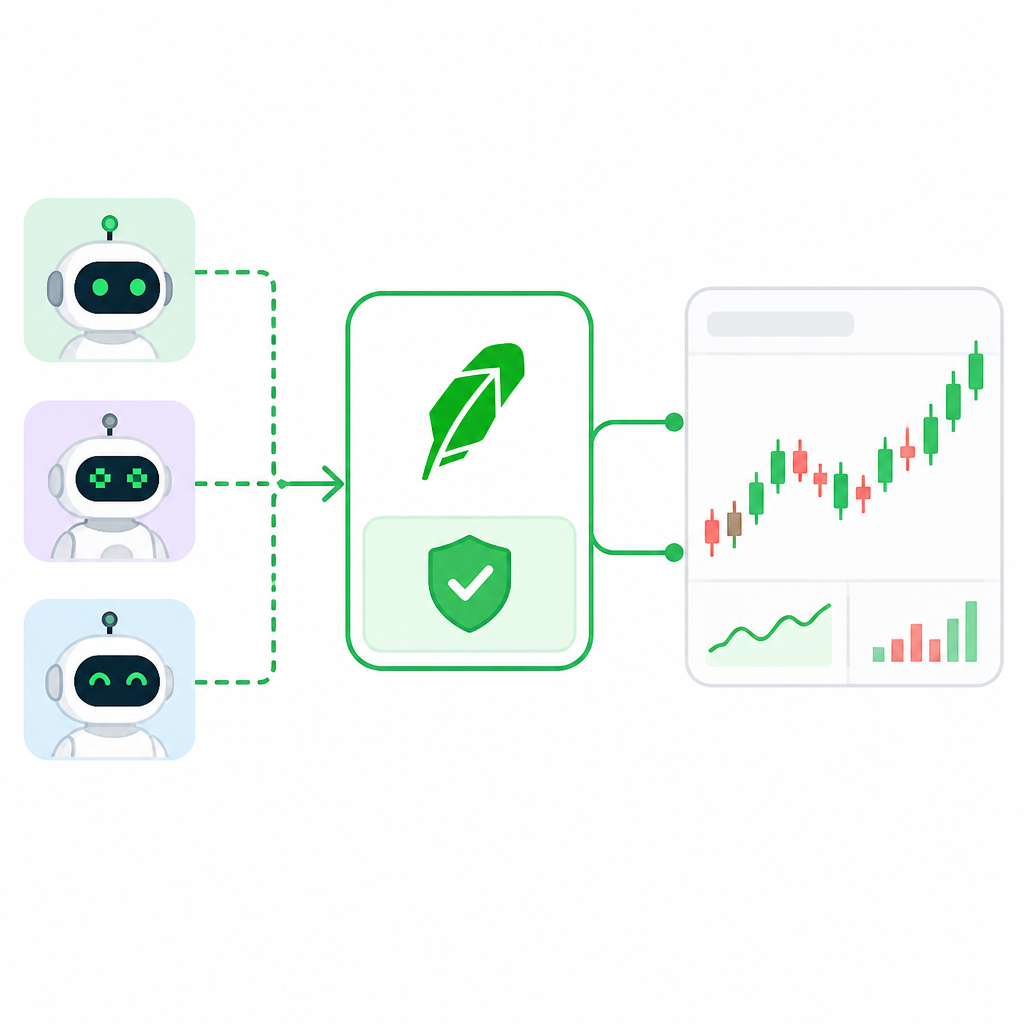
Robinhood is adding agentic accounts that let AI bots trade stocks with guardrails.
I've been using trading apps long enough to know when a product pitch sounds cleaner than the actual workflow. Robinhood has always been good at making finance feel like a tap-and-go app, but this one made me wince a little. Letting an AI agent buy and sell stocks sounds slick until you picture the mess: bad prompts, overconfident models, a market moving while your bot is “thinking,” and a user who only notices the damage after the fact. I’ve built enough automation to know the real problem is never the happy path. It’s the weird edge case where the bot interprets “reduce risk” as “sell everything,” or keeps trading because it can’t tell a signal from noise. So when I read that Robinhood is opening dedicated agentic trading accounts, I didn’t hear “cool feature.” I heard “we need hard boundaries, audit trails, and a way to stop the thing before it gets expensive.” That’s the part worth unpacking.
The source that kicked this off is Zachary Folk’s Forbes report on Robinhood’s announcement. The key detail isn’t just “AI trading.” It’s the separate account model, the pause button, and the fact that Robinhood is starting with equities in beta before widening the blast radius to options, crypto, event contracts, and futures later. That tells me the company knows this needs guardrails before it needs hype.
Robinhood is not letting your bot loose in your main account
Get the latest AI news in your inbox
Weekly picks of model releases, tools, and deep dives — no spam, unsubscribe anytime.
No spam. Unsubscribe at any time.
“Robinhood will allow customers to open dedicated agentic trading accounts separate from their standard accounts—allowing their AI agents to autonomously buy and sell stocks with the funds they have access to.”
What this actually means is that Robinhood is trying to box the risk into a separate pocket. That’s the right instinct. I’ve seen too many automation systems fail because the bot had the same permissions as the human and no meaningful separation between “test” and “real money.” A dedicated account is a blunt but useful control. It says: this agent can act, but only inside this sandbox.

That matters because finance is one of the few places where a bad prompt can become a real liability in seconds. If the agent is wrong, you want the damage capped by design, not by hope. A separate account also makes it easier to audit what the agent touched, what it ignored, and what it was allowed to do in the first place.
I ran into this exact pattern when wiring agents into internal tooling. The teams that survived were the ones that split permissions early. The teams that didn’t kept saying, “We’ll add controls later,” and then spent a month cleaning up after the first weird action. In trading, “later” is a luxury you do not have.
How to apply it: if you’re building agentic workflows, create a dedicated execution layer. Don’t let the agent share the same credentials, wallet, or admin surface as the user’s primary account. Separate the funds, separate the logs, separate the blast radius.
- Use a dedicated sub-account or wallet.
- Restrict the asset classes the agent can touch.
- Keep a human-readable activity log for every action.
- Make revocation a one-click operation, not a support ticket.
That same logic shows up in platforms like OpenAI, Anthropic, and LangChain, where tool permissions and structured outputs matter more than raw model capability. The model is not the safety system. The account design is.
Pause buttons are not optional theater
“Users can pause this autonomous trading at any time, according to the company, and preview trades made by their agents when asked.”
What this actually means is Robinhood knows nobody is going to trust an always-on trader without an emergency brake. And honestly, good. I don’t care how smart the model is; if I can’t stop it instantly, I don’t want it anywhere near my money. Pause is not a nice-to-have. It is the minimum viable trust feature.
The preview piece is also interesting. It suggests Robinhood wants the user to inspect what the agent is doing, not just watch the account balance after the fact. That’s a better pattern than blind automation. It turns the agent into something closer to a junior trader with approval chains than a black box with a brokerage login.
I’ve used enough AI tools to know that “autonomous” becomes a marketing word fast. In practice, the useful systems are the ones that can be interrupted, rolled back, or forced into review mode. If the agent starts drifting, I want to freeze it, inspect the last actions, and decide whether the strategy is broken or the model is just having a bad day.
How to apply it: build three controls into any agent that can spend money or modify state.
- Pause: stop all future actions immediately.
- Preview: show the next action before execution when risk is high.
- Approve: require a human confirmation on thresholds you define.
If you’re using workflow tools like n8n or Zapier, don’t bury these controls in a settings page nobody checks. Put them where the operator can hit them fast. The whole point is to keep the agent useful without pretending it’s infallible.
Starting with equities is the least reckless version
“The agentic trading feature is launching in a beta release, the company said, and will initially only support equities trading with trading in options, crypto, event contracts and futures coming in later releases.”
What this actually means is Robinhood is staging the rollout in the order I’d expect from a team that has seen enough foot-guns to be nervous. Equities are still risky, obviously, but they’re simpler than options and futures, and they’re far less structurally weird than event contracts. Starting there gives the company a narrower surface area to test failure modes.
Beta is doing a lot of work in that sentence. It tells users not to treat this as finished, and it gives Robinhood room to collect ugly edge cases before the product expands. That’s not just product caution. That’s survival.
I’ve shipped AI features into systems where someone inevitably asks, “Can we just add the advanced stuff now?” My answer is always the same: not until the base behavior is boring. If the bot can’t handle plain-vanilla stock orders cleanly, it has no business touching options chains or leveraged products. Those are where small mistakes turn into expensive lessons.
How to apply it: sequence your own agent rollout by complexity, not by ambition. Start with the narrowest action space. Test that the agent can interpret intent, follow policy, and stop when it should. Only then widen the permissions.
- Phase 1: read-only analysis.
- Phase 2: draft actions with human approval.
- Phase 3: limited autonomous execution.
- Phase 4: expand to more complex instruments or tasks.
That staged approach is the same reason serious teams use evals before deployment. If you’re building with agent tooling from OpenAI or similar systems, don’t skip the boring middle. The boring middle is where the real product gets made.
Spending on your behalf is the same problem in a different hat
“The stock trading platform will also allow users to use agents to ‘spend on your behalf’ by making payments on a virtual credit card for holders of the Robinhood Gold Card.”
What this actually means is Robinhood is treating trading and payments as two versions of the same permission problem. Once an agent can move money, the question is not “can it?” but “under what rules?” A virtual card adds another layer between the agent and the user’s actual balance, which is smart. It creates a narrower channel for mistakes.
I like this because it acknowledges a hard truth: most AI agent failures are not glamorous. They’re boring finance failures. Wrong amount. Wrong merchant. Wrong timing. Wrong interpretation of a user instruction that sounded obvious to a person but not to a model.
Robinhood says users can set spending limits or require manual approvals for purchases. That is exactly the right shape of control. You do not want a model deciding that a vague “take care of it” means “buy the expensive thing.” You want policy, thresholds, and explicit tripwires.
How to apply it: if your agent can spend, give it a narrow payment rail, not full access to the primary account. Build policies around categories, limits, and approval thresholds.
- Set per-transaction limits.
- Set daily or weekly caps.
- Require approval for unknown merchants.
- Block categories that are never allowed.
I’d use the same pattern with internal procurement, ad buying, cloud spend, or API credits. The agent should not be a blank check. It should be a constrained operator with a paper trail.
Robinhood is selling trust, not just automation
“Our mission has always been to democratize finance for all, and now, that mission extends to AI agents,” Vlad Tenev said in a statement on Wednesday.
What this actually means is Robinhood is trying to reframe AI agents as the next interface layer for retail finance. Not just charts, not just buttons, but delegated action. That’s a bold move, and it only works if users believe the company is serious about control.
That’s where the details matter more than the slogan. Dedicated accounts. Pause controls. Preview. Manual approvals. Beta rollout. Those are the parts that make the story believable. Without them, this would just be another “let the bot trade for you” pitch that sounds cool until the first bad run.
There’s also a strategic angle here. Robinhood has spent years trying to turn itself from a stock app into a broader financial platform. Agentic accounts fit that story because they make the app feel less like a destination and more like an operating layer for money movement. I can see why that’s attractive. I can also see why it needs a lot of restraint.
How to apply it: if you’re building a product with agentic features, don’t sell autonomy first. Sell control first. Users need to know where the guardrails are before they care about how smart the model is.
The real lesson is permission design, not trading
I keep coming back to the same point because it’s the one people skip: the model is not the product. The permission model is the product. Robinhood’s announcement is interesting because it treats the agent like a powered-up operator, not a magical oracle. That’s the right mental model, and it’s one I wish more teams would adopt before they start wiring agents into anything with money attached.
If I were building this from scratch, I’d ask four questions before shipping a single trade:
- What can the agent do without approval?
- What must be previewed?
- What can be paused instantly?
- What gets logged for later review?
Those questions sound basic because they are. But basic is good when the downside is real. I’ve seen too many teams obsess over prompt quality while ignoring the fact that the agent had too much access in the first place. That’s backwards. First constrain the blast radius. Then make the model better.
Robinhood’s beta is a useful reminder that agentic finance is not going to be won by whoever writes the fanciest demo. It’s going to be won by whoever makes the user feel like the bot is useful, bounded, and stoppable. That’s a much less glamorous problem, which is probably why it matters.
The template you can copy
# Agentic trading account policy template

## Account structure
- Create a dedicated agentic account separate from the user’s main brokerage account.
- Move only a fixed amount of capital into the agentic account.
- Keep the main account read-only for the agent.

## Allowed actions
- Buy and sell only the approved asset class.
- Limit the agent to pre-approved tickers, watchlists, or strategies.
- Block all unsupported products by default.

## Risk controls
- Set a per-trade maximum size.
- Set a daily maximum loss or spend cap.
- Require human approval above a defined threshold.
- Freeze the agent automatically after repeated failed actions.

## Operator controls
- Pause all agent activity instantly.
- Preview the next trade before execution when the risk score is high.
- Show a clear activity log with timestamps, reasoning, and outcomes.
- Provide a one-click revoke button for all permissions.

## Escalation rules
- If market conditions are abnormal, switch to approval-only mode.
- If the agent’s confidence is low, do not execute automatically.
- If the user is inactive for a defined period, reduce permissions.

## Audit trail
- Log prompt, tool call, order details, and execution result.
- Store the exact policy in effect at the time of each action.
- Keep a human-readable summary for every trade or payment.

## Copy-paste policy text
This agent may only act inside its dedicated account.
It may buy and sell only the approved instruments.
It must stop immediately when paused.
It must preview high-risk actions before execution.
It must require manual approval above configured limits.
It must log every action for later review.
It may not access the user’s primary account, credentials, or unrestricted funds.
That block is the part I’d actually copy into a product spec, a compliance doc, or an internal agent policy. It’s not fancy, but it forces the right questions before anyone starts talking about “autonomous finance” like it’s free money with better branding.
This piece is my breakdown of Forbes’ report on Robinhood’s announcement, not an original Robinhood product document. The structure, interpretation, and copy-ready policy template here are mine; the underlying product details come from Forbes’ coverage of Robinhood’s statement.
// Related Articles
- [TOOLS]
Nvidia and LG turn AI plans into a playbook
- [TOOLS]
Ollama is the best free AI path in 2026 for real work
- [TOOLS]
This MLOps list turns chaos into a stack
- [TOOLS]
BentoML turns model serving into Python APIs
- [TOOLS]
Magenta RealTime 2 lets you score in the DAW
- [TOOLS]
Open-source AI tools beat Claude’s paid tiers on value